How the Compound Interest calculator works
Lump sum
FV = P × (1 + r ÷ n)n × t
- P
- starting deposit
- r
- annual interest rate as a decimal
- n
- times interest is compounded each year (12 for monthly)
- t
- years
Regular contributions (made at the end of each period)
FV = PMT × ((1 + i)k − 1) ÷ i
- PMT
- each contribution
- i
- growth rate per contribution period
- k
- number of contributions
Annual percentage yield
APY = (1 + r ÷ n)n − 1
Worked example
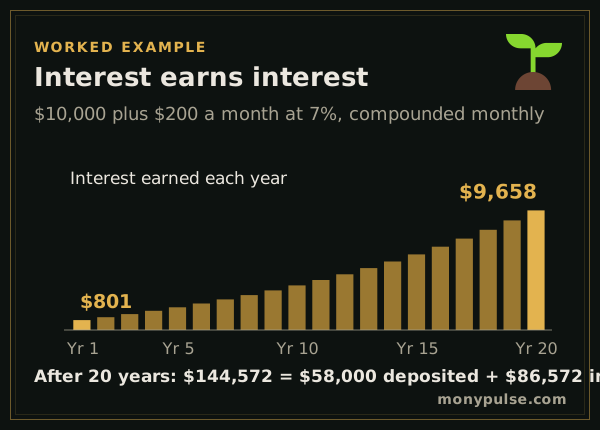
Start with $10,000 and add $200 at the end of every month at 7% a year, compounded monthly. After 20 years the balance is $144,572.72. You put in $58,000.00; the other $86,572.72 is interest, more than half of the final balance.
The effective yearly rate is 7.23%, so the starting deposit alone doubles in about 9.9 years (the Rule of 72 estimate is 10.3 years).
How does compound interest work?
Compound interest is interest earned on your original money and on the interest already added to it, so the balance grows a little faster every period. $10,000 at 5% a year earns $500 in the first year, $525 in the second and $551.25 in the third: after three years you have $11,576.25, compared with $11,500 from simple interest, which pays interest on the original $10,000 only.
The gap is small at first and large later, because each year’s interest is calculated on a bigger balance. In Excel or Google Sheets, =10000*(1+0.05)^3 gives the yearly-compounding figure above, and =10000*(1+0.05/12)^(12*3) gives monthly compounding ($11,614.72).
How to calculate compound interest
Compound interest is also called compounding interest; the math is the same. How do you calculate compound interest by hand? To figure compound interest, calculator or not, you need four numbers: the starting amount (P), the yearly rate (r), how many times a year interest is added (n) and the number of years (t). Here is $10,000 at 5%, compounded monthly, for 3 years:
- Divide the rate by the number of periods: 0.05 ÷ 12 = 0.0041667 per month.
- Add 1 and raise it to the total number of periods: 1.0041667^36 = 1.16147.
- Multiply by the starting amount: $10,000 × 1.16147 = $11,614.72.
- Subtract the starting amount to get the interest: $1,614.72.
Simple interest, paid only on the original $10,000, would come to $1,500 over the same three years. The extra $114.72 is interest earned on interest. Compounded yearly instead, the balance would be $11,576.25; compounded daily, $11,618.22.
Compound interest calculated daily
With daily compounding the yearly rate is divided by 365 and interest is added every day: FV = P × (1 + r ÷ 365)^(365 × t). Many savings and money market accounts compound daily and pay the interest out monthly. Pick Daily in the Compounding menu to use this as a daily compounding interest calculator. The gain over monthly compounding is small: at 5%, the APY is 5.127% with daily compounding and 5.116% with monthly. Credit cards work the same way in reverse, charging a daily rate of APR ÷ 365 (some issuers use 360) on your balance, which is why the credit card payoff calculator shows such large interest totals.
What $1,000 grows to with compound interest
One $1,000 deposit, compounded once a year, with nothing added:
| Annual rate | After 10 years | After 20 years | After 30 years |
|---|---|---|---|
| 4% | $1,480.24 | $2,191.12 | $3,243.40 |
| 7% | $1,967.15 | $3,869.68 | $7,612.26 |
| 10% | $2,593.74 | $6,727.50 | $17,449.40 |
At 10%, the last ten years add $10,721.90, almost twice what the first twenty years added. These rates are examples, not forecasts: a savings account pays a set rate, while stock returns change from year to year. For a stock or fund portfolio, the investment calculator shows a range of outcomes instead of one line.
Why time matters more than anything
Compound interest is interest earned on earlier interest. In the first years the balance grows mostly from your deposits; later, the interest each year is bigger than what you add. The chart shows the gold interest section taking over in the later years. Starting five years earlier often adds more than raising your monthly contribution.
Compounding interest: frequency and APY
Knowing how to calculate compounding interest at different frequencies helps you compare accounts. Banks quote savings rates as APY because it already includes compounding. If you know the stated rate and how often it compounds, choose that frequency above and compare the APY in the results. Continuous compounding is the mathematical limit; it adds only a few hundredths of a percent over daily compounding.
Contributions at the start or the end
How do we calculate compound interest on regular deposits? By default, each deposit is added at the end of the month and starts earning interest the next month. A deposit made at the start of each month earns one more month of interest than a deposit made at the end. Change the timing under More options to see the difference. You can also raise the contribution a little each year, for example in step with your pay raises, which has a large effect over long periods.
Compound interest with withdrawals
Under Withdrawals, enter an amount to take out each month and the year withdrawals start. The calculator then shows how long the money lasts, or what is left at the end if interest keeps up with what you take out.
$500,000 earning 5% a year, compounded monthly, earns about $2,083 in its first month. Withdraw $1,500 a month and the balance keeps growing: after 30 years it is about $985,484. Withdraw $3,000 a month and the money runs out after 23 years and 10 months, because each withdrawal is larger than the interest the balance earns.
The rule behind it: a balance lasts indefinitely only while monthly withdrawals stay below the interest it earns each month. Real investment returns are not steady, and a bad year early in retirement hurts more than the same year later, so treat a fixed-rate projection as a starting point.
Related calculators
For investments with returns that vary from year to year, use the investment calculator, which shows a range of outcomes. To find the monthly amount needed for a target, use the savings goal calculator, and for a savings account with a set APY, the savings calculator.
Assumptions and limits
- The rate stays the same for the whole period.
- Contributions and compounding are combined month by month using the rate that matches your compounding choice, which gives the same yearly growth as the bank's method; day-count details can shift the result by a few cents.
- No taxes or fees are taken out. Interest in a taxable account is taxed each year.
- Today’s-dollar figures use one steady inflation rate.
Frequently asked questions
How do you calculate compound interest?
Divide the yearly rate by the number of compounding periods, add 1, raise it to the total number of periods and multiply by the starting amount: P × (1 + r/n)^(n×t). Subtract the starting amount to get the interest. Regular contributions are added on top, each one compounding from the day it goes in.
Is daily compounding much better than monthly?
Only slightly. At 7%, monthly compounding gives an APY of about 7.23% and daily about 7.25%. The rate itself and the number of years matter far more than the compounding frequency.
What is the Rule of 72?
A shortcut for doubling time: divide 72 by the annual rate. At 7%, money doubles in roughly 10.3 years; the exact figure with monthly compounding is 9.9 years. The calculator shows both.
What is the difference between APR and APY?
APR is the stated yearly rate without compounding. APY includes the effect of compounding, so it is the true yearly growth. Savings accounts usually advertise APY; enter the stated rate and the compounding frequency here and the calculator shows the APY.
How do I find the compound interest rate between two amounts?
Use (ending amount ÷ starting amount)^(1 ÷ years) − 1. For example, $1,000 that grew to $2,000 in 10 years earned about 7.18% a year, compounded yearly. The interest rate calculator does this for any two amounts: choose Growth between two amounts.
How do I calculate compound interest on a savings account?
Enter the account's interest rate and pick how often it compounds; many savings accounts compound daily and pay interest monthly. If your bank quotes an APY instead, the savings calculator takes the APY directly. For a set amount by a date, the savings goal calculator works backward from the target.
Sources and method
- Compound Interest Calculator · Investor.gov, U.S. Securities and Exchange Commission
- How Does Compound Interest Work? · Federal Reserve Bank of St. Louis
Formulas and figures checked against these sources on November 12, 2026. The calculator runs entirely in your browser; nothing you type is sent to us or stored. Results are estimates for education, not financial, tax or legal advice, and MonyPulse is not a lender, tax preparer or investment adviser. Found an error? Tell us. See how we build and test our calculators and our editorial standards.