How the Dividend calculator works
Dividend yield
Yield = (Dividend per payment × payments per year) ÷ share price × 100
Each dividend payment, with reinvestment
Payment = Shares × yearly dividend per share ÷ payments a year; new shares = payment after tax ÷ share price
- Yearly dividend per share
- rises by the dividend growth rate once a year
Worked example
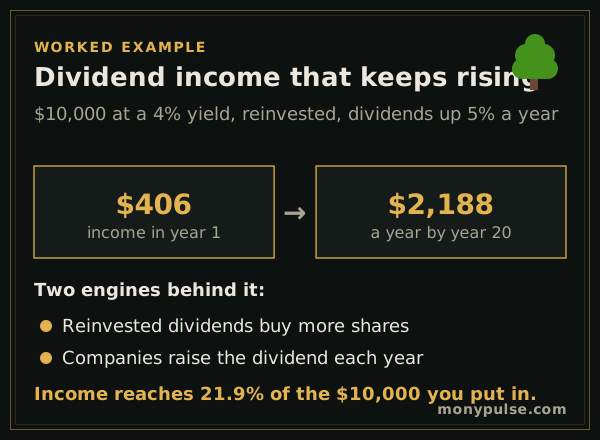
Invest $10,000 in stocks yielding 4%, with dividends growing 5% a year, share prices rising 5% a year and every dividend reinvested. In the first year the portfolio pays about $406 in dividends.
After 20 years the portfolio is worth about $57,437 and pays $2,188 a year in dividends, a yield on cost of 21.9%. Along the way it paid $21,081 in dividends, all of which bought more shares.
Reinvest or take the cash?
Reinvesting dividends buys more shares, and those shares pay their own dividends, which is why the bars in the chart grow faster each year. Taking the cash gives you spendable income now but a smaller portfolio later. Many investors reinvest while working and switch to cash in retirement; flip the DRIP switch to compare.
A high yield isn’t always better
A very high yield can be a warning: it often means the share price has fallen because investors expect a dividend cut. A lower yield with steady dividend growth can produce more income over 10 to 20 years. Try a 6% yield with no growth against a 3% yield growing 8% a year to see the difference.
Dividend yield calculator: find a stock’s yield
Switch to Dividend yield of a stock and enter the price, the dividend per payment and how often it is paid. You also see the yearly income on the amount you plan to invest.
Related calculators
To turn dividend income into a plan for covering expenses, use the passive income calculator. For total portfolio growth at an average return, use the investment calculator, and for the tax on selling shares, the capital gains tax calculator.
Assumptions and limits
- The dividend yield you enter applies at the start; after that, dividends and the share price grow at the steady rates you set.
- Reinvested dividends buy fractional shares at the price on the payment date, with no fees.
- The tax rate, if any, is taken from each dividend before it is reinvested. Qualified dividends are often taxed at 0%, 15% or 20% federally.
- Companies can cut or suspend dividends; the projection does not model that risk.
Frequently asked questions
How do I calculate dividend yield?
Divide the yearly dividend per share by the share price. A $50 stock paying $0.50 every quarter pays $2 a year, a yield of 4%.
What is a DRIP?
A dividend reinvestment plan uses each dividend to buy more shares of the same stock or fund. More shares pay more dividends, so income compounds. Turn the DRIP switch off to see the same portfolio with dividends taken as cash.
How much do I need to invest to make $1,000 a month in dividends?
Divide the yearly income you want, $12,000, by the yield. At a 4% yield that is $300,000; at 3% it is $400,000. Dividend growth and reinvestment can get you there with less money up front, given time.
Are reinvested dividends taxed?
Yes, in a taxable account. Dividends are taxable in the year they are paid even if you reinvest them. In an IRA or 401(k) they are not taxed until you withdraw, or at all in a Roth.
What is yield on cost?
Your yearly dividend income divided by what you originally invested. As dividends grow, yield on cost rises above the yield you bought at.
Sources and method
- Topic no. 404, Dividends and other corporate distributions · Internal Revenue Service
- Publication 550, Investment Income and Expenses · Internal Revenue Service
Formulas and figures checked against these sources on November 11, 2026. The calculator runs entirely in your browser; nothing you type is sent to us or stored. Results are estimates for education, not financial, tax or legal advice, and MonyPulse is not a lender, tax preparer or investment adviser. Found an error? Tell us. See how we build and test our calculators and our editorial standards.