How the 401(k) Investment calculator works
Each year
You add = min(Salary × your rate, IRS limit); Employer adds = Salary × min(your rate, match cap) × match rate
- IRS limit (2026)
- $24,500; plus $8,000 catch-up at 50 and over, or $11,250 at ages 60 to 63
Growth
Balance grows monthly at (1 + return − fees)1/12 − 1, with contributions added each month
Worked example
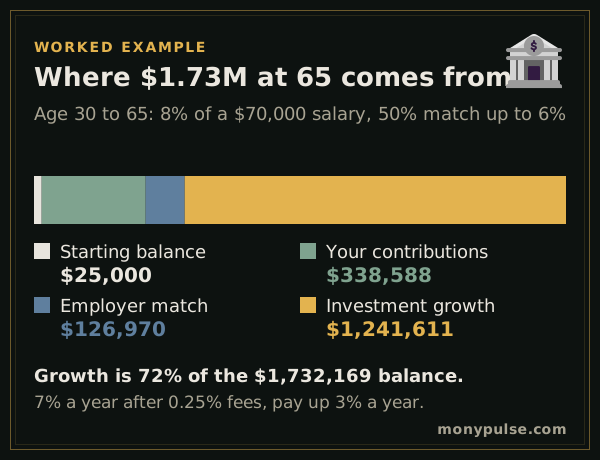
You are 30, earn $70,000 and have $25,000 in your 401(k). You contribute 8% of pay, and your employer matches 50% of your contributions up to 6% of pay, so this year you put in $5,600 and your employer adds $2,100.
With 3% yearly raises, a 7% average return and 0.25% in fund fees, the account grows to about $1,732,169 at 65. That is roughly $729,886 in today’s dollars, enough to support about $2,433 a month at a 4% yearly withdrawal. Over the 35 years you contribute $338,588, your employer adds $126,970 and investment growth adds $1,241,611.
Don’t leave the match on the table
The employer match is an instant return on your money. If your contribution rate is below the level your employer matches, the calculator shows how much free money you are giving up each year. Raising your contribution by even 1% a year until you reach the match is one of the easiest ways to boost retirement savings.
How your 401(k) investments grow
Used as a 401(k) investment calculator, the projection compounds each year’s contributions at the average return you enter, after fund fees. Small changes matter over decades: a 1-point higher return or a 1-point lower fee can change the balance at retirement by a six-figure amount for a young saver. Compare a few returns, such as 5%, 7% and 9%, to see a realistic range rather than a single promise.
Limits and catch-up contributions
For 2026, the IRS lets you defer up to $24,500 of pay. At 50 and over you can add $8,000, and at 60 through 63 the catch-up rises to $11,250. If your contribution rate would exceed the limit, the calculator holds it to the limit and tells you. Since 2026, high earners’ catch-up contributions must go in as Roth contributions, which changes the tax timing but not the amount you can save.
401(k) contribution limits
| Limit | 2026 | 2027 |
|---|---|---|
| Employee contributions (pre-tax and Roth) | $24,500 | Not announced yet |
| Catch-up, age 50 and older | $8,000 | Not announced yet |
| Catch-up, ages 60 to 63 (instead of the one above) | $11,250 | Not announced yet |
Employer matches do not count toward the employee limit. The IRS usually announces next year’s limits in November. Source: IRS.
Related calculators
To see how much you need in total, including IRAs and other savings, use the retirement savings calculator. For a target date to stop working, try the financial independence calculator, and to check how a contribution changes your take-home pay, use the paycheck calculator.
Assumptions and limits
- Contribution limits stay at their 2026 levels. The IRS raises them with inflation most years, so the projection is slightly conservative for high savers.
- Your pay rises by the same percentage every year and contributions are spread evenly through the year.
- The employer match is a percentage of your contribution up to a share of pay, the most common formula. Vesting schedules are not modeled.
- Taxes on withdrawals are not deducted; traditional 401(k) withdrawals are taxed as income, qualified Roth withdrawals are not.
Frequently asked questions
How much can I contribute to a 401(k) in 2026?
Up to $24,500 of your own pay. Workers 50 and over can add an $8,000 catch-up contribution, and those aged 60 to 63 can add $11,250 instead. Employer contributions are on top of these limits.
How does an employer match work?
A common formula is 50% of what you contribute, up to 6% of your pay. If you earn $70,000 and contribute 6% ($4,200), your employer adds $2,100. Contributing less than the cap leaves part of the match unclaimed.
How much should I have in my 401(k)?
It depends on your age, income and other savings. A common goal is to save 15% of pay, including the match, from your 20s or 30s. Use the 4% withdrawal figure in the results to see what monthly income your projected balance could support.
How much do fund fees matter?
A lot over decades. A 1% yearly fee can cost a large share of your final balance compared with a low-cost index fund. Enter your funds' expense ratio under More options to see the difference.
Should I choose a traditional or Roth 401(k)?
Traditional contributions lower your taxable income now and are taxed when withdrawn; Roth contributions are taxed now and withdrawn tax-free in retirement. The balance projection is the same; the difference is when the tax is paid.
Sources and method
- 401(k) limit increases to $24,500 for 2026, IRA limit increases to $7,500 · Internal Revenue Service
- Retirement topics: 401(k) and profit-sharing plan contribution limits · Internal Revenue Service
- A Look at 401(k) Plan Fees · U.S. Department of Labor, Employee Benefits Security Administration
Formulas and figures checked against these sources on November 11, 2026. The calculator runs entirely in your browser; nothing you type is sent to us or stored. Results are estimates for education, not financial, tax or legal advice, and MonyPulse is not a lender, tax preparer or investment adviser. Found an error? Tell us. See how we build and test our calculators and our editorial standards.