How the Savings calculator works
Monthly growth from the APY
Monthly rate = (1 + APY)1/12 − 1
- APY
- annual percentage yield, which already includes compounding
Balance
Balance = Start × (1 + i)n + Deposit × ((1 + i)n − 1) ÷ i
- i
- monthly rate
- n
- number of months
Worked example
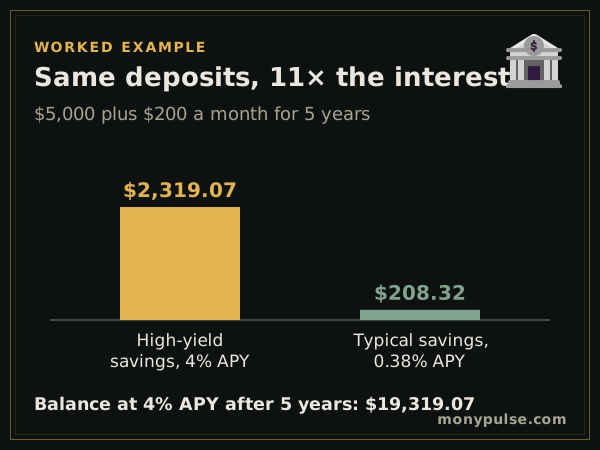
Start with $5,000 and add $200 a month at 4% APY. After 5 years you have $19,319.07, of which $2,319.07 is interest.
Keep the same money in an account paying the FDIC’s national average of 0.38% and you would earn only $208.32. The higher rate is worth $2,110.75 more over five years, for doing nothing but choosing a different account.
Savings interest calculator: why the rate matters
Savings rates differ enormously between banks. Large traditional banks often pay a fraction of a percent, while online banks and credit unions often pay several percent. Because savings accounts are usually insured by the FDIC or NCUA up to $250,000 per depositor, per bank, for each ownership category, moving to a higher-paying insured account rarely adds risk.
Compound savings calculator: growth over time
Interest earns interest. In the first year the example earns about $244; in the fifth year, close to $700, because the balance and the interest on it have grown. The table shows each year’s figures, and you can download them.
After tax and after inflation
Interest is taxable, and inflation reduces what savings can buy. Under More options, enter your tax rate and an inflation rate to see a more realistic picture. Savings accounts are best for emergency funds and short-term goals; long-term money usually belongs in investments that can outpace inflation.
Related calculators
To save toward a specific amount by a date, use the savings goal calculator. To size a safety net first, try the emergency fund calculator, and for any rate and compounding frequency, the compound interest calculator.
Assumptions and limits
- The APY stays the same for the whole period. Savings rates are variable and can change at any time.
- Deposits are made at the end of each month.
- If you enter a tax rate, interest is reduced by that rate as it is earned, as if taxes were paid from the account.
Frequently asked questions
How much interest will I earn on my savings?
It depends on your balance, your deposits, the APY and time. $5,000 plus $200 a month at 4% APY earns about $2,319 of interest over five years. At a 0.38% rate the same savings would earn about $208.
What is APY?
Annual percentage yield is the yearly return on a deposit account including compounding. Banks must disclose it, which makes it the right number to compare accounts with. Enter it here exactly as your bank shows it.
What is the average savings account rate?
The FDIC's national average savings rate was 0.38% in August 2026. Many online high-yield savings accounts paid around ten times that, so where you keep your savings matters.
Is savings account interest taxable?
Yes. Interest is taxed as ordinary income in the year it is paid, and banks report $10 or more on Form 1099-INT. Interest in an IRA or HSA is not taxed each year.
How is this different from the compound interest calculator?
This calculator is built for bank savings accounts quoted in APY and lets you compare two accounts. The compound interest calculator takes a stated rate and a compounding frequency and covers any fixed-rate growth.
Sources and method
- National Rates and Rate Caps · Federal Deposit Insurance Corporation
- Topic no. 403, Interest received · Internal Revenue Service
Formulas and figures checked against these sources on November 11, 2026. The calculator runs entirely in your browser; nothing you type is sent to us or stored. Results are estimates for education, not financial, tax or legal advice, and MonyPulse is not a lender, tax preparer or investment adviser. Found an error? Tell us. See how we build and test our calculators and our editorial standards.