How the Credit Card Payoff calculator works
Months to pay off at a fixed payment
n = −ln(1 − r × B ÷ M) ÷ ln(1 + r)
- B
- card balance
- M
- monthly payment; it must be more than r × B or the balance never falls
- r
- APR ÷ 12
Payment to be done in n months
M = B × r(1 + r)n ÷ ((1 + r)n − 1)
Worked example
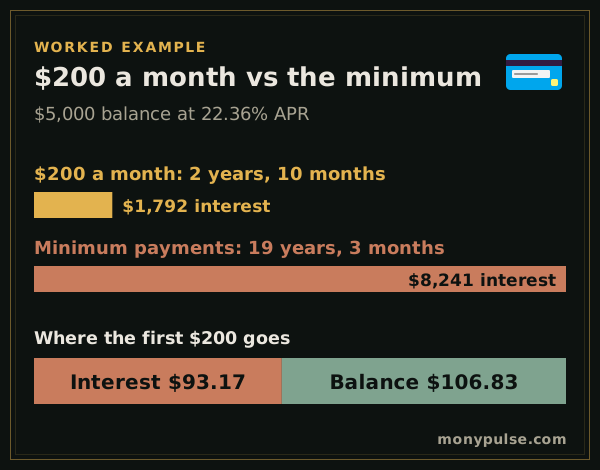
Paying $200.00 a month on a $5,000.00 balance at 22.36% APR clears the card in 2 years, 10 months, with $1,792.96 of interest along the way.
Paying only a typical minimum, interest plus 1% of the balance, would take 19 years, 3 months and cost $8,241.21 in interest. The first minimum would be about $143, so $200 is not a huge step up, but because a fixed payment doesn’t shrink as the balance falls, the card is paid off years sooner.
How is credit card interest calculated?
Most card issuers charge interest daily. They divide the APR by 365 (some use 360) to get a daily rate and apply it to your balance each day, then add up those charges for the billing cycle. At a 22.36% APR, a $5,000 balance costs about $3.06 a day, or roughly $92 over a 30-day cycle. Paying the full statement balance by the due date usually avoids interest on new purchases, because most cards give a grace period; carrying any balance usually ends it.
Monthly interest ≈ balance × APR ÷ 365 × days in the billing cycle
Your statement shows the method your issuer uses and the interest charged; the Consumer Financial Protection Bureau explains grace periods.
Two ways to plan the payoff
- How long at a set payment: enter what you can afford each month to see the payoff date and interest.
- The payment to be done by a date: enter a number of months, for example 12 or 24, to see the payment that gets you there.
If your payment doesn’t cover the month’s interest, the calculator tells you, because the balance would never go down.
Why the minimum payment keeps you in debt
Most card minimums are set as a small share of the balance plus interest. As the balance falls, so does the minimum, which stretches the payoff over many years. Card statements must show this, along with the payment that would clear the balance in three years.
Ways to pay a card off faster
- Pay a fixed amount instead of the minimum, and raise it when you can.
- Stop using the card while you pay it down, or the balance keeps refilling.
- Ask the issuer for a lower APR; a long on-time record helps.
- Consider a 0% balance transfer or a lower-rate personal loan, after counting the fees.
With several cards or loans, the debt payoff calculator orders them for you. To compare a consolidation loan, use the personal loan calculator, and to free up money for payments, try the budget calculator.
Assumptions and limits
- No new purchases, fees or rate changes while you pay the card off.
- Interest is charged monthly at APR ÷ 12. Cards that compound daily charge slightly more.
- The minimum-payment comparison uses a common formula: that month's interest plus 1% of the balance, at least $25. Your card's formula may differ; your statement shows it.
Frequently asked questions
How long will it take to pay off my credit card?
It depends on the balance, the APR and what you pay. Enter all three: at a fixed payment, the calculator counts the months until the balance reaches zero and adds up the interest along the way.
Why does paying the minimum take so long?
The minimum falls as the balance falls, and most of it goes to interest, so the balance shrinks very slowly. Paying the same fixed amount every month, even one close to today's minimum, cuts years off.
What is the 36-month figure on my statement?
Card issuers must show how long payoff takes if you make only the minimum payment and what monthly payment would clear the balance in 36 months, assuming no new charges. Enter 36 months here to check it.
Does a balance transfer help?
A 0% intro APR can save a lot if you clear the balance before the promotion ends, but most transfers charge a fee of a few percent. Set the APR to 0 and add the fee to the balance to compare.
What APR should I use?
Use the purchase APR on your statement. The default is the Federal Reserve's average for card accounts that were charged interest, 22.36% in the third quarter of 2026.
Sources and method
- A box on my credit card bill says that I will pay off the balance in three years if I pay a certain amount. What does that mean? · Consumer Financial Protection Bureau
- Consumer Credit - G.19 · Federal Reserve Board
- How to reduce your debt · Consumer Financial Protection Bureau
Formulas and figures checked against these sources on November 12, 2026. The calculator runs entirely in your browser; nothing you type is sent to us or stored. Results are estimates for education, not financial, tax or legal advice, and MonyPulse is not a lender, tax preparer or investment adviser. Found an error? Tell us. See how we build and test our calculators and our editorial standards.