How the Millionaire calculator works
Balance after n months
Balance = Saved × (1 + g)n + Monthly × ((1 + g)n − 1) ÷ g
- g
- monthly growth equal to the yearly return: (1 + return)^{1/12} − 1
Goal in today’s dollars
Real value = Goal ÷ (1 + inflation)years
Worked example
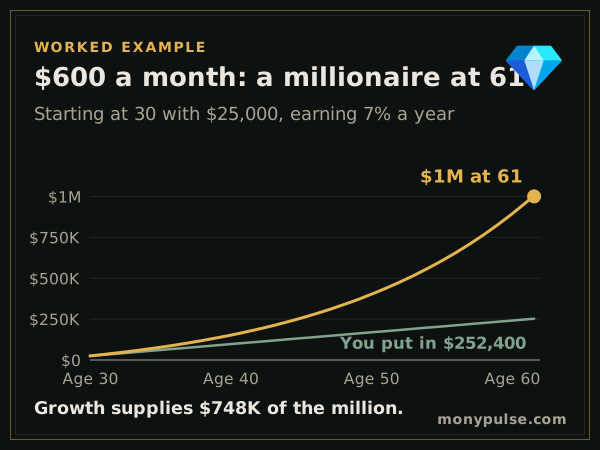
At 30, with $25,000 invested and $600 added every month at a 7% average return, you reach $1,000,000 at age 61, 31 years, 7 months from now. You put in $252,400 of your own money; compound growth supplies the rest.
Three decades of 3% inflation would mean that $1,000,000 buys about what $393,149 buys today, which is why many people set a higher target for retirement.
Start early or save more?
Time is the biggest lever. Reaching $1 million by 65 at a 7% return takes roughly $405 a month starting from zero at 25, about $855 starting at 35 and about $1,970 starting at 45. The table under the results shows these amounts for your own starting point and savings.
Make the goal real
- Invest automatically every payday, ideally through a 401(k) or IRA for the tax benefits.
- Capture your full employer match; it is part of the monthly amount.
- Raise your contribution with every raise so your lifestyle doesn’t absorb it.
Related calculators
To project your 401(k) with an employer match and IRS limits, use the 401(k) calculator. For a full retirement plan with Social Security, try the retirement savings calculator, and to see when your savings could cover your spending, the financial independence calculator.
Assumptions and limits
- Returns are a steady yearly average. Actual markets rise and fall.
- The monthly investment stays the same; raise it in the calculator to test larger amounts.
- Taxes and fees are not deducted. In a 401(k) or IRA, growth isn't taxed along the way.
Frequently asked questions
How long does it take to become a millionaire?
It depends mostly on how much you invest and for how long. Starting at 30 with $25,000 invested and adding $600 a month at a 7% average return, you would reach $1 million at about 61.
How much do I need to save a month to have $1 million by 65?
Starting from zero at 25, about $405 a month at a 7% average return. Starting at 45, it is close to $2,000 a month. The table under the results shows the amount for several target ages.
Is $1 million enough to retire?
At a 4% withdrawal rate, $1 million supports about $40,000 a year, before Social Security. Inflation also shrinks it: in 30 years, $1 million may buy what about $400,000 buys today.
What return should I use?
A diversified stock portfolio has historically averaged more than 7% a year before inflation over long periods, but with big swings. Lower returns, such as 5% or 6%, give a more cautious plan.
Sources and method
- Compound Interest Calculator · Investor.gov, U.S. Securities and Exchange Commission
- Historical Returns on Stocks, Bonds and Bills (January 2026 update, data through 2025) · Aswath Damodaran, NYU Stern School of Business
Formulas and figures checked against these sources on November 11, 2026. The calculator runs entirely in your browser; nothing you type is sent to us or stored. Results are estimates for education, not financial, tax or legal advice, and MonyPulse is not a lender, tax preparer or investment adviser. Found an error? Tell us. See how we build and test our calculators and our editorial standards.