How the Investment calculator works
Ending balance
FV = Start × (1 + g)m + Monthly × ((1 + g)m − 1) ÷ g
- g
- monthly growth equal to the yearly return: (1 + annual return)^{1/12} − 1
- m
- number of months
Monthly amount or return needed
Solve the same equation for Monthly, or for the annual return, so that FV = your goal
Worked example
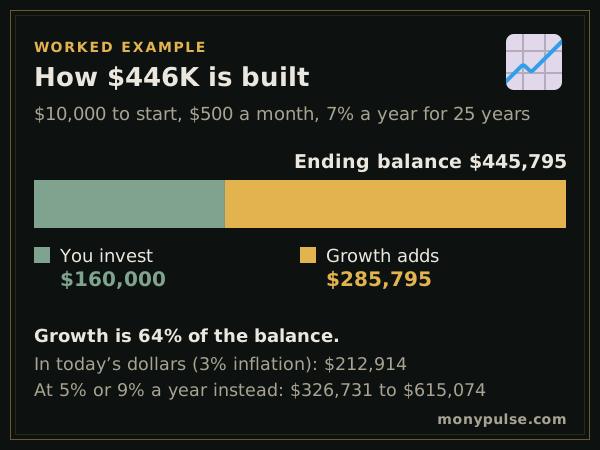
Start with $10,000 and invest $500 a month for 25 years at an average of 7% a year. The portfolio grows to about $445,795. You put in $160,000; investment growth adds $285,795.
Because prices rise too, that balance would buy what about $212,914 buys today, at 3% inflation. If returns averaged two points less, you would end with about $326,731; two points more, about $615,074.
Investment growth, monthly investment and investment return
- Investment growth: what a plan of regular investing could grow to, the ending balance.
- Monthly investment calculator: what to invest each month to reach a number, such as $1 million for retirement.
- Investment return calculator: the average yearly return your current plan requires to hit the goal. If it is far above what diversified portfolios have earned, the plan needs more time or more money, not more risk.
Why the range matters
An average return hides a bumpy path. The middle line assumes the same return every year; real portfolios move ahead and fall back. The low and high lines show how much a two-point difference compounds over decades, which is a useful way to judge how much margin your plan has.
Fees and inflation
A 1% yearly fee takes a large share of long-term growth. Subtract your funds’ expense ratios from the expected return to see their effect. The today’s-dollar figure under the results shows what the ending balance means in current prices.
Related calculators
For a fixed rate with a chosen compounding frequency, use the compound interest calculator. For workplace retirement savings with an employer match, use the 401(k) calculator, and to see what actual S&P 500 returns did to an investment in any period since 1928, use the S&P 500 calculator.
Assumptions and limits
- Returns are a steady average. Real markets rise and fall, which is why the results also show the balance at 2 points lower and 2 points higher.
- Contributions are made at the end of each month.
- Taxes, fund fees and trading costs are not deducted. Subtract your fund's expense ratio from the return to include fees.
- Today’s-dollar figures assume one steady inflation rate (3% unless you change it).
Frequently asked questions
How much will my investment be worth?
Enter what you have now, what you will add each month, the average yearly return you expect and the number of years. The calculator compounds the balance month by month and shows the ending value, plus what it buys in today's dollars.
What return should I assume?
There is no guaranteed figure. Broad U.S. stock indexes returned roughly 10% a year over the last century before inflation, with large swings; mixed stock and bond portfolios have earned less. Many planners use 5% to 7% to stay conservative, and the low scenario shows what happens if returns disappoint.
How much do I need to invest each month to reach my goal?
Choose Monthly amount for a goal, enter the goal, what you have now, the return and the number of years. The calculator solves for the monthly investment, including any yearly increase you set.
How is this different from the compound interest calculator?
The compound interest calculator is built for a fixed rate, like a savings account or CD, with a chosen compounding frequency. This calculator is built for market investments: an average return, scenarios above and below it, inflation and solving for the amount or return you need.
Does this include taxes?
No. In a 401(k) or IRA the growth is tax-deferred or tax-free; in a taxable account dividends and gains are taxed. Use the capital gains tax calculator for the tax on a sale.
Sources and method
- Compound Interest Calculator · Investor.gov, U.S. Securities and Exchange Commission
- Historical Returns on Stocks, Bonds and Bills (January 2026 update, data through 2025) · Aswath Damodaran, NYU Stern School of Business
- Consumer Price Index · U.S. Bureau of Labor Statistics
Formulas and figures checked against these sources on November 11, 2026. The calculator runs entirely in your browser; nothing you type is sent to us or stored. Results are estimates for education, not financial, tax or legal advice, and MonyPulse is not a lender, tax preparer or investment adviser. Found an error? Tell us. See how we build and test our calculators and our editorial standards.