How the Savings Goal calculator works
Monthly saving needed
Monthly = (Goal − Saved × (1 + i)n) × i ÷ ((1 + i)n − 1)
- i
- monthly rate from the APY: (1 + APY)^{1/12} − 1
- n
- months until the deadline
Time to reach the goal
Find the number of months n where Saved × (1 + i)n + Monthly × ((1 + i)n − 1) ÷ i ≥ Goal
Worked example
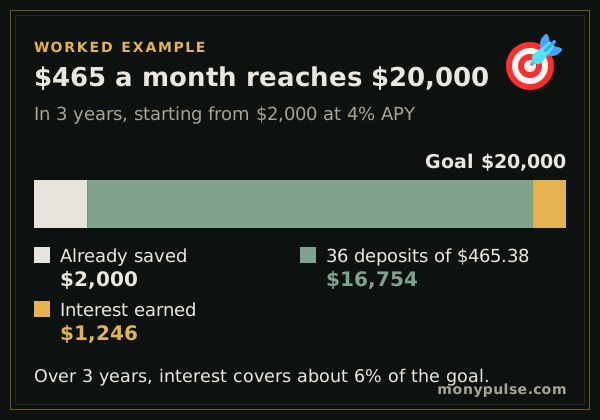
You want $20,000 for a down payment in three years and have $2,000 saved in an account paying 4% APY. You need to save $465.38 a month. Over the three years you put in $18,754, and interest adds about $1,246.
Switch to How long it will take to flip the question: at $400 a month, the same goal takes longer, and the calculator shows the month you would get there.
A how long to save calculator and a monthly savings plan
- By a deadline: when the date is fixed, such as a wedding, a tuition bill or a move, find the monthly amount that gets you there on time.
- By what you can afford: when the monthly amount is fixed, find out when you will reach the goal, then decide whether to save more or wait.
Make the plan stick
Set up an automatic transfer for the monthly amount on payday, keep the money in a separate account so it isn’t spent by accident, and put windfalls such as tax refunds toward the goal. Check progress every few months; the Goal progress line shows how far along you are.
Related calculators
To compare savings accounts and see the interest each one pays, use the savings calculator. For a safety net before other goals, use the emergency fund calculator, and to find room in your budget for the monthly amount, the budget calculator.
Assumptions and limits
- The interest rate stays the same and deposits are made at the end of each month.
- Interest is not taxed along the way. In a taxable account the real figure is slightly lower.
- The target date is counted from this month.
Frequently asked questions
How much should I save each month to reach my goal?
Subtract what you have from the goal, then spread the rest over the months you have, less the interest your savings will earn. To reach $20,000 in three years with $2,000 saved at 4% APY, you need about $465 a month.
How long will it take to save $10,000?
Choose How long it will take, enter $10,000 as the goal, what you have saved and your monthly amount. At $400 a month starting from zero at 4% APY, it takes a little over two years.
Does interest really make a difference?
On short goals it helps a little; on goals several years away it helps more. The calculator shows how long the same plan would take with no interest at all.
Where should I keep money for a savings goal?
For goals within a few years, an FDIC-insured high-yield savings account, a money market account or CDs keep the money safe and earn interest. Investing in stocks makes more sense for goals five or more years away.
Sources and method
- National Rates and Rate Caps · Federal Deposit Insurance Corporation
- An essential guide to building an emergency fund · Consumer Financial Protection Bureau
Formulas and figures checked against these sources on November 11, 2026. The calculator runs entirely in your browser; nothing you type is sent to us or stored. Results are estimates for education, not financial, tax or legal advice, and MonyPulse is not a lender, tax preparer or investment adviser. Found an error? Tell us. See how we build and test our calculators and our editorial standards.