How the Roth IRA calculator works
Growth, one year at a time
Balance at year end = (balance at year start + contribution) × (1 + r)
- r
- expected yearly return as a decimal
Contribution limit in the phase-out range
Limit = full limit × (top of range − MAGI) ÷ width of range
- full limit
- $7,500 for 2026, or $8,600 at age 50 or older
- MAGI
- modified adjusted gross income
- width of range
- $15,000 for single and head of household, $10,000 for married filers
Worked example
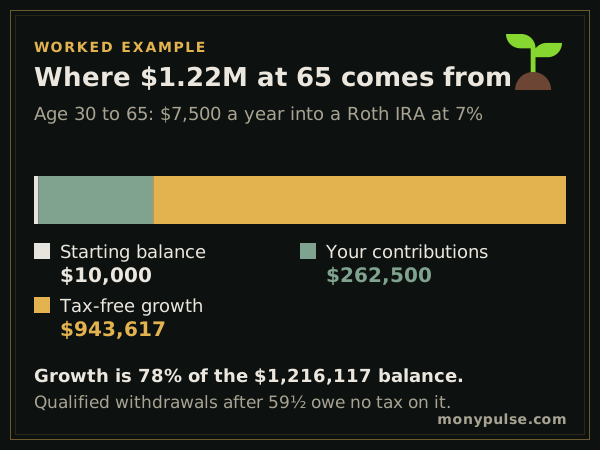
You are 30 with $10,000 in a Roth IRA and put in $7,500 at the start of each year. At a 7% yearly return, by 65 the account grows to $1,216,117. Your contributions total $262,500; the other $943,617 is growth that is not taxed when you withdraw it in retirement, provided the withdrawals are qualified.
In today’s dollars, after 2.5% inflation a year, that is about $512,436, enough for roughly $1,708 a month at a 4% first-year withdrawal.
Roth IRA contribution limits for 2026
| 2026 | |
|---|---|
| Contribution limit, under 50 | $7,500 |
| Contribution limit, 50 or older | $8,600 ($7,500 + $1,100 catch-up) |
| Full contribution allowed, single or head of household | Modified AGI up to $153,000 |
| Phase-out range, single or head of household | $153,000 to $168,000 |
| Full contribution allowed, married filing jointly | Modified AGI up to $242,000 |
| Phase-out range, married filing jointly | $242,000 to $252,000 |
| Phase-out range, married filing separately | $0 to $10,000 |
The limit is for all your IRAs combined, Roth and traditional, and you can’t contribute more than you earned from work that year. Contributions for 2026 can be made until the tax filing deadline in April 2027.
How the income test works
Inside the phase-out range, your limit shrinks in proportion to how far into the range your income is. A single filer under 50 with $160,000 of modified AGI is $8,000 short of the top of the $15,000 range, so the limit is $7,500 × 8,000 ÷ 15,000 = $4,000. At 52, the same income allows $8,600 × 8,000 ÷ 15,000, which rounds up to $4,590. Enter your filing status and modified AGI above and the calculator applies this to every year of the projection.
When Roth IRA money is tax-free
- Contributions can be withdrawn at any time, for any reason, without tax or penalty.
- Earnings are tax-free in a qualified distribution: generally after age 59½ and at least five years after your first Roth IRA contribution, or because of disability or death. A first-home purchase of up to $10,000 can also qualify once the five-year rule is met.
- Other withdrawals of earnings can owe income tax and a 10% additional tax, with some exceptions.
- No required minimum distributions apply to the original owner of a Roth IRA.
Roth IRA vs. 401(k)
A Roth IRA is an account you open yourself, with a much lower limit than a 401(k) ($7,500 versus $24,500 for 2026) and income limits that a 401(k) doesn’t have. An employer match only comes through a workplace plan, which is why many savers use both. The 401(k) calculator projects the workplace side with your match.
Related calculators
To see whether your total savings cover the retirement you want, use the retirement savings calculator. For growth at any rate, try the compound interest calculator, and to project monthly investing outside a retirement account, the investment calculator.
Assumptions and limits
- Contributions go in at the start of each year and the return is the same every year. Real returns vary, and some years are negative.
- Contribution limits and income ranges stay at their 2026 amounts. The IRS raises them with inflation over time, and the catch-up amount applies from the year you turn 50.
- Your modified AGI stays the same in every year of the projection. If your income rises into or above the phase-out range, your limit falls.
- A reduced limit is rounded up to the next $10, and any amount between $0 and $200 is raised to $200, as IRS Publication 590-A describes.
- The calculator does not check the earned-income rule: you can't contribute more than your taxable compensation for the year.
Frequently asked questions
How much can I contribute to a Roth IRA in 2026?
Up to $7,500, or $8,600 if you are 50 or older, but no more than your taxable compensation. The limit is shared with traditional IRAs: $7,500 is the total for all your IRAs together.
What are the Roth IRA income limits for 2026?
The amount you can contribute phases out between $153,000 and $168,000 of modified AGI for single filers and heads of household, and between $242,000 and $252,000 for married couples filing jointly. For married filing separately the range is $0 to $10,000.
Are Roth IRA withdrawals tax-free?
Your contributions can come out at any time without tax or penalty. Earnings are tax-free in a qualified distribution, which generally means you are 59½ or older and your first Roth IRA contribution was at least five years earlier. Other early withdrawals of earnings can owe income tax and a 10% penalty.
Roth IRA or traditional IRA?
A Roth IRA is funded with money you have already paid tax on and grows tax-free; a traditional IRA may give a deduction now, and withdrawals are taxed later. Which comes out ahead depends mostly on whether your tax rate is higher now or in retirement.
What happens if my income is too high for a Roth IRA?
Above the top of the phase-out range you can't contribute directly. Some people contribute to a traditional IRA and later convert it to a Roth; conversions are taxable to the extent of pre-tax money, and IRS Publication 590-A explains the rules.
How much will my Roth IRA be worth?
At a 7% return, $10,000 today plus $7,500 a year from age 30 grows to about $1.2 million by 65, of which $262,500 is your contributions. In today's dollars, after 2.5% inflation, that is about $512,000.
Sources and method
- 401(k) limit increases to $24,500 for 2026, IRA limit increases to $7,500 (IR-2025-111) · Internal Revenue Service
- Roth IRAs · Internal Revenue Service
- Publication 590-A, Contributions to Individual Retirement Arrangements (IRAs) · Internal Revenue Service
- Publication 590-B, Distributions from Individual Retirement Arrangements (IRAs) · Internal Revenue Service
Formulas and figures checked against these sources on November 12, 2026. The calculator runs entirely in your browser; nothing you type is sent to us or stored. Results are estimates for education, not financial, tax or legal advice, and MonyPulse is not a lender, tax preparer or investment adviser. Found an error? Tell us. See how we build and test our calculators and our editorial standards.