How the Interest Rate calculator works
Rate behind a loan
Find r where Payment = P × r(1 + r)n ÷ ((1 + r)n − 1); APR = r × 12
- P
- amount borrowed
- n
- number of monthly payments
- r
- monthly rate, found by narrowing in until the payment matches
Growth rate between two amounts
Rate = (End ÷ Start)1 ÷ years − 1
Worked example
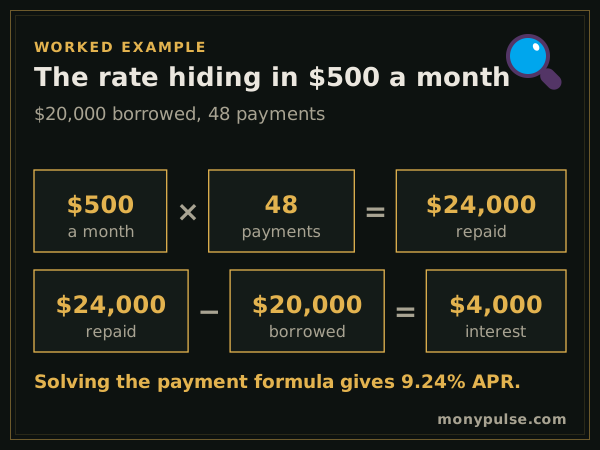
A lender offers $20,000.00 repaid with 48 monthly payments of $500.00. Those payments add up to $4,000.00 more than you borrow. The rate that produces exactly that payment is 9.24% APR.
In growth mode, $10,000 that becomes $15,000 in five years grew at about 8.45% a year, since 1.5 raised to the power of one fifth is about 1.0845.
Check a quoted payment
Dealers and lenders often quote a monthly payment first. If the payment is higher than the stated rate should produce, something else is in the loan: fees, add-ons or a higher rate. Enter the amount, payment and term here and compare the result with the rate on the contract. The Truth in Lending disclosure you get before signing must show the APR, the amount financed and the total of payments.
Rate per month, APR and APY
- Monthly rate: what is charged each month on the balance.
- APR: the monthly rate times 12, the figure lenders must disclose.
- APY or effective rate: the yearly rate with monthly compounding counted, always a little higher than the APR.
Related calculators
To see a full payment schedule at a rate you know, use the loan calculator. For the APR of an offer with an origination fee, the personal loan calculator does it in one step, and for investment returns with money added along the way, use the ROI calculator or the compound interest calculator.
Assumptions and limits
- Loan mode assumes equal monthly payments and no balloon payment at the end.
- If fees were taken from the loan, enter the cash you actually received as the loan amount to get the APR including fees.
- Growth mode gives a smoothed yearly rate. Real investments rise and fall along the way.
Frequently asked questions
How do I find the interest rate on a loan?
Enter the amount you borrowed, the monthly payment and the number of payments. There is no simple formula to solve for the rate, so the calculator tries rates until the payment matches yours to the cent.
What is the difference between the interest rate and the APR?
The interest rate is the cost of the money borrowed. The APR also counts upfront fees. Entering the cash you received after fees gives you the APR; entering the full loan amount gives the interest rate.
Why is the APY higher than the APR?
The APR is a simple yearly rate. The APY, or effective annual rate, counts interest charged on interest each month, so for the same loan it is a bit higher.
How do I find the annual growth rate of an investment?
Choose growth, enter the starting and ending values and the number of years. The result is the compound annual growth rate: the steady yearly return that would produce the same ending value.
Sources and method
- What is the difference between a loan interest rate and the APR? · Consumer Financial Protection Bureau
- What is the difference between a mortgage interest rate and an APR? · Consumer Financial Protection Bureau
Formulas and figures checked against these sources on November 11, 2026. The calculator runs entirely in your browser; nothing you type is sent to us or stored. Results are estimates for education, not financial, tax or legal advice, and MonyPulse is not a lender, tax preparer or investment adviser. Found an error? Tell us. See how we build and test our calculators and our editorial standards.