How our calculators work
Who builds them, how we test them, the official figures behind them and how we keep them current. Last reviewed November 12, 2026.
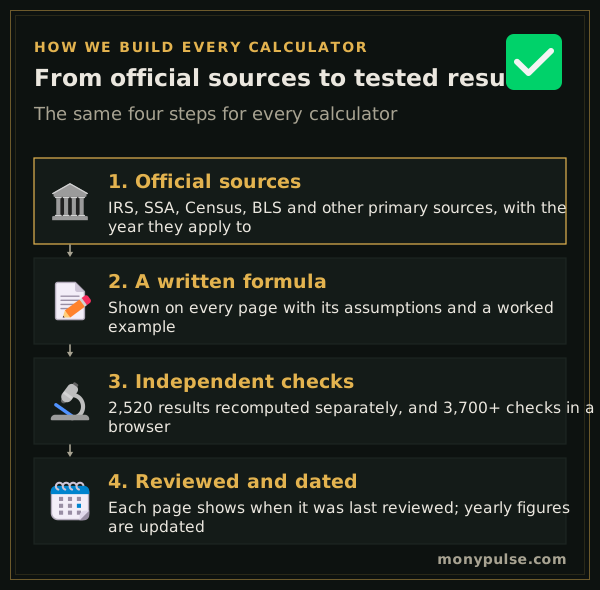
What every calculator page includes
- The formula the calculator uses, written out, with each term defined.
- A worked example whose numbers come from the calculator itself, so the text and the tool always agree.
- The assumptions behind the result and the cases it does not cover.
- The official or primary sources we checked, and the date we last checked them.
Who builds and checks them
The calculators are built and maintained by the MonyPulse team. We use software, including AI tools, to help write code and first drafts. Every formula and every official figure is then checked against its source before a page goes live, and each page lists those sources with the date of the last check.
MonyPulse is an independent publisher, not a bank, lender, tax preparer, investment adviser or law firm. Our calculator pages are not reviewed by a licensed CPA, financial planner or attorney. If that changes, the page will name the reviewer and their credentials.
How we test them
- Independent math check. Random inputs go through each calculator and through reference math written separately, in a different program; the two must agree. The run on November 12, 2026 made 2,857 such comparisons with no differences.
- Every input, every screen. Each calculator is exercised with ordinary and unusual inputs (zero, the largest allowed values, empty fields) on phone and desktop screen sizes: 3,975 interface checks in the same run.
- Official tables. Tax results are compared with the IRS figures for the year shown: brackets, standard deduction, credits, the Social Security wage base and contribution limits.
- The page agrees with the tool. Worked examples in the text are produced by the calculator itself when the page is built, so the explanation can't drift from the result.
Independence
- No calculator asks for your name, email or phone number, and none has a lead form or passes your numbers to a lender, adviser or partner.
- Defaults are examples, never offers. Where a default comes from published data, such as an average card rate, the page says whose data and for which period.
- No calculator contains affiliate links, sponsored rates or product rankings.
- Any ads sit outside the calculator and its result and are labelled "Advertisement".
Where the tax and payroll figures come from
Federal figures are taken from the IRS's annual inflation adjustments and the Social Security Administration's yearly announcements. We use the 2026 and 2027 tax years.
| Figure | 2026 | 2027 |
|---|---|---|
| Standard deduction, single | $16,100 | $16,600 |
| Standard deduction, married filing jointly | $32,200 | $33,200 |
| Standard deduction, head of household | $24,150 | $24,925 |
| Top (37%) bracket starts, single | $640,600 | $661,375 |
| Child tax credit per child (refundable part) | $2,200 ($1,700) | $2,300 ($1,800) |
| Social Security wage base | $184,500 | $192,300 |
| 401(k) employee deferral limit | $24,500 | Not announced yet; 2026 limit used |
| Additional Medicare Tax threshold, single | $200,000 (set by law, not indexed) | |
Sources: IRS Rev. Proc. 2025-32 and Rev. Proc. 2026-35, IRS Notice 2025-67, IRS Topic 560 and the Social Security Administration; see IRS, tax year 2026 inflation adjustments (IR-2025-103); IRS, tax year 2027 inflation adjustments (IR-2026-133); Journal of Accountancy, 2027 Social Security wage base.
Data sets
- S&P 500 history: annual total returns with dividends reinvested, 1928 to 2025, from Aswath Damodaran's dataset at NYU Stern. Inflation from the same dataset through 2023 and the Bureau of Labor Statistics for 2024 and 2025.
- Income ranks: household income percentiles for 2025 from the U.S. Census Bureau's Income in the United States: 2025, and weekly earnings of full-time workers from the Bureau of Labor Statistics (third quarter of 2026).
- Net worth by age: the Federal Reserve's 2025 Survey of Consumer Finances, released in October 2026.
Rounding and precision
Calculations run at full precision and are rounded only for display, usually to the cent. Loan schedules round nothing until the end, so the final payment may differ by a few cents from what a lender shows. Tax results are estimates: actual withholding follows your W-4 and IRS Publication 15-T tables, and your return may include items these tools leave out.
What the calculators don't do
- They estimate federal taxes only. Where state or local tax matters, you can enter your own rate; we don't present a federal figure as a full state calculation.
- Investment projections assume a steady return you choose. Real returns vary from year to year, and past returns don't predict future ones.
- They are not financial, tax or legal advice. For decisions with real consequences, check with a licensed professional.
Privacy
Every calculation runs in your browser. We don't ask for your name, email or phone number, and the numbers you type are not sent to us or to anyone else, nor saved. A "Share link" puts your numbers in a link only when you choose to copy it, and we strip those numbers from the page address before it reaches our analytics. See the privacy policy.
Updates and corrections
We review the tax and payroll figures each autumn when the IRS and the Social Security Administration publish the next year's amounts, and again whenever a new law changes them, as the 2025 budget law did. Benchmark rates and data sets (Federal Reserve, FDIC, BLS, Census) are refreshed when the agency publishes a new release. Each page shows the tax year or data period it uses and the date it was last checked.
If you find an error, tell us which calculator, the numbers you entered and what you expected. We recheck it against the source, fix it if it's wrong and update the page's date, following our corrections policy.