How the Net Worth calculator works
Net worth
Net worth = Total assets − Total debts
- Assets
- cash, retirement and investment accounts, home value, vehicles and other things you could sell
- Debts
- mortgage, car loans, student loans, credit cards and any other money you owe
Debt-to-asset ratio
Ratio = Total debts ÷ Total assets × 100
Worked example
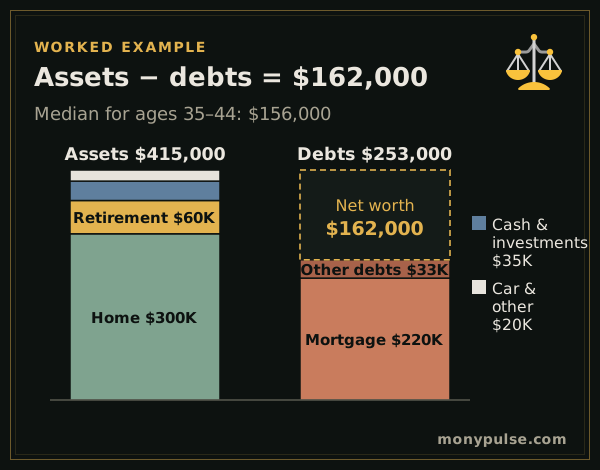
A 38-year-old has $15,000 in the bank, $60,000 in retirement accounts, $20,000 in other investments, a $300,000 home, a $15,000 car and $5,000 of other assets: $415,000 in all. Against that they owe $253,000: a $220,000 mortgage, a $10,000 car loan, $20,000 of student loans and $3,000 on credit cards.
Their net worth is $162,000. The median for families aged 35–44 was $156,000 in 2025, so they are at about 104% of the median for their age.
Net worth and wealth vs. income
Income is what you earn in a year; net worth is what you have built up over time. Two households with the same income can have very different net worth, depending on how much they save, how much debt they carry and how long they have been investing. Tracking net worth once or twice a year with a wealth calculator like this one is one of the clearest ways to see financial progress.
How net worth changes with age
Median net worth rises steadily with age as people pay down mortgages and build retirement savings, from about $33,000 for families under 35 to about $505,000 for families 75 and older in 2025. The chart compares your figure with each age group. Medians are better comparisons than averages, which are pulled far higher by the wealthiest families.
Ways to grow your net worth
- Pay down high-interest debt first; every dollar repaid raises net worth by a dollar.
- Save automatically into retirement and investment accounts.
- Avoid counting on your home’s value alone; build financial assets too.
Plan the debt side with the debt payoff calculator, the saving side with the investment calculator, and see how your income ranks with the income percentile calculator.
Assumptions and limits
- Assets are valued at what they would sell for today, not what you paid.
- Retirement accounts are counted at full value, before the income tax due on withdrawals from traditional accounts.
- Age comparisons use median net worth of U.S. families by the age of the family head in the 2025 Survey of Consumer Finances, rounded to the nearest $1,000.
Frequently asked questions
How do I calculate my net worth?
Add up the current value of everything you own, then subtract everything you owe. A household with $415,000 in assets, including a $300,000 home, and $253,000 in debts, mostly the mortgage, has a net worth of $162,000.
What is the median net worth in the U.S.?
The median U.S. family had a net worth of about $215,900 in 2025, according to the Federal Reserve's Survey of Consumer Finances. Averages are far higher, about $1.24 million, because a small number of very wealthy families pull them up.
What is a good net worth for my age?
The 2025 medians were about $33,000 for families under 35, $156,000 for ages 35 to 44, $255,000 for 45 to 54, $411,000 for 55 to 64, $432,000 for 65 to 74 and $505,000 for 75 and older. Being near or above the median for your age means you are doing better than half of families like yours.
Should I include my home in my net worth?
Yes, at its market value, with the mortgage counted as a debt. Because you need somewhere to live, the calculator also shows your net worth without your home, which is a better guide to money you could use.
Can net worth be negative?
Yes. Many young adults with student loans owe more than they own. Paying down debt and saving steadily turns it positive over time.
Sources and method
- Federal Reserve Board releases results of the 2025 Survey of Consumer Finances · Board of Governors of the Federal Reserve System
- Changes in U.S. Family Finances from 2022 to 2025: Evidence from the Survey of Consumer Finances · Board of Governors of the Federal Reserve System
Formulas and figures checked against these sources on November 11, 2026. The calculator runs entirely in your browser; nothing you type is sent to us or stored. Results are estimates for education, not financial, tax or legal advice, and MonyPulse is not a lender, tax preparer or investment adviser. Found an error? Tell us. See how we build and test our calculators and our editorial standards.