How the Retirement Savings calculator works
Savings needed at retirement
Need = (Spending − Social Security and pensions) ÷ 12 × (1 − (1 + i)−n) ÷ i
- i
- monthly real return in retirement: return after inflation
- n
- months from retirement to the age you plan for
Savings at retirement
Grow today's savings and monthly saving at the real return before retirement
Worked example
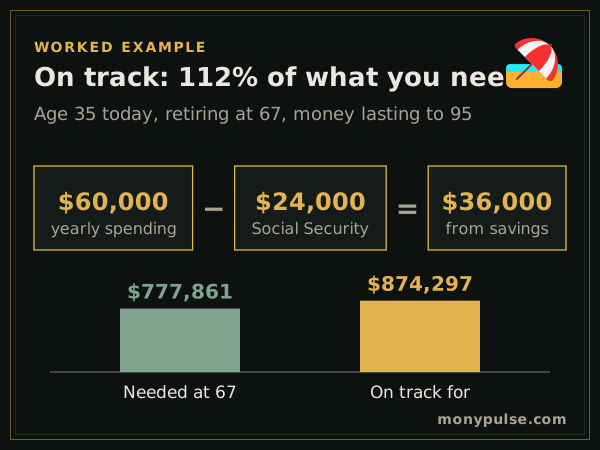
A 35-year-old has $80,000 saved and puts away $800 a month. At a 6.5% return before retirement and 2.5% inflation, savings reach about $874,297 by 67, in today’s dollars.
They expect to spend $60,000 a year in retirement and to receive $24,000 from Social Security, so savings must supply $36,000 a year. To last to 95 at a 4.5% return, that takes about $777,861. They are on track, and the money lasts past 95.
How much do you need to retire?
A common starting point is 25 times the yearly spending your savings will have to cover. That is the flip side of the 4% rule of thumb: taking 4% in the first year, then adjusting for inflation, held up through most 30-year periods in U.S. market history. Covering $40,000 a year from savings points to about $1 million. Social Security, pensions and part-time work lower the amount your savings must cover.
A rule of thumb is not a plan: returns, inflation, taxes and how long retirement lasts all move the number. The calculator above works from your own spending, other retirement income and timeline, and shows the savings it implies. To see your Social Security estimate, use your record at ssa.gov/myaccount.
Retirement investment calculator: three numbers to watch
- Savings at retirement: what your current plan builds, in today’s dollars so it is easy to compare with today’s costs.
- Savings you need: the amount that pays the gap between spending and Social Security every year to your planning age.
- Money lasts until: the age when savings would run out if returns and spending match the plan.
If you’re behind
Saving more, working a few years longer, delaying Social Security or planning to spend less all close the gap. Working longer is especially powerful: it adds savings, shortens retirement and can raise Social Security benefits. Try retirement at 69 or 70 in the calculator.
Related calculators
To project a 401(k) with an employer match and IRS limits, use the 401(k) calculator. If you want to retire early, try the financial independence calculator, and for a quick target, the millionaire calculator shows when you’d reach $1 million.
Assumptions and limits
- All figures are in today's dollars: returns are reduced by inflation, so spending and Social Security keep their buying power.
- Returns are steady averages. Poor returns early in retirement can shorten how long money lasts, so many planners leave a margin.
- Taxes on withdrawals from traditional 401(k)s and IRAs are not deducted; include them in your spending figure.
- Social Security is treated as starting at retirement. If you claim later, count only pensions until then.
Frequently asked questions
How much do I need to retire?
Work out the yearly spending you expect, subtract Social Security and any pension, and multiply the rest by about 25 for a 4% withdrawal rate. Needing $36,000 a year from savings points to roughly $900,000; the calculator refines this for your ages and returns.
Am I on track for retirement?
If your projected savings at retirement cover what you need, you are on track. If not, the calculator shows the extra monthly saving that would close the gap at your assumed returns.
How much will Social Security pay me?
It depends on your earnings history and claiming age. Your Social Security statement at ssa.gov shows your estimate at different ages; enter the yearly amount in today's dollars.
What return should I assume?
Lower than recent stock market gains to be safe. Many planners use about 5% to 7% before retirement and 4% to 5% after, when portfolios usually hold more bonds.
How long will my retirement savings last?
The results show the age when the money runs out at your spending level, or that it lasts past your planning age. Planning to 95 protects against a long life.
Sources and method
- my Social Security · Social Security Administration
- Social Security Quick Calculator · Social Security Administration
- 401(k) limit increases to $24,500 for 2026, IRA limit increases to $7,500 · Internal Revenue Service
Formulas and figures checked against these sources on November 12, 2026. The calculator runs entirely in your browser; nothing you type is sent to us or stored. Results are estimates for education, not financial, tax or legal advice, and MonyPulse is not a lender, tax preparer or investment adviser. Found an error? Tell us. See how we build and test our calculators and our editorial standards.