How the Passive Income calculator works
Savings needed
Capital = Monthly income × 12 ÷ (yield × (1 − tax rate))
- Yield
- dividend or interest yield, or a sustainable withdrawal rate
Income from savings
Monthly income = Capital × yield × (1 − tax rate) ÷ 12
Worked example
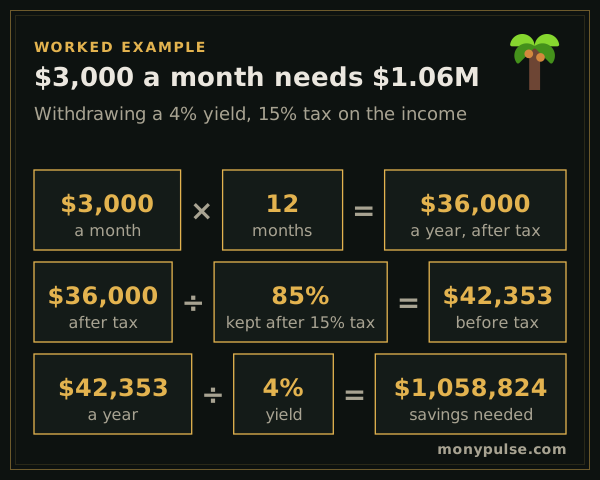
To receive $3,000 a month after tax from investments yielding 4%, with 15% tax on the income, you need about $1,058,824 invested.
Starting from $50,000 and investing $1,000 a month at a 7% return, you would get there in about 25 years, 1 month. Each $1,000 of monthly income needs about $353,000 of savings at these rates.
Yield, withdrawal rate and risk
There are two ways to live off savings. One spends only the income, dividends and interest, and leaves the capital alone. The other spends a set share of the portfolio each year, including some growth, the approach behind the 4% rule. A higher yield shrinks the savings you need, but very high yields often mean higher risk of cuts or losses, so test 3% and 5% in the results to see the range.
Building the income faster
- Invest more each month; it shortens the time more than anything else.
- Reinvest dividends while you build, then switch to taking them as cash.
- Use tax-advantaged accounts so less of the income goes to tax.
Related calculators
To model dividend income with reinvestment and growth, use the dividend calculator. To plan a full early retirement, try the financial independence calculator, and for a savings account’s interest, the savings calculator.
Assumptions and limits
- The yield or withdrawal rate stays the same, and the income is taken without selling more than that each year.
- One tax rate applies to all of the income. Qualified dividends, interest and withdrawals from retirement accounts are taxed differently.
- While you build the savings, the portfolio grows at the rate you enter with monthly additions.
- Inflation is not modeled; for a target in today's dollars, raise the monthly income over time or use a lower withdrawal rate.
Frequently asked questions
How much money do I need to make $3,000 a month in passive income?
At a 4% yield taxed at 15%, about $1.06 million. Before tax, $3,000 a month at 4% needs $900,000. A higher yield lowers the amount needed but usually comes with more risk.
What counts as passive income?
Money that arrives without ongoing work: dividends, interest, rental profits and planned withdrawals from investments. This calculator covers income from invested savings.
What yield is realistic?
Broad stock index funds have paid dividend yields of roughly 1% to 2% in recent years, many dividend-focused funds and bonds more, and high-yield savings accounts around 4% in 2026. Many retirees plan with a 3% to 4% withdrawal rate from a diversified portfolio.
Is passive income taxed?
Yes. Interest is taxed as ordinary income, qualified dividends at 0%, 15% or 20% federally, and rental income after expenses. Income inside a Roth IRA is not taxed if withdrawals are qualified.
Sources and method
- Topic no. 404, Dividends and other corporate distributions · Internal Revenue Service
- Topic no. 403, Interest received · Internal Revenue Service
Formulas and figures checked against these sources on November 11, 2026. The calculator runs entirely in your browser; nothing you type is sent to us or stored. Results are estimates for education, not financial, tax or legal advice, and MonyPulse is not a lender, tax preparer or investment adviser. Found an error? Tell us. See how we build and test our calculators and our editorial standards.