How the CD calculator works
Balance from the APY
Balance = Deposit × (1 + APY)months ÷ 12
- APY
- annual percentage yield as a decimal, which already includes compounding
- months
- the CD's term in months
APY from a stated rate
APY = (1 + r ÷ n)n − 1
- r
- the stated yearly interest rate as a decimal
- n
- compounding periods a year: 365 daily, 12 monthly, 4 quarterly
Early withdrawal penalty (months of interest)
Penalty = Deposit × r × penalty months ÷ 12
- r
- the CD's stated interest rate
Worked example
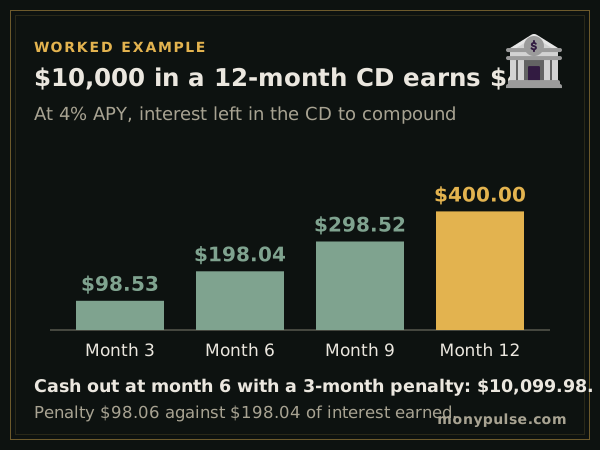
Put $10,000 in a 12-month CD at 4% APY. At maturity you have $10,400.00, of which $400.00 is interest. The first month earns $32.74, and each month earns a little more than the one before because the interest stays in the CD.
If the bank quotes the same CD as an interest rate compounded daily, the rate is about 3.922%: a slightly lower number for the same result, which is why banks are required to show the APY.
How is CD interest calculated?
A CD pays a fixed rate for a fixed term. If you have the APY, the math is one step: multiply the deposit by one plus the APY, raised to the number of years. $10,000 at 4% APY for 18 months grows to $10,000 × 1.04^1.5 = $10,606.02.
If the bank gives you a stated interest rate and a compounding frequency instead, turn the rate into an APY first. A 4% rate compounded monthly is an APY of (1 + 0.04 ÷ 12)^12 − 1 = 4.074%, so 18 months grows $10,000 to $10,617.31. Compounded daily, the same 4% rate is an APY of 4.081%.
In Excel or Google Sheets: =10000*(1+0.04)^(18/12) with an APY, or =10000*(1+0.04/12)^18 with a rate compounded monthly.
What does an early withdrawal cost?
Cashing out a CD before it matures usually costs a penalty, most often a set number of months of interest. Federal law requires a minimum penalty on withdrawals in the first six days but sets no maximum, so the size of the penalty depends on your bank and the term.
Turn on See what an early withdrawal costs above and enter the month you might withdraw and the penalty from your CD’s disclosure. In the example, cashing out the 12-month CD after 6 months with a 3-month penalty leaves you with $10,099.98: you keep $198.04 of interest minus a $98.06 penalty. Withdraw early enough and the penalty can be larger than the interest you have earned, which means it comes out of your deposit.
CD vs. high-yield savings account
| CD | High-yield savings account | |
|---|---|---|
| Rate | Fixed for the term | Can change at any time |
| Access to money | Penalty before maturity | Withdraw any time (some banks limit transfers) |
| Best for | Money you won’t need until a set date | Emergency funds and money you may need soon |
| Insurance | FDIC or NCUA, up to $250,000 per depositor, per bank, per ownership category | Same |
A CD ladder splits savings across several CDs that mature at different times, for example 6, 12, 18 and 24 months. As each one matures, you can use the money or roll it into a new CD, so part of your savings is always within a few months of being free.
Taxes on CD interest
CD interest is ordinary income. It is taxable in the year it is credited to your CD, even when the CD hasn’t matured, and the bank reports it on Form 1099-INT. Enter your tax rate under More options to see the interest you keep. A CD inside an IRA follows the IRA’s tax rules instead.
Related calculators
For an account with deposits every month, use the savings calculator. For any rate and compounding frequency, the compound interest calculator shows growth over longer periods, and the savings goal calculator works out how much to put away for a target date. Keeping an emergency cushion first? The emergency fund calculator sizes it.
Assumptions and limits
- The rate is fixed for the whole term, as it is for a standard CD, and interest stays in the CD until maturity.
- The penalty is figured as simple interest on the deposit for the number of months you enter. Banks set their own method, so check the CD's account disclosure.
- A tax rate, if you enter one, is applied to the interest at the end. In practice CD interest is taxable in the year it is credited, even before the CD matures.
- No fees, no partial withdrawals and no change in the deposit during the term.
Frequently asked questions
How much interest will a $10,000 CD earn?
At 4% APY, a $10,000 CD earns $400 in one year and about $617 over 18 months at a 4% rate compounded monthly. The APY, the term and whether interest stays in the CD decide the total.
How is CD interest calculated?
With the APY, multiply the deposit by (1 + APY) raised to the number of years: $10,000 × 1.04 = $10,400 after one year at 4% APY. With a stated rate, first turn it into an APY using the compounding frequency, or let the calculator do it.
What is the penalty for withdrawing a CD early?
Banks set their own penalties, usually a number of months of interest, and longer terms often carry larger ones. Federal law sets a minimum penalty but no maximum, and a penalty can be larger than the interest earned, cutting into your deposit. The penalty is listed in the CD's disclosure.
Are CDs FDIC-insured?
CDs at FDIC-insured banks are covered up to $250,000 per depositor, per bank, for each account ownership category, and CDs at federally insured credit unions are covered the same way by the NCUA.
Is CD interest taxable?
Yes. CD interest is taxed as ordinary income in the year it is credited to your account, even if you can't withdraw it without a penalty, and banks report it on Form 1099-INT. CDs held in an IRA are taxed under the IRA's rules instead.
Is a CD better than a high-yield savings account?
A CD locks in a rate for a set term, which helps if rates fall, but your money is tied up until maturity. A savings account's rate can change at any time, but you can withdraw whenever you like. Compare the APYs and how soon you may need the money.
Sources and method
- What is a certificate of deposit (CD)? · Consumer Financial Protection Bureau
- What are the penalties for withdrawing money early from a CD? · Office of the Comptroller of the Currency (HelpWithMyBank.gov)
- Understanding Deposit Insurance · Federal Deposit Insurance Corporation
- National Rates and Rate Caps · Federal Deposit Insurance Corporation
- Topic no. 403, Interest received · Internal Revenue Service
Formulas and figures checked against these sources on November 12, 2026. The calculator runs entirely in your browser; nothing you type is sent to us or stored. Results are estimates for education, not financial, tax or legal advice, and MonyPulse is not a lender, tax preparer or investment adviser. Found an error? Tell us. See how we build and test our calculators and our editorial standards.