How the Emergency Fund calculator works
Emergency fund target
Target = Essential monthly costs × months to cover
- Essential costs
- housing, utilities, groceries, transportation, insurance, minimum debt payments and other must-pay bills
Time to reach it
Months = (Target − savings today) ÷ monthly saving
Worked example
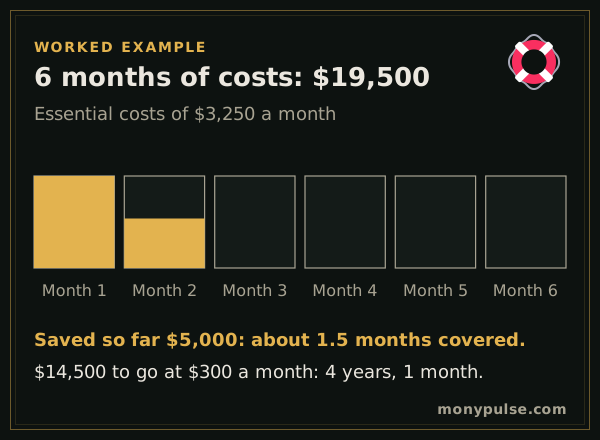
A household with one steady income spends $3,250 a month on essentials: $1,500 for rent, $250 for utilities and phone, $500 for groceries, $300 for transportation, $300 for insurance, $200 in minimum debt payments and $200 of other must-pay costs. Six months of that is an emergency fund target of $19,500.
They have $5,000 saved, enough to cover about 1.5 months, so the gap is $14,500. Saving $300 a month, they would reach the target in about 4 years, 1 month; raising it to $500 cuts that to under two and a half years.
How many months is right for you?
- 3 months: two steady incomes and stable jobs.
- 6 months: one income supports the household.
- 9 months: self-employed, commission-based or seasonal income.
- 12 months: a single income with dependents, a job at risk, or health needs that make job loss harder.
Build it in stages
A full fund can feel out of reach, so set milestones. A starter fund of one month of essential costs handles most surprise bills. Then work toward three months, then six. Automatic transfers on payday and putting part of every tax refund or bonus into the fund speed things up.
Related calculators
To find money to set aside each month, start with the budget calculator. To see how much interest the fund earns in a high-yield account, use the savings calculator, and to plan the timeline to any savings target, the savings goal calculator.
Assumptions and limits
- Only essential costs count; spending you could cut in an emergency is left out.
- Interest on the savings is not included, which keeps the timeline cautious.
- Months to cover are guidelines; choose more if your income is irregular or one person supports the household.
Frequently asked questions
How much should I have in an emergency fund?
A common guideline is three to six months of essential expenses: three if your household has two steady incomes, six or more if it depends on one income, and more still if your pay varies. With $3,250 of monthly essentials, six months is $19,500.
What expenses should an emergency fund cover?
The costs you can't stop if your income does: rent or mortgage, utilities, groceries, transportation, insurance, minimum debt payments and essentials like child care and medicine.
Where should I keep my emergency fund?
Somewhere safe and easy to reach, such as an FDIC-insured high-yield savings account or a money market account. Avoid investments that can lose value just when you need the money.
Should I pay off debt or build an emergency fund first?
Many people start with a small fund of about one month of costs, then pay down high-interest debt, then finish the full fund. Without any cushion, a surprise bill often ends up on a credit card.
How many Americans could cover an emergency?
In the Federal Reserve's survey of 2025, 63% of adults said they would cover a $400 emergency expense with cash or its equivalent, unchanged from the year before.
Sources and method
- An essential guide to building an emergency fund · Consumer Financial Protection Bureau
- Economic Well-Being of U.S. Households in 2025: Savings and Investments · Board of Governors of the Federal Reserve System
Formulas and figures checked against these sources on November 11, 2026. The calculator runs entirely in your browser; nothing you type is sent to us or stored. Results are estimates for education, not financial, tax or legal advice, and MonyPulse is not a lender, tax preparer or investment adviser. Found an error? Tell us. See how we build and test our calculators and our editorial standards.