How the Financial Independence & Early Retirement calculator works
FI number
FI number = Yearly spending ÷ withdrawal rate
- Withdrawal rate
- 4% gives the familiar rule of 25 times spending
Years to FI
Years until Invested × (1 + r)t + Savings × ((1 + r)t − 1) ÷ r ≥ FI number
- r
- real return: (1 + return) ÷ (1 + inflation) − 1
- Savings
- take-home pay − spending, each year
Worked example
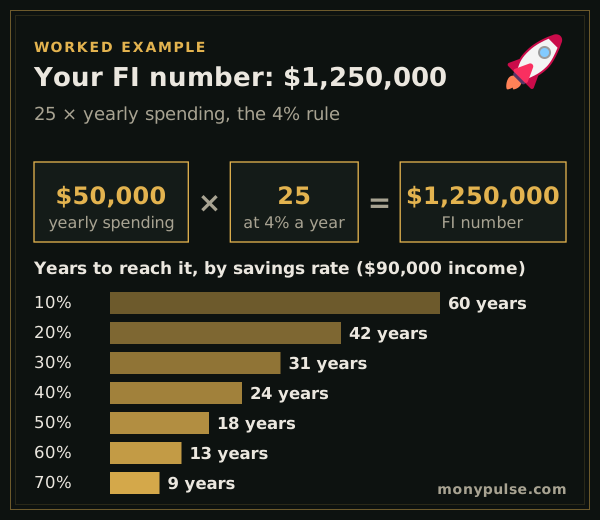
You are 30, take home $90,000 a year, spend $50,000 and have $100,000 invested. Your FI number is $1,250,000, 25 times your spending at a 4% withdrawal rate.
You save $40,000 a year, a savings rate of 44%. At a 7% return and 3% inflation, your investments reach the FI number in about 18 years, around age 49. Your Coast FI number is $329,443: with that much invested now, growth alone would reach your FI number by 65.
Early retirement calculator: the savings rate is the key
How early you can retire depends far more on the share of income you save than on income itself. The table under the results shows the years to financial independence at savings rates from 10% to 70%, starting from zero. Moving from saving 20% to 50% of pay can cut the wait by decades.
Financial independence calculator: choosing a withdrawal rate
The 4% guideline comes from studies of 30-year retirements with mixed stock and bond portfolios. Early retirees may need their money to last 40 or 50 years, so many plan on 3.5% or even 3%, which raises the FI number. Try different rates to see the trade-off between safety and time.
Related calculators
For a traditional retirement with Social Security, use the retirement savings calculator. To see how much income your savings could pay, try the passive income calculator, and to find more to save each month, the budget calculator.
Assumptions and limits
- All figures are in today's dollars, using the real return after inflation.
- Spending stays the same in retirement as now. Health insurance before Medicare and taxes on withdrawals should be included in it.
- Returns are a steady average; early bad years can make a 4% withdrawal rate risky over very long retirements, so many early retirees use 3% to 3.5%.
Frequently asked questions
What is my FIRE number?
Your yearly spending divided by your withdrawal rate. At $50,000 a year and a 4% rate, it is $1.25 million, which is 25 times spending.
How long until I can retire early?
It depends mostly on your savings rate. Saving 44% of take-home pay with $100,000 already invested, the example reaches financial independence in about 18 years at a 3.9% real return.
What is Coast FI?
The amount that, invested today and never added to, would grow to your FI number by a traditional retirement age. Once you pass it you could cover just your current costs and still retire at 65.
Can I touch retirement accounts if I retire early?
Withdrawals from traditional IRAs and 401(k)s before age 59½ usually carry a 10% additional tax, with some exceptions such as substantially equal periodic payments. Early retirees often hold taxable accounts or Roth contributions to bridge the gap.
Why does the savings rate matter so much?
It works twice: a higher savings rate means more money invested each year and less spending to replace. The table shows how quickly the years to financial independence fall as the rate rises.
Sources and method
- Topic no. 557, Additional tax on early distributions from traditional and Roth IRAs · Internal Revenue Service
- Retirement age and benefit reduction · Social Security Administration
Formulas and figures checked against these sources on November 11, 2026. The calculator runs entirely in your browser; nothing you type is sent to us or stored. Results are estimates for education, not financial, tax or legal advice, and MonyPulse is not a lender, tax preparer or investment adviser. Found an error? Tell us. See how we build and test our calculators and our editorial standards.