How the Debt Payoff calculator works
Each month
Interest on each debt = Balance × APR ÷ 12; pay every minimum; put (Budget − minimums) on the target debt
- Budget
- the sum of all minimum payments plus your extra amount; it stays the same until every debt is paid
- Target debt
- avalanche: the highest APR; snowball: the smallest balance
Worked example
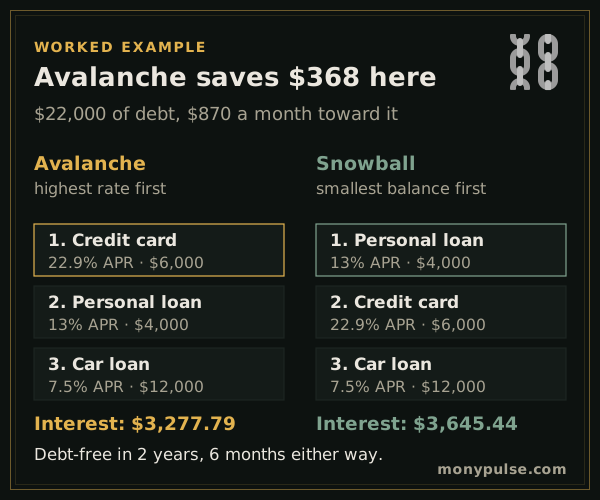
The calculator starts with three debts: a $6,000 credit card at 22.9%, a $12,000 car loan at 7.5% and a $4,000 personal loan at 13%, with $670 of minimum payments plus $200 extra each month.
With the avalanche method, the extra goes to the card first. You are debt-free in 2 years, 6 months and pay $3,277.79 in interest. The snowball method would start with the personal loan, take 2 years, 6 months and cost $3,645.44. Compared with paying only the minimums, the plan saves $2,385.28.
Avalanche or snowball?
Both methods pay the minimum on every debt and differ only in where the extra money goes:
- Avalanche (highest rate first) saves the most money, because the most expensive balance shrinks first.
- Snowball (smallest balance first) gets the first debt closed quickly, and one fewer bill can make the plan easier to stick with.
When the smallest debt also has the highest rate, the two plans are the same. Switch the Payoff order to see how far apart they are for your debts; often the gap is small, and the plan you will follow is the better one.
Why the rollover matters
The key is keeping the total payment the same after each debt is paid. When the card is gone, its $180 minimum plus the $200 extra moves to the next debt, so each balance falls faster than the one before. The payoff order table shows the month each debt reaches zero and the interest it cost.
Make the plan work
- Stop adding new charges to the cards you are paying off.
- Call your card issuers and ask for a lower APR; even a few points cut the interest.
- Look at a 0% balance transfer or a consolidation loan, but count the fees first.
- Put raises, refunds and bonuses toward the target debt.
For a single card, use the credit card payoff calculator. To find the extra money, start with the budget calculator, and to compare a consolidation loan, use the personal loan calculator.
Assumptions and limits
- Your total monthly payment stays the same, so when a debt is paid off its minimum rolls into the next target.
- No new charges are added and the APRs don't change.
- Interest is charged monthly on each balance. Cards that charge daily interest come out slightly higher.
- Minimum payments are the amounts you enter. On cards the real minimum falls as the balance falls, which is why paying a fixed amount clears them sooner.
Frequently asked questions
Which is better, avalanche or snowball?
The avalanche method, highest rate first, always costs the least interest. The snowball method, smallest balance first, clears the first debt sooner, which keeps many people motivated. The calculator shows both so you can see what the motivation costs.
How does the debt snowball work?
You pay the minimum on everything and put every extra dollar on the smallest balance. When it is gone, its payment moves to the next smallest, so the amount aimed at each debt grows like a rolling snowball.
What if I can only pay the minimums?
Set the extra amount to zero to see the timeline. Even a small extra amount usually shortens the plan by months, because it goes straight to the most expensive or smallest debt.
Should I include my mortgage?
Usually not. Mortgages have low rates and long terms, and most payoff plans focus on cards, personal loans, car loans and student loans. You can add it if you want it in the plan.
Is a consolidation loan better?
Only if its APR, including fees, is lower than the rates you pay now and you stop using the cards. Compare offers in the personal loan calculator.
Sources and method
- How to reduce your debt · Consumer Financial Protection Bureau
- A box on my credit card bill says that I will pay off the balance in three years if I pay a certain amount. What does that mean? · Consumer Financial Protection Bureau
- Consumer Credit - G.19 · Federal Reserve Board
Formulas and figures checked against these sources on November 11, 2026. The calculator runs entirely in your browser; nothing you type is sent to us or stored. Results are estimates for education, not financial, tax or legal advice, and MonyPulse is not a lender, tax preparer or investment adviser. Found an error? Tell us. See how we build and test our calculators and our editorial standards.