How the Mortgage calculator works
Monthly principal and interest
M = P × r(1 + r)n ÷ ((1 + r)n − 1)
- M
- monthly principal-and-interest payment
- P
- loan amount (price minus down payment)
- r
- monthly interest rate: the annual rate ÷ 12
- n
- number of monthly payments: years × 12
Total monthly payment (PITI plus HOA and PMI)
Payment = M + property tax ÷ 12 + insurance ÷ 12 + HOA + PMI
- PMI
- PMI rate × original loan ÷ 12, charged while the balance is above 80% of the price
Worked example
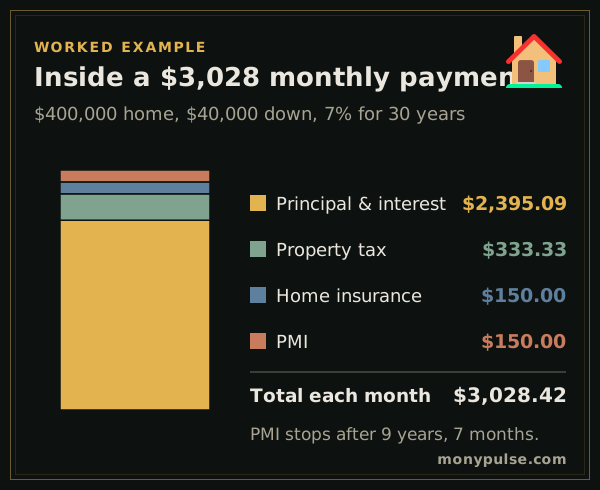
Take a $400,000 home bought with 10% down. The down payment is $40,000, so the loan is $360,000. At 7% for 30 years, principal and interest come to $2,395.09 a month.
Add property tax at 1% of the price ($333.33 a month), insurance of $1,800 a year ($150.00 a month) and PMI at 0.5% of the loan ($150.00 a month), and the full payment is $3,028.42. Because the down payment is under 20%, PMI is charged for 9 years, 7 months, until the balance falls to 78% of the price.
Over the full 30 years the loan costs $502,232 in interest, and the last payment falls in Dec 2056 when payments start in January 2027.
Mortgage payment calculator: what goes into the payment
Most payments have four parts, often shortened to PITI:
- Principal pays down what you borrowed. It is small at first and grows each month.
- Interest is the lender’s charge on the balance. Early payments are mostly interest, which is why the schedule above shifts from interest to principal over time.
- Taxes are your property tax, usually collected monthly into an escrow account.
- Insurance is your homeowners policy, often paid through the same escrow account.
HOA dues and PMI sit on top when they apply. Two buyers with the same loan can have very different payments because of property tax alone, so use your county’s real rate rather than a national guess.
To check the principal and interest part in Excel or Google Sheets, use =PMT(rate/12, years*12, -loan): =PMT(0.07/12, 360, -320000) returns $2,128.97 for a $320,000 loan at 7% over 30 years. Add property tax, insurance, HOA dues and any PMI to get the full payment.
How PMI works and when it ends
Private mortgage insurance protects the lender, not you, when you put down less than 20% on a conventional loan. This calculator charges PMI only while the balance is above 80% of the price, and it drops PMI once the balance reaches 78%, the level where most conventional loans must cancel it automatically. Extra principal payments reach that point sooner.
15-year or 30-year?
A 15-year loan has a higher monthly payment but usually a lower rate and far less total interest, because you borrow for half as long. A 30-year loan keeps the payment lower and leaves more room in the budget. Switch the loan term above to compare the payment and the total interest side by side, and try the refinance calculator if you already have a loan. To see the price your income supports first, start with the mortgage affordability calculator.
Biweekly mortgage payments
Paying half of your monthly payment every two weeks means 26 half payments, or 13 full payments, a year instead of 12. The extra payment goes straight to principal, so the loan ends years early. For the worked example above, that saves $122,909 of interest and pays the loan off 6 years, 3 months sooner. Before you sign up for a lender’s biweekly program, check for fees: you get the same effect for free by adding one twelfth of a payment to each monthly payment under More options.
Assumptions and limits
- A fixed-rate loan with the same rate for the whole term. Adjustable-rate loans change after the fixed period.
- Property tax, insurance and HOA dues stay at today's amounts. In practice they usually rise, so treat them as a floor.
- PMI stops when the balance reaches 78% of the original price, the point where federal law requires automatic cancellation on most conventional loans. You can usually ask to cancel it at 80%.
- Closing costs, points and lender fees are not included in the payment.
- FHA, VA and USDA loans price mortgage insurance differently; use the PMI box only as a rough stand-in for them.
Frequently asked questions
How is a mortgage payment calculated?
Principal and interest come from the amortization formula M = P × r(1 + r)^n ÷ ((1 + r)^n − 1), using the loan amount, the monthly rate and the number of payments. Property tax, insurance, HOA dues and PMI are then added to get the full monthly payment.
What does PITI mean?
PITI stands for principal, interest, taxes and insurance, the four parts of most monthly mortgage payments. Lenders often collect the taxes and insurance through an escrow account and pay those bills for you.
When does PMI go away?
On most conventional loans the lender must end PMI automatically when the balance is scheduled to reach 78% of the home's original value, and you can ask for it to be removed at 80% if you're current on payments. FHA mortgage insurance follows different rules.
How much do extra payments save?
Every extra dollar of principal stops earning interest for the rest of the loan, so even small extra payments shorten the loan and cut total interest. Enter an amount under More options to see the interest saved and how much sooner the loan is paid off.
Is the rate in the calculator today's mortgage rate?
No. It is an example value you should replace. Rates change weekly and depend on your credit, down payment and loan type, so use the rate on your own loan estimate.
Sources and method
- What is private mortgage insurance? · Consumer Financial Protection Bureau
- When can I remove private mortgage insurance (PMI) from my loan? · Consumer Financial Protection Bureau
- What is an escrow or impound account? · Consumer Financial Protection Bureau
- Mortgage Rates (Primary Mortgage Market Survey) · Freddie Mac
Formulas and figures checked against these sources on November 12, 2026. The calculator runs entirely in your browser; nothing you type is sent to us or stored. Results are estimates for education, not financial, tax or legal advice, and MonyPulse is not a lender, tax preparer or investment adviser. Found an error? Tell us. See how we build and test our calculators and our editorial standards.