How the Mortgage Affordability calculator works
Largest housing payment allowed
Budget = lower of (Monthly income × front-end limit) and (Monthly income × back-end limit − other debt payments)
- Monthly income
- gross yearly income ÷ 12, before taxes
Home price
Find the price where P&I + property tax + insurance + HOA + PMI = Budget
- P&I
- principal and interest on (price − down payment)
- PMI
- charged when the loan is more than 80% of the price
Worked example
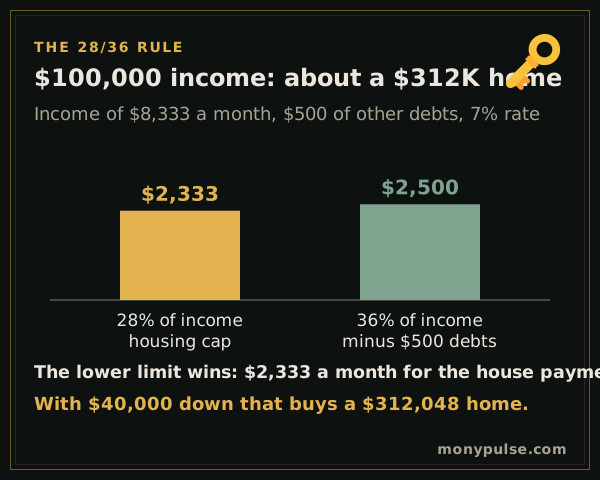
A household earning $100,000 a year has $500 a month in car and card payments and $40,000 saved for the down payment. Under the 28/36 rule, the housing limit allows a full house payment of $2,333.33 a month, and the all-debt limit allows $2,500.00 once the $500 of debts is counted. The lower figure sets the budget.
At 7% for 30 years, with property tax at 1% of the price, $1,800 a year for insurance and PMI because the down payment is under 20%, that budget supports a home of about $312,048. The loan is $272,048 and the monthly payment is $2,333.33.
How much house can I afford?
With the traditional 28% housing limit, no other debts and 10% down, a household earning $100,000 a year can afford a home of about $299,000 at a 7.18% mortgage rate. The full monthly payment, with property tax, insurance and mortgage insurance, comes to about $2,333, which is 28% of $8,333 of monthly income.
| Household income | Home price | Down payment (10%) | Monthly payment (with tax, insurance, PMI) |
|---|---|---|---|
| $50,000 | $139,000 | $13,900 | $1,166.67 |
| $75,000 | $219,000 | $21,900 | $1,750.00 |
| $100,000 | $299,000 | $29,900 | $2,333.33 |
| $125,000 | $379,000 | $37,900 | $2,916.67 |
| $150,000 | $459,000 | $45,900 | $3,500.00 |
| $200,000 | $618,000 | $61,800 | $4,666.67 |
Worked out with this calculator: 28/36 limits, no other monthly debts, 10% down, a 30-year fixed rate of 7.18% (Freddie Mac’s weekly average for November 5, 2026), property tax of 1% of the price a year, insurance of $1,800 a year and PMI of 0.5% a year. Monthly debts of more than 8% of your gross income lower these prices, because the 36% all-debt limit then binds first. A lower rate, a bigger down payment or a lower property tax raises them.
Lenders look at two ratios. The front-end ratio is the house payment divided by gross monthly income. The back-end ratio adds every other monthly debt payment: car loans, student loans, card minimums and support payments. Whichever limit you hit first sets your maximum payment, and the payment sets the price.
Common limits:
- 28/36: the traditional guideline for conventional loans.
- 31/43: HUD’s standard limits for manually underwritten FHA loans.
- Higher limits: Fannie Mae allows a total ratio up to 45% for some manually underwritten loans and up to 50% through its automated system, so choose Custom to test them.
Affordable to the lender versus affordable to you
A lender’s limit uses income before taxes, retirement savings and child care. A payment at the very top of the limit can leave a tight budget. Try the calculator at 25% for housing to see a more comfortable price, and build a full picture with the budget calculator.
Next steps
Check your current ratios in the debt-to-income ratio calculator, then take the price into the mortgage calculator to see the payment schedule and how extra payments change it.
Assumptions and limits
- Lenders count gross (pre-tax) income and the minimum payments on your debts, so the result is the most a lender may allow, not what is comfortable for your budget.
- Property tax is a percentage of the price; insurance and HOA dues stay fixed.
- PMI is charged only when the down payment is under 20%. FHA, VA and USDA loans price insurance differently.
- Closing costs and cash reserves are not taken out of the down payment. Set aside money for them separately.
Frequently asked questions
How much house can I afford on my salary?
Under the 28/36 rule, your full house payment should be no more than 28% of gross monthly income, and all debts including the house no more than 36%. The calculator finds the price whose payment fits the lower of those two limits at your rate and down payment.
What is the 28/36 rule?
It is a long-standing lending guideline: 28% of gross income for housing (the front-end ratio) and 36% for all monthly debt payments (the back-end ratio). Many loans allow more, but staying inside it leaves more room in your budget.
What DTI do FHA loans allow?
For manually underwritten FHA loans, HUD's standard limits are 31% for housing and 43% for total debt, and borrowers with strong compensating factors can qualify above them. Loans approved through automated underwriting can go higher.
Does a bigger down payment let me buy a more expensive home?
Yes, two ways: you borrow less for each dollar of price, and at 20% down there is no PMI, which frees part of the payment for the loan itself.
Why does the interest rate matter so much?
The payment limit is fixed by your income, so a higher rate leaves less of it for principal. A one-point rise in the rate can lower the price you can afford by roughly a tenth.
Sources and method
- What is a debt-to-income ratio? · Consumer Financial Protection Bureau
- B3-6-02, Debt-to-Income Ratios · Fannie Mae Selling Guide
- Mortgagee Letter 2014-02: Manual Underwriting · U.S. Department of Housing and Urban Development
- Mortgage Rates (Primary Mortgage Market Survey) · Freddie Mac
Formulas and figures checked against these sources on November 12, 2026. The calculator runs entirely in your browser; nothing you type is sent to us or stored. Results are estimates for education, not financial, tax or legal advice, and MonyPulse is not a lender, tax preparer or investment adviser. Found an error? Tell us. See how we build and test our calculators and our editorial standards.