How the Refinance calculator works
Break-even point
Months to break even = Closing costs ÷ (Current payment − New payment)
Lifetime difference
Difference = Current payment × payments left − (New payment × new payments + closing costs paid up front)
- Payments
- principal and interest only; both loans use the standard formula M = P × r(1 + r)^{n} ÷ ((1 + r)^{n} − 1)
Worked example
Say you owe $300,000 at 7.8% with 27 years left, so your principal and interest payment is $2,222.36. A lender offers a new 30-year loan at 7% with $6,000 in closing costs paid at closing.
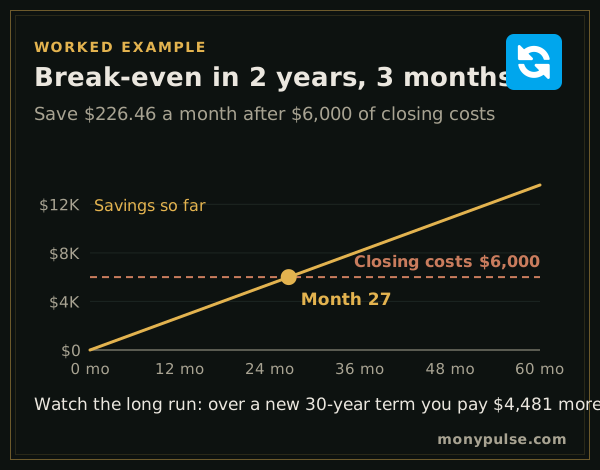
The new payment is $1,995.91, a saving of $226.46 a month, which earns back the closing costs in 2 years, 3 months. But because the new loan runs three years longer, you would pay $4,481 more in total by the time it is paid off. A shorter new term, or extra principal payments, would keep the lower rate and avoid that.
How the break-even point works
Closing costs are paid on day one; the savings arrive a month at a time. The break-even point is the month when the savings add up to the costs. If you might sell the home or refinance again before then, the refinance loses money even though the payment is lower.
Watch the new loan’s term
The most common refinance trap is comparing a new 30-year payment with an old loan that has fewer years left. Part of the lower payment then comes from spreading the balance over more years, not from the better rate. The calculator warns you when the new term is longer, and the Lifetime difference shows the real cost. Try a 20- or 25-year term to compare.
When refinancing tends to make sense
- The new rate is meaningfully lower than yours and you will stay past the break-even month.
- You can shorten the term without straining your budget, which cuts total interest.
- Your equity now lets you drop PMI or FHA mortgage insurance.
Average rates change weekly, so compare actual offers. For the full schedule of a new loan, use the amortization calculator, and to see a whole new payment with tax and insurance, use the mortgage calculator.
Assumptions and limits
- Both loans are fixed-rate, and you keep the new loan to the end of its term.
- Payments compared are principal and interest. Tax, insurance and PMI are left out because they usually don't change when you refinance.
- If you add the closing costs to the new loan, interest is charged on them too, and the break-even month uses the same costs.
- Cash-out refinancing, points and lender credits are not modeled. Add points to the closing costs if you pay them.
Frequently asked questions
How do I know if refinancing is worth it?
Divide the closing costs by the monthly savings to get the break-even point in months. If you expect to keep the home and the loan well past that point, and the new loan doesn't stretch your payoff date too far, refinancing usually pays.
Why can a lower payment still cost more in total?
A new 30-year loan restarts the clock. If you had 27 years left, the extra three years of payments can outweigh a lower rate. The Lifetime difference in the results shows this, and a shorter new term fixes it.
How much are refinance closing costs?
They vary by lender and loan size and include the appraisal, title insurance, lender fees and recording fees. Your Loan Estimate lists them; enter that total rather than a rule of thumb.
Should I roll the closing costs into the new loan?
It saves cash today but you pay interest on those costs for the life of the loan. Turn the toggle on and off to see the difference in the total.
Does this include PMI?
No. If refinancing removes PMI or FHA mortgage insurance because you now have enough equity, add that monthly amount to your savings when you judge the break-even point.
Sources and method
- Loan Estimate explainer · Consumer Financial Protection Bureau
- What is the difference between a mortgage interest rate and an APR? · Consumer Financial Protection Bureau
- What is a prepayment penalty? · Consumer Financial Protection Bureau
- Mortgage Rates (Primary Mortgage Market Survey) · Freddie Mac
Formulas and figures checked against these sources on November 11, 2026. The calculator runs entirely in your browser; nothing you type is sent to us or stored. Results are estimates for education, not financial, tax or legal advice, and MonyPulse is not a lender, tax preparer or investment adviser. Found an error? Tell us. See how we build and test our calculators and our editorial standards.