How the Property Tax calculator works
Taxable value
Taxable value = Market value × assessment ratio − exemptions
Property tax
Tax = Taxable value × tax rate; with mills: Tax = Taxable value × mills ÷ 1,000
- 1 mill
- $1 of tax for every $1,000 of taxable value, or 0.1%
Worked example
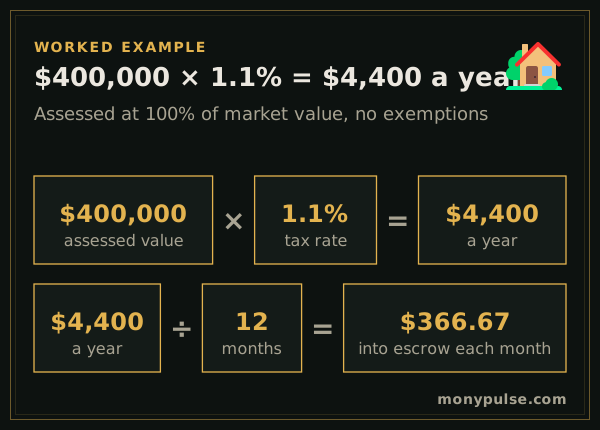
A home with a market value of $400,000 is assessed at its full value in a place with a combined property tax rate of 1.1%. The yearly property tax is $4,400, about $366.67 a month if your lender collects it through escrow.
Switch the rate to mills to match a bill that says, for example, 22 mills: on a $400,000 taxable value that is $8,800 a year.
Assessed value vs market value
Property tax is based on the assessed value, which isn’t always what your home would sell for. Some states assess at full market value; others use a fixed share of it, and several limit how much the assessed value of a home you live in can rise each year. If you think your assessment is too high, you can usually appeal within a short window after the notice arrives.
Why property taxes vary so much
Property taxes fund schools, roads, police and other local services, so rates depend on the town and school district more than the state. Two homes of the same value a few miles apart can have very different bills. When you compare homes, look up the actual tax bill on the county’s website rather than estimating from a state average.
Related calculators
See the tax as part of your monthly house payment in the mortgage calculator, check what price your budget supports with the mortgage affordability calculator, and for your full federal return with itemized deductions, use the income tax calculator.
Assumptions and limits
- One combined rate for all local taxing bodies: county, city, school district and special districts. Your tax bill lists each one.
- Exemptions are entered as a dollar reduction in taxable value. Some states give credits or percentage reductions instead.
- The projection assumes the rate stays the same while the assessed value rises at the rate you enter.
Frequently asked questions
How is property tax calculated?
Your local assessor sets an assessed value, often your market value or a fixed share of it. Exemptions are subtracted, and the result is multiplied by the combined local tax rate. A $400,000 home taxed at 1.1% of its full value owes $4,400 a year.
What is a mill rate?
A way of stating the tax rate: one mill is $1 per $1,000 of taxable value. A rate of 22 mills equals 2.2%. Choose Mills above if your bill states the rate that way.
What is a homestead exemption?
Many states reduce the taxable value of a home you live in as your main residence. Seniors, veterans and people with disabilities often qualify for extra exemptions. Check your county assessor's website and apply; most aren't automatic.
Is property tax deductible?
Yes, as an itemized deduction for state and local taxes. For 2026 the total deduction for those taxes is capped at $40,400 ($20,200 married filing separately), and the cap shrinks for incomes above $505,000, down to $10,000.
Why does my mortgage payment include property tax?
Many lenders collect it monthly in an escrow account and pay the bill for you. The monthly figure here is what that part of your payment would be.
Sources and method
- Topic no. 503, Deductible taxes · Internal Revenue Service
- What is an escrow or impound account? · Consumer Financial Protection Bureau
Formulas and figures checked against these sources on November 11, 2026. The calculator runs entirely in your browser; nothing you type is sent to us or stored. Results are estimates for education, not financial, tax or legal advice, and MonyPulse is not a lender, tax preparer or investment adviser. Found an error? Tell us. See how we build and test our calculators and our editorial standards.