Walmart
Sam Walton Lost His First Store. Then He Built Walmart.
In 1945 Sam Walton borrowed $20,000 from his father-in-law to buy a variety store in a small Arkansas town. He made it a success, then lost it because of a missing clause in the lease. In fiscal 2026 Walmart had revenue of $713 billion.
- First store, 1945
- $25,000First store, 1945. Sam Walton's stake in his first store in Newport, Arkansas, in 1945: $5,000 he saved in the Army and $20,000 lent by his father-in-law.
- Revenue, FY2026
- $713BRevenue, FY2026. Walmart's total revenue for the fiscal year ended January 31, 2026.
In this story · 6 chapters
The short answer
In 1945 Sam Walton bought a Ben Franklin store in Newport, Arkansas, with $5,000 of savings and a $20,000 loan from his father-in-law. He made it the best-performing Ben Franklin in its region, but his lease had no renewal option. In 1950 the landlord took it back, paying $50,000 for his stock and fixtures. Walton started again in Bentonville.
On September 1, 1945, a 27-year-old former Army captain took over a variety store on Front Street in Newport, Arkansas. It was a small cotton town in the Mississippi Delta, and the store was a franchise of the Ben Franklin chain. It was not doing well. The previous owner had sold about $72,000 of goods a year.
Sam Walton had $5,000 saved from his time in the Army. His father-in-law, Leland Robson, a prosperous lawyer and rancher, lent him $20,000 more. That was the $25,000 that bought his first store.
Five years later he lost it, because of a sentence that was not in the lease.
Learning in Newport
Walton had worked briefly as a management trainee at J.C. Penney, but he had never run a store. He learned by doing, and by watching the competition. Across the street was a better-established store, the Sterling, and Walton spent a lot of time in it.
His methods were simple and relentless. He drove across the state line to buy goods cheaply from wholesalers instead of paying the franchise’s prices. He cut prices and found that he sold so much more that he made more money overall, a lesson he later said shaped everything he did. He stayed open late, put an ice-cream machine on the sidewalk and kept the shelves full.
The sales came. In his first year the store sold $105,000 of goods. The next year it sold $140,000, then $175,000. By the fifth year it was selling about $250,000 a year and making a profit of $30,000 to $40,000. It had become the leading Ben Franklin store in its six-state region and the biggest variety store in Arkansas. When an old Kroger site came free down the street, Walton took the lease and opened a small department store, the Eagle, so that his competitor could not have it.
The sentence that wasn’t there
There were two problems with the lease Walton signed in 1945, and he had not noticed either. The rent was 5% of sales, very high for the business, which meant that the landlord shared in every bit of Walton’s success. And there was no clause giving him the option to renew after five years.
The landlord was P. K. Holmes, whose family owned a department store in town. Holmes watched the Ben Franklin become the most successful store in Newport. When the lease ran out in 1950, he refused to renew it. He wanted the store and the franchise for his son.
Walton had no right to stay, and there was nowhere else in town for him to go. Holmes bought the store’s stock and fixtures for $50,000, which Walton later called a fair price. The business he had built in five years was gone. He was 32, with a wife, four young children and $50,000.
Starting again in Bentonville
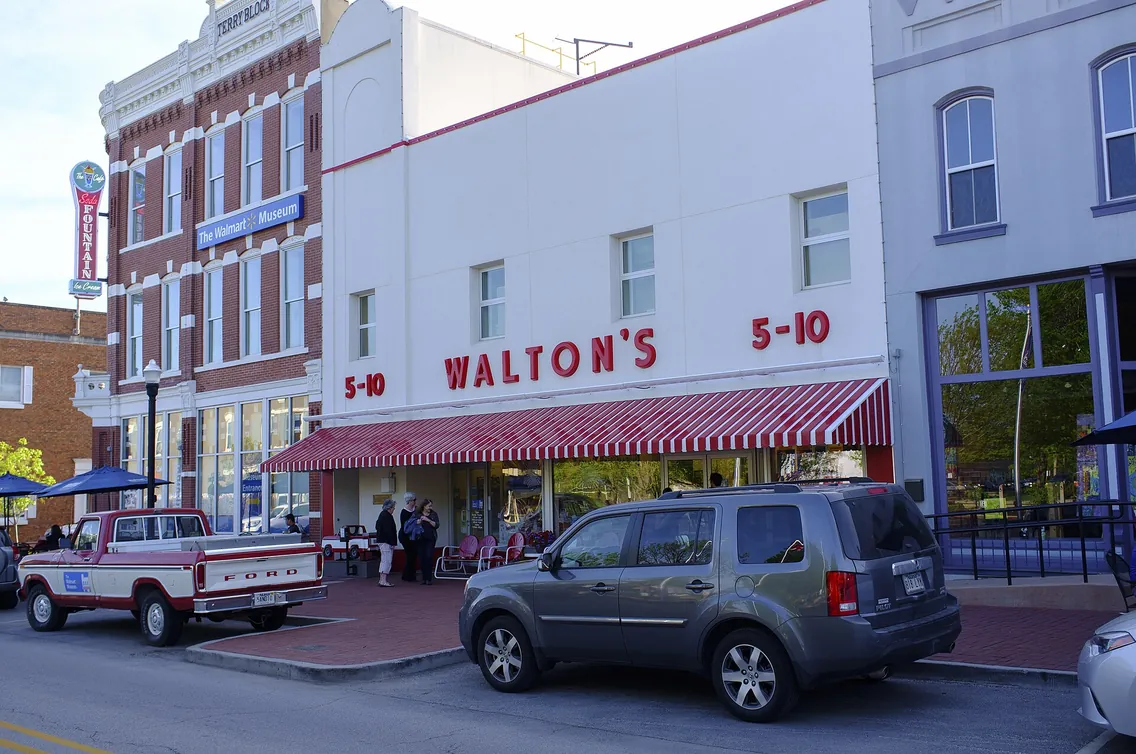
The Waltons looked for a new town and chose Bentonville, then a sleepy place of about 3,000 people in the far northwest of Arkansas. Helen Walton wanted to live in a small town, and Bentonville was close to good quail hunting, which Sam loved. He bought a small, run-down variety store on the town square and the building next to it, knocked them together and made one store.
It was still a Ben Franklin franchise, but he called it Walton’s 5&10. It opened on May 9, 1950, with a remodeling sale. This time Walton read his lease carefully.
From one store to sixteen
Bentonville became a base. Over the next decade Walton and his brother, Bud, opened or bought more variety stores across Arkansas, Missouri and Kansas. He flew between them in a secondhand two-seater plane to save time. By 1962 the brothers owned 16 stores, 15 of them Ben Franklins.
Walton could see where the business was going. Big discount stores, selling a huge range of goods at low prices, were spreading across America. But they were being built in big cities. Walton believed they could work in small towns too, if the prices were low enough. The Ben Franklin company was not interested. So he did it himself.
On July 2, 1962, the first Wal-Mart Discount City opened at 719 West Walnut Street in Rogers, Arkansas. Walton was 44.
The empire
The company went public in 1970 and used the money to grow. It built its own warehouses and trucking fleet, and later invested heavily in computers and satellite links to track what sold. In October 1985 Forbes named Walton the richest man in America, worth an estimated $2.8 billion. He still drove an old pickup truck to work.
In March 1992 President George H. W. Bush presented him with the Presidential Medal of Freedom. Walton died on April 5, 1992. Walmart became the largest retailer in the world. For the fiscal year that ended on January 31, 2026, it reported total revenue of $713.2 billion. That is more than $20,000 every second, close to the price of his first store.
What the record shows
- The small print matters. A missing renewal clause cost Walton the business he built.
- Success can invite trouble. The landlord wanted the store only because Walton had made it profitable.
- What you learn can’t be taken away. Walton lost the store but kept the lessons and the $50,000.
- Low prices can mean more profit. Walton discovered in Newport that selling more at lower prices paid better than selling less at high ones.
Losing everything once was also the start for Henry Ford, who failed twice before Ford Motor Company. For another retailer who learned from a defeat, read how Trader Joe’s began. And for another founder who built an empire after his first business slipped away, see Colonel Sanders.
 $50MRead nextBlockbuster Could Have Bought Netflix for $50 MillionIn early 2000 Netflix's founders flew to Dallas and offered to sell their company to Blockbuster for $50 million. Blockbuster said no. Ten years later Blockbuster was bankrupt.Blockbuster · 5 min read
Questions readers ask
- How did Sam Walton start Walmart?
- In 1945 he bought a Ben Franklin variety store in Newport, Arkansas, with $5,000 of Army savings and a $20,000 loan from his father-in-law, Leland Robson. After losing that store, he opened Walton's 5&10 in Bentonville in 1950, built a chain of variety stores with his brother Bud, and opened the first Walmart in Rogers, Arkansas, in 1962.
- Why did Sam Walton lose his first store?
- His lease had no renewal option. The landlord, P. K. Holmes, refused to renew it so he could take the store and franchise for his son. Holmes bought Walton's stock and fixtures for $50,000.
- What happened to Sam Walton's first store?
- Walton's first store, a Ben Franklin variety store in Newport, Arkansas, became the best-performing Ben Franklin in its six-state region. In 1950 the landlord refused to renew the lease, so he could hand the store to his son, and bought Walton's stock and fixtures for $50,000.
- What was the name of Sam Walton's first store?
- His first store was a Ben Franklin franchise in Newport, Arkansas, bought in 1945. His second start, in Bentonville in 1950, was also a Ben Franklin franchise, but he called it Walton's 5&10. The building is now part of the Walmart Museum.
- How big is Walmart today?
- Walmart reported total revenue of $713.2 billion for the fiscal year ended January 31, 2026.
Run the numbers yourself
- Mortgage CalculatorEstimate the monthly payment with taxes, insurance, HOA and PMI, plus the full amortization schedule.
- Break-Even Point CalculatorFind the units and sales needed to cover fixed costs, and the volume needed for a profit target.
- Business Loan CalculatorPrice a business loan with fees and weekly or monthly payments, and turn a factor rate into an APR.
People and companies in this story
People
- Sam Walton
- Helen Walton
- Bud Walton
- Leland Robson
- P. K. Holmes
Companies
- Walmart
- Ben Franklin
This story is on these lists
Share this story
Send the link to someone who would like this story, or keep it for later.
The timeline
Drawn to scale: the gaps are the years in between. Choose a year.
Sources & further reading 8
- Sam Walton: great from the start (excerpt from Giants of Enterprise by Richard Tedlow)Harvard Business School Working Knowledge
- Sam Walton (1918–1992)CALS Encyclopedia of Arkansas
- Empowering the Delta (the Waltons in Newport)Arkansas Democrat-Gazette, January 2018
- The Walton brothersState Historical Society of Missouri
- Sam WaltonWalmart Corporate
- Walton, Samuel Moore (1918–1992)Encyclopedia of Oklahoma History and Culture
- Is Wal-Mart good for America? ChronologyPBS Frontline
- Walmart revenue rises by 4.7% in fiscal 2026Retail Insight Network / Yahoo Finance, February 2026
Spot an error? Send a correction. Corrections are dated and noted here.
Photographs are credited under each picture; licenses are listed on the image credits page.