How the Debt to Income Ratio calculator works
Back-end (total) DTI
DTI = (Housing payment + all other monthly debt payments) ÷ Gross monthly income × 100
- Gross monthly income
- pay before taxes and deductions ÷ 12 if you know the yearly figure
Front-end (housing) ratio
Housing ratio = Housing payment ÷ Gross monthly income × 100
- Housing payment
- rent, or mortgage principal and interest plus property tax, insurance and HOA dues
Worked example
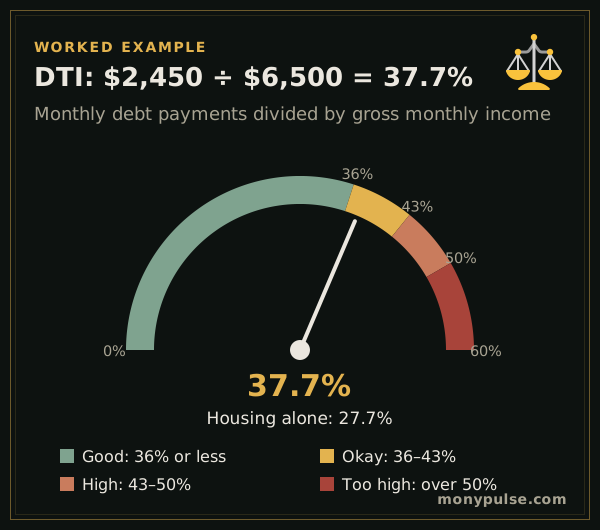
With gross income of $6,500.00 a month, $1,800 for rent, a $350 car payment, $200 for student loans and $100 in card minimums, monthly debt payments total $2,450.00.
The housing ratio is 27.7%, just inside the 28% guideline. The total ratio is 37.7%, a little above 36%. Many mortgage lenders would still approve this, but a lower ratio usually means more choice and better terms.
What counts as debt
Included: rent or the full house payment, car loans and leases, student loans (even in deferment, lenders count a payment), minimum card payments, personal loans, and child support or alimony you pay.
Not included: groceries, utilities, phone and internet, car insurance, health insurance and other living costs. They matter for your budget, but lenders don’t count them as debt.
What is a good debt-to-income ratio?
For a mortgage, a total (back-end) ratio of 36% or less is generally considered good, 43% is a common ceiling, and some loans allow 45% to 50% with strong credit, savings or an automated approval. For the housing payment alone (front-end), 28% to 31% of gross income is the usual guideline. Lenders set their own limits within these program rules:
- 28/36: the traditional guideline, 28% for housing and 36% overall.
- 43%: a long-used benchmark from the original federal Qualified Mortgage rule. The fixed 43% cap was later replaced by a test based on the loan’s price, but many lenders still watch it.
- Fannie Mae: up to 36% for manually underwritten loans, or 45% with strong credit and reserves, and up to 50% through its automated underwriting.
- FHA: 31% for housing and 43% overall as the standard for manual underwriting, with room above that for compensating factors.
Lower your ratio
Paying off a debt entirely removes its whole payment from the ratio, so a small balance can move the number more than a partial payment on a large one. Plan it with the debt payoff calculator. When your ratios look good, see the price they support in the mortgage affordability calculator.
Assumptions and limits
- Debts are the minimum payments shown on your statements, not balances.
- Living costs such as groceries, utilities, phone bills and insurance you pay yourself are not debts and are left out.
- Lenders may count debts differently. Fannie Mae, for example, can leave out installment loans with ten or fewer payments left.
Frequently asked questions
How do I calculate my debt-to-income ratio?
Add up your monthly debt payments, including rent or the mortgage, car loans, student loans, card minimums and support payments, and divide by your gross monthly income. Multiply by 100 for a percentage.
What is a good debt-to-income ratio?
Many lenders like to see 36% or less for all debts and 28% or less for housing. Ratios up to 43% are common for mortgages, and some loan programs allow up to 50% for borrowers with strong credit and savings.
What is the difference between front-end and back-end DTI?
The front-end ratio counts only housing costs. The back-end ratio counts housing plus every other monthly debt payment, and it is the one most lenders focus on.
Do lenders use gross or net income?
Gross income, before taxes and deductions. That is why a ratio that looks fine to a lender can still feel tight in your budget.
How can I lower my DTI quickly?
Pay off a small balance completely so its minimum disappears, avoid new loans before applying, and include all qualifying income such as a co-borrower's. Paying down card balances also lowers their minimum payments.
Sources and method
- What is a debt-to-income ratio? · Consumer Financial Protection Bureau
- B3-6-02, Debt-to-Income Ratios · Fannie Mae Selling Guide
- Mortgagee Letter 2014-02: Manual Underwriting · U.S. Department of Housing and Urban Development
Formulas and figures checked against these sources on November 12, 2026. The calculator runs entirely in your browser; nothing you type is sent to us or stored. Results are estimates for education, not financial, tax or legal advice, and MonyPulse is not a lender, tax preparer or investment adviser. Found an error? Tell us. See how we build and test our calculators and our editorial standards.