How the Loan calculator works
Monthly payment
M = P × r(1 + r)n ÷ ((1 + r)n − 1)
- M
- monthly payment
- P
- amount borrowed
- r
- monthly rate: the annual rate ÷ 12
- n
- number of monthly payments
Total interest
Interest = M × n − P
Worked example
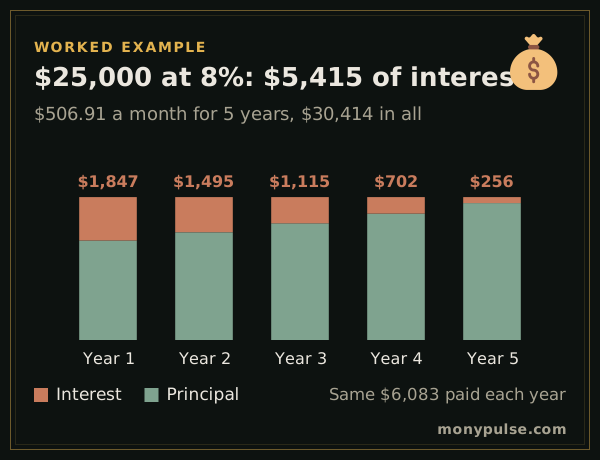
Borrow $25,000 at 8% for five years, which is 60 monthly payments. The payment is $506.91. Over the life of the loan you pay $5,414.59 in interest, or $30,414.59 in all.
The chart above shows where that money goes each year. In year one most of each payment is interest; by the last year almost all of it is principal, because the balance the interest is charged on has shrunk.
Loan payment calculator: how the payment is figured
A fixed-rate installment loan has one payment that never changes. Each month the lender first takes interest on the balance you still owe (the annual rate divided by 12, times the balance), and whatever is left of the payment lowers the balance. The formula above finds the one payment that brings the balance to exactly zero on the final month.
Three things set the payment: how much you borrow, the rate and the number of payments. A longer term lowers the payment but raises the total interest, because you owe money for longer. Try the term box with 3, 5 and 7 years to see the trade-off.
In Excel or Google Sheets, =PMT(rate/12, months, -amount) gives the same monthly payment: =PMT(0.08/12, 60, -20000) returns $405.53 for $20,000 at 8% over five years.
Interest rate or APR?
The interest rate is the price of borrowing the money. The APR adds the fees charged to make the loan, such as an origination fee, so it is usually higher. Federal law requires lenders to show the APR before you sign, which makes it the fairest single number for comparing offers. To see the APR on an offer with a fee, use the personal loan calculator, and to work backward from a quoted payment to its rate, use the interest rate calculator.
Ways to pay less interest
- Choose the shortest term you can afford. The payment goes up, but the total interest falls sharply.
- Pay a little extra. Even $50 a month on a five-year loan trims months off the end.
- Borrow less. A larger down payment cuts interest on every future payment.
- Compare APRs from several lenders rather than taking the first offer.
A calculator for each kind of loan
This calculator covers any fixed-rate installment loan. For loans with their own costs, use the mortgage calculator, the car loan calculator, the student loan calculator or the business loan calculator. For the full month-by-month table with one-time payments, open the amortization calculator.
Assumptions and limits
- The rate is fixed for the whole loan and every payment is made on time, once a month.
- Interest is charged each month on the remaining balance. Loans that charge interest daily can differ by a few dollars.
- Extra payments go straight to principal in the month you make them.
- Fees are not part of the payment. If your lender adds fees to the loan, add them to the loan amount.
Frequently asked questions
How is a monthly loan payment calculated?
The payment comes from the amortization formula M = P × r(1 + r)^n ÷ ((1 + r)^n − 1), where P is the amount borrowed, r is the monthly interest rate and n is the number of payments. It is the one fixed payment that covers each month's interest and pays the balance to zero on the last payment.
Should I enter the interest rate or the APR?
Enter the interest rate to get the payment. The APR adds the lender's fees to the cost and is the better number for comparing offers, but the payment itself is set by the interest rate and the amount you owe.
Does paying extra each month shorten my loan?
Yes. Every extra dollar goes to principal, so less interest builds up afterward and the loan ends sooner. Enter an amount under More options to see the months and the interest you save. Check first that your loan has no prepayment penalty.
Why is so much of my first payment interest?
Interest is charged on the balance, and the balance is largest at the start. As it falls, the interest part of each payment shrinks and more of the same payment goes to principal.
Can I use this for a mortgage or a car loan?
You can, for principal and interest. The mortgage and car loan calculators add the extra costs those loans carry, such as property tax and PMI for a home, or sales tax and a trade-in for a car.
Sources and method
- What is the difference between a loan interest rate and the APR? · Consumer Financial Protection Bureau
- What is amortization and how could it affect my auto loan? · Consumer Financial Protection Bureau
- What is a prepayment penalty? · Consumer Financial Protection Bureau
- Consumer Credit - G.19 · Federal Reserve Board
Formulas and figures checked against these sources on November 12, 2026. The calculator runs entirely in your browser; nothing you type is sent to us or stored. Results are estimates for education, not financial, tax or legal advice, and MonyPulse is not a lender, tax preparer or investment adviser. Found an error? Tell us. See how we build and test our calculators and our editorial standards.