How the Personal Loan calculator works
Monthly payment
M = P × r(1 + r)n ÷ ((1 + r)n − 1)
- P
- the amount you owe: the loan amount, plus the fee if it is added to the loan
- r
- interest rate ÷ 12
- n
- number of monthly payments
APR with the fee
Find the monthly rate i where (cash you receive) = M × (1 − (1 + i)−n) ÷ i; APR = i × 12
Worked example
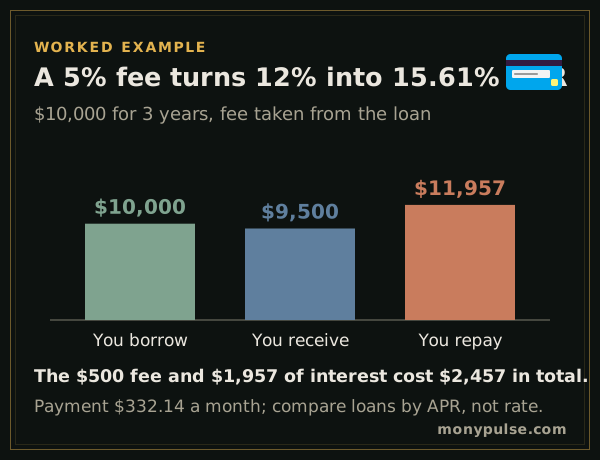
You borrow $10,000 at 12% for three years, and the lender charges a 5% origination fee taken from the loan. The fee is $500.00, so $9,500.00 reaches your account, yet you repay the full $10,000 at $332.14 a month.
Interest over the three years is $1,957.15. Add the fee and the total cost of borrowing is $2,457.15. Measured against the cash you received, that is an APR of 15.61%, well above the 12% rate.
Why the fee matters more on short loans
An origination fee is paid once, at the start. Spread over three years it adds a lot to the yearly cost; spread over seven it adds less. That is why the APR, which counts the fee, is the number to compare. Federal rules require lenders to disclose it before you sign.
Deducted or added?
Most lenders take the fee out of the money they send you. Some add it to the balance instead, so you get the full amount but pay interest on the fee too. Switch “The fee is” between the two to see both. If the fee is deducted and you need a set amount in hand, borrow a little more: the needed amount divided by one minus the fee rate.
How to compare personal loan offers
- Get quotes for the same amount and term from a bank, a credit union and an online lender.
- Enter the best two here and turn on Compare with a second offer.
- Pick the lower total cost of borrowing, as long as the monthly payment fits your budget.
The Federal Reserve’s survey of commercial banks put the average rate on 24-month personal loans between about 11% and 12% in the first half of 2026, and your rate depends heavily on your credit.
If the loan is for paying off debt
A consolidation loan only helps if its APR is lower than what you pay now and you stop adding new balances. Compare your current plan in the debt payoff calculator or the credit card payoff calculator, and check how the new payment affects your debt-to-income ratio.
Assumptions and limits
- A fixed-rate installment loan with equal monthly payments.
- The origination fee is a percentage of the loan amount, either taken from the money you receive or added to what you owe.
- Other fees, such as late fees or optional credit insurance, are not included.
- APR is worked out the way U.S. disclosures do it: the rate at which the payments equal the cash you actually get.
Frequently asked questions
How is a personal loan payment calculated?
It uses the standard installment formula: the loan amount, the monthly interest rate and the number of payments give one fixed payment that covers interest and pays off the balance by the last month.
Why is my APR higher than my interest rate?
When a fee is deducted, you repay the full loan amount but receive less cash. The APR measures the cost against the money you actually got, so a 5% fee on a three-year loan adds more than three points to the APR.
How much should I borrow if the fee is taken out?
Divide what you need by one minus the fee rate. To net $10,000 with a 5% fee deducted, borrow about $10,526.
Is a lower rate always the better offer?
Not always. A loan with a lower rate and a large fee can cost more than one with a higher rate and no fee, especially if you pay it off early. Compare the total cost of borrowing and the APR, which the calculator shows for both offers.
Can I pay a personal loan off early?
Many lenders allow it, but some charge a prepayment penalty, and a deducted origination fee is never refunded. Read the loan agreement before you sign.
Sources and method
- What is a personal installment loan? · Consumer Financial Protection Bureau
- Do personal installment loans have fees? · Consumer Financial Protection Bureau
- What is the difference between a loan interest rate and the APR? · Consumer Financial Protection Bureau
- Consumer Credit - G.19 · Federal Reserve Board
Formulas and figures checked against these sources on November 11, 2026. The calculator runs entirely in your browser; nothing you type is sent to us or stored. Results are estimates for education, not financial, tax or legal advice, and MonyPulse is not a lender, tax preparer or investment adviser. Found an error? Tell us. See how we build and test our calculators and our editorial standards.