McDonald's
McDonald's: The Burger Chain That Is Really a Landlord
In 1956 Ray Kroc was franchising McDonald's and barely making money. A finance man named Harry Sonneborn showed him a different business hiding underneath: own the land, rent it to the franchisees. In 2025 McDonald's collected $10.4 billion in rent.
- Brothers' cut
- 0.5%Brothers' cut. The McDonald brothers' cut of franchise sales under their 1954 deal with Ray Kroc, one sign of how little franchising alone paid.
- Franchise rent
- $10.4BFranchise rent. Rent McDonald's collected from franchised restaurants in 2025, against $6.0 billion in royalties, per its annual report.
In this story · 6 chapters
The short answer
In part. McDonald's is a franchisor that also acts as a landlord: under its usual model it owns or leases the land and building, and franchisees pay rent plus royalties. The idea came from Harry Sonneborn, a finance man Ray Kroc hired in 1956. In 2025 rent brought in $10.4 billion of its $16.5 billion in franchised revenue.
By 1956, Ray Kroc had the right to sell McDonald’s franchises almost anywhere in the United States, and he was selling them. What he didn’t have was much money.
The problem was the deal itself. Under the agreement Kroc signed with Richard and Maurice McDonald in 1954, franchisees paid a percentage of their sales, and the brothers took 0.5% of gross sales for themselves. Kroc’s company kept what was left of a thin slice. A percentage of cheap hamburgers did not build a company fast, and it gave Kroc little hold over franchisees who didn’t follow his rules.
Then he met Harry Sonneborn.
The finance man
Sonneborn had started out in New York’s garment district and worked his way up to vice president of finance at Tastee-Freez, the soft-serve chain. He looked at McDonald’s and saw a different business underneath the one Kroc thought he was running.
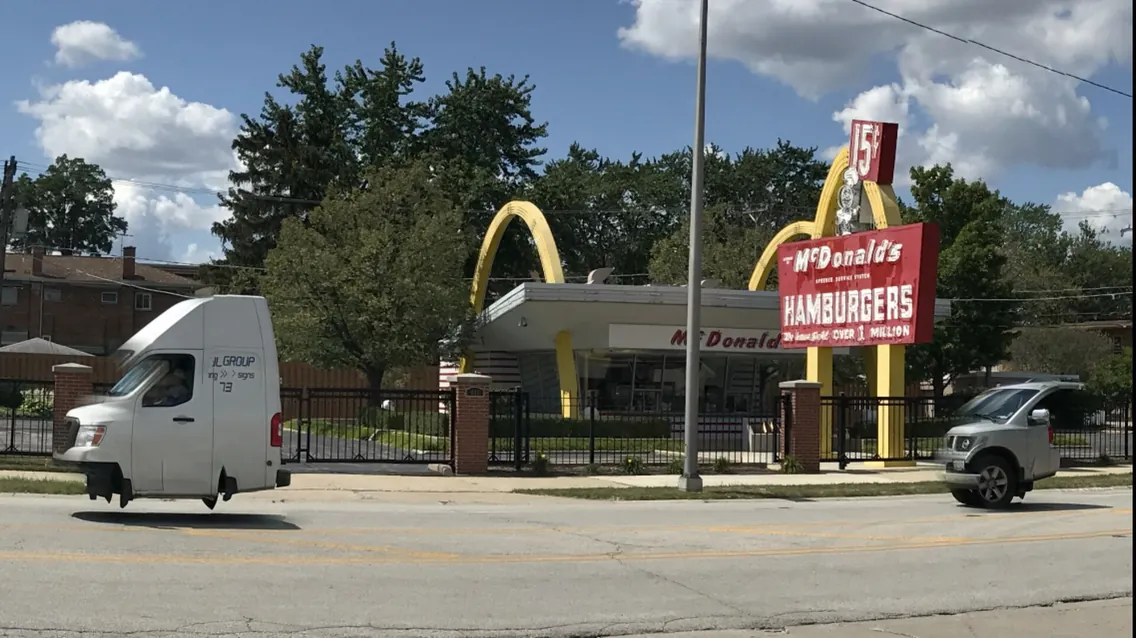
His proposal was for McDonald’s to control the real estate on which future restaurants would be built. Kroc hired him, and they set up a separate company to do it: Franchise Realty Corporation.
The mechanics were simple. Franchise Realty signed leases on suitable sites, or took out mortgages to buy them, covering both the land and the building. Then it rented the property to the franchisee, passing on its costs with a markup of 20% to 40%. To make the offer easier to accept, the initial deposit franchisees paid was cut to $950.
Why the rent mattered
The change turned McDonald’s from a collector of small royalties into a landlord. Rent had big advantages over a percentage of hamburger sales.
It was more predictable. A royalty depends on how many burgers a restaurant sells. A lease comes with a minimum payment, whatever the month brings.
It gave McDonald’s leverage. A franchisee who rented the land from the company could not easily ignore the company’s standards. A lease could end. A royalty agreement offered no such hold.
And it gave McDonald’s assets. Land is something banks will lend against. A franchising company with nothing but contracts is not. Sonneborn told skeptical bankers that McDonald’s was really in the real estate business, not the shaky restaurant trade. A line attributed to him in John F. Love’s history of the company put it more bluntly: “We are not technically in the food business.”
Money against the land
The bankers began to listen. By 1959 Kroc had opened more than 100 restaurants. Sonneborn then raised $1.5 million from three insurance companies, State Mutual Life, Paul Revere Life and Massachusetts Protective, as an unsecured 15-year loan at 7%. The price of the money was steep: the lenders also received 22.5% of the company’s stock.
The pattern was set. McDonald’s would find a site, buy it on a 10-year contract, persuade the landowner to stand behind a building loan, and rent the finished restaurant to a franchisee. Each new restaurant added rent, and each property added something to borrow against.
Buying the name
The model also helped pay for the brand itself. By 1960, McDonald’s restaurants were grossing $56 million a year, but Kroc still didn’t own the name, and his relationship with the brothers had soured.
In 1961 Kroc asked Dick McDonald to name a price. The answer was $2.7 million in cash: $1 million for each brother after taxes, and $700,000 for the government. It was far more than Kroc had.
He did not have the money. Sonneborn found it, in a loan from a group of college endowment funds. The terms were punishing: 6% a year in interest, plus half a percent of the gross sales of every McDonald’s restaurant until the debt was repaid. “The $2.7 million ended up costing me $14 million,” Kroc told TIME in 1973. He thought it was worth it. He needed the name and the golden arches.
The deal has a famous footnote. Some accounts, and the 2016 film The Founder, say Kroc also promised the brothers an ongoing royalty on a handshake that was never written into the contract and never paid. The signed agreement was for the $2.7 million.
The landlord today
Seven decades later, the structure Sonneborn designed is still the core of the business. McDonald’s annual report for 2025 counts 45,356 restaurants worldwide at year end, about 95% of them franchised. Under its conventional franchise arrangement, the company says, it “generally owns or secures a long-term lease on the land and building,” while the franchisee pays for equipment, signs, seating and decor.
The money follows the property. In 2025 McDonald’s reported $16.5 billion in revenue from franchised restaurants. Of that, $10.442 billion was rent and $6.018 billion was royalties. Rent was the bigger stream by a wide margin.
The balance sheet tells the same story. At the end of 2025 McDonald’s carried $8.169 billion of land at cost, plus $22.2 billion in buildings and improvements on land it owns.
What the record shows
- The asset under the business can be worth more than the business. Hamburgers paid the rent. The land under the restaurants kept its value whether or not any one restaurant did.
- Fixed income beats a thin percentage. Swapping a slice of sales for a lease with minimum rent made McDonald’s income stable enough to borrow against.
- Ownership is control. A franchisee who rents from the franchisor follows the franchisor’s standards.
- Finance can be the real invention. The McDonald brothers invented the fast kitchen. Kroc spread it. Sonneborn’s financial structure is what made the company rich.
Other stories in this archive turn on the same quiet decision. Michael Bloomberg built a business on monthly fees that customers kept paying. Trader Joe’s won by rethinking the economics of a store, not its products. In each case the money came from how the business was structured.
 217 of 242Read nextHoward Schultz Bought Starbucks for $3.8 MillionHoward Schultz was turned down by 217 of the 242 investors he asked to back his first coffee bar. Then Starbucks' founders offered him their six stores for $3.8 million, and a rival investor tried to take the deal. In fiscal 2025 Starbucks had revenue of $37.2 billion.Starbucks · 4 min read
Questions readers ask
- Is McDonald's a real estate company?
- It is a franchisor that also acts as a landlord. Under its conventional franchise model, McDonald's generally owns or leases the land and building, and franchisees pay rent plus royalties. In 2025 rent was $10.4 billion of its $16.5 billion in franchised revenue.
- Who came up with McDonald's real estate model?
- Harry J. Sonneborn, a former Tastee-Freez finance executive whom Ray Kroc hired in 1956. He set up Franchise Realty Corp. to lease or buy restaurant sites and rent them to franchisees.
- How much did Ray Kroc pay the McDonald brothers?
- $2.7 million in 1961. Kroc did not have the money himself; Harry Sonneborn raised it.
- How much of McDonald's revenue comes from rent?
- In 2025 McDonald's reported $10.442 billion in rent and $6.018 billion in royalties from franchised restaurants, out of total revenue of about $26.9 billion.
Run the numbers yourself
- Profit Margin CalculatorTurn cost and price into profit, margin and markup, or find the price that hits a target margin.
- Passive Income CalculatorTurn savings into yearly and monthly income, or find the capital needed for an income target.
- Mortgage CalculatorEstimate the monthly payment with taxes, insurance, HOA and PMI, plus the full amortization schedule.
People and companies in this story
People
- Ray Kroc
- Harry Sonneborn
- Richard McDonald
- Maurice McDonald
Companies
- McDonald's
- Franchise Realty Corp.
- Tastee-Freez
This story is on these lists
Share this story
Send the link to someone who would like this story, or keep it for later.
The timeline
Drawn to scale: the gaps are the years in between. Choose a year.
Sources & further reading 8
- FOOD: The Burger That Conquered the CountryTIME, September 1973
- Kroc, Raymond Albert (Ray)Encyclopedia.com (Scribner Encyclopedia of American Lives)
- The secret Jewish history of McDonald'sThe Forward, 2017
- The Jewish history of McDonald'sMy Jewish Learning
- McDonald's Corporation Form 10-K for fiscal year 2025US Securities and Exchange Commission
- McDonald's Corporation Form 10-Q, second quarter 2025US Securities and Exchange Commission
- Ray Kroc: not the founder but a financial engineerRestaurant Finance Monitor
- McDonald's Corporation: A Real Estate Empire Financed by French FriesThe Motley Fool
Spot an error? Send a correction. Corrections are dated and noted here.
Photographs are credited under each picture; licenses are listed on the image credits page.