How the Business Loan calculator works
Payment on a term loan
Payment = P × i(1 + i)n ÷ ((1 + i)n − 1)
- i
- annual rate ÷ payments per year
- n
- number of payments
Factor rate financing
Total repaid = Amount × Factor rate; Payment = Total repaid ÷ number of payments
APR
The yearly rate at which the payments equal the cash you actually receive
Worked example
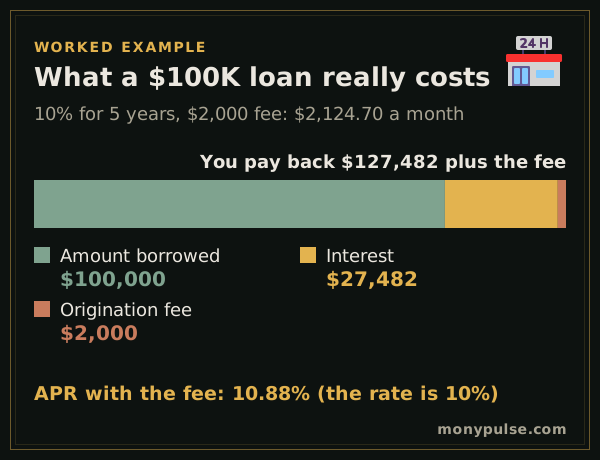
A $100,000 term loan at 10% for 5 years with monthly payments costs $2,124.70 a month. Over the term you pay $27,482 in interest. A 2% fee ($2,000) taken at closing means you receive less cash, so the APR is 10.88%.
Switch to Factor rate to compare a $100,000 cash advance at a 1.3 factor repaid over 12 months in business-day payments. You repay $130,000, about $516 every business day, and the equivalent APR is roughly 55%, several times the term loan’s cost.
Interest rate or factor rate?
Banks, credit unions and SBA lenders quote an interest rate, and the cost falls if you pay early. Merchant cash advances and many online short-term lenders quote a factor rate, a fixed fee that stays the same however fast you repay. Short terms and frequent payments make a factor rate far more expensive than it looks, which is why converting it to an APR is the best way to compare offers.
Check the cash flow
Daily or weekly payments come out of your account long before most customers pay you. The results show the monthly cash needed for payments; make sure your slowest months can cover it.
Related calculators
To see whether a loan-funded expansion pays off, use the break-even calculator and the ROI calculator. For a full schedule of any fixed loan, open the amortization calculator, and to value a business you plan to buy with the loan, try the business valuation calculator.
Assumptions and limits
- Fixed payments on a fixed schedule. Many merchant cash advances collect a share of daily card sales instead, so their real term and APR vary with your sales.
- Fees are paid at closing and taken from the loan amount.
- Daily payments are counted on business days, about 252 a year.
Frequently asked questions
How is a business loan payment calculated?
Like any installment loan: the amount, the rate per payment period and the number of payments set one fixed payment that covers interest and pays the loan off by the end of the term.
What is a factor rate?
A multiplier used to price merchant cash advances and some short-term loans. A 1.3 factor rate on $100,000 means you repay $130,000. The fee is fixed, so repaying faster doesn't lower it.
How do I convert a factor rate to an APR?
Spread the total repayment over the actual payment schedule and find the yearly rate that matches it. Because the fee is charged up front on a short term, a 1.3 factor repaid over a year in daily payments works out to an APR above 50%.
What are SBA loan rates?
SBA 7(a) loans have maximum interest rates set by the SBA as a spread over a base rate, which depends on the loan size and whether the rate is fixed or variable. Lenders can charge less. Check the SBA's current terms for the caps.
Why does the APR differ from the interest rate on a term loan?
Upfront fees reduce the money you receive while the payments stay the same, so the true yearly cost, the APR, is higher than the stated rate.
Sources and method
- 7(a) loans · U.S. Small Business Administration
- 7(a) loan terms for SBA lenders · U.S. Small Business Administration
- What is the difference between a loan interest rate and the APR? · Consumer Financial Protection Bureau
Formulas and figures checked against these sources on November 11, 2026. The calculator runs entirely in your browser; nothing you type is sent to us or stored. Results are estimates for education, not financial, tax or legal advice, and MonyPulse is not a lender, tax preparer or investment adviser. Found an error? Tell us. See how we build and test our calculators and our editorial standards.