How the Revenue calculator works
Revenue
Revenue = Average price × Units sold × (1 − returns and discounts)
Subscription revenue
MRR = Paying customers × Monthly price; ARR = MRR × 12
Customers next month
Customers = Customers × (1 − churn) + New customers
- Churn
- share of customers who cancel each month
Worked example
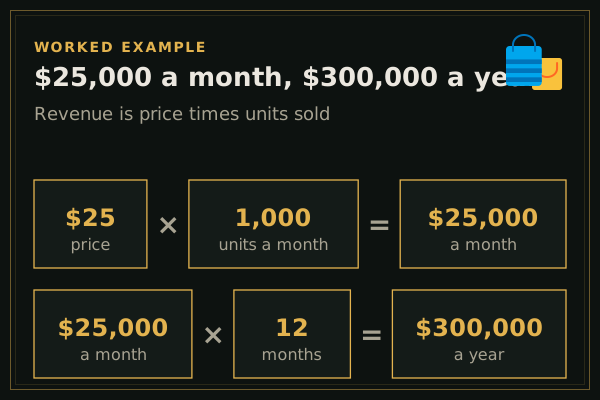
A shop sells about 1,000 items a month at an average price of $25.00. Its revenue is $25,000 a month, or $300,000 a year. If 5% of sales are returned or discounted, enter that under More options to see net revenue.
In subscription mode, 500 customers paying $30 a month bring in $15,000 of monthly recurring revenue, a $180,000 annual run rate. With 50 new customers a month and 3% churn, MRR keeps rising for the next year and levels off once cancellations match sign-ups.
Gross and net revenue
Gross revenue is total sales at the prices charged. Net revenue subtracts returns, refunds and discounts, which is the figure that ends up in your income statement and on a tax return as gross receipts less returns. Use net revenue when you compare months or plan costs.
Growth and churn
A monthly growth rate compounds: 5% a month is about 80% over a year, not 60%. For subscriptions, the number to watch is churn. Cutting churn from 5% to 3% a month raises the average customer’s lifetime from 20 months to about 33, which is often worth more than a price increase.
Related calculators
Revenue is only the first line. Turn it into profit with the profit calculator, find the sales volume that covers your costs with the break-even calculator, and see what a buyer might pay for the business with the business valuation calculator.
Assumptions and limits
- Price and sales volume are averages; seasonal swings are not modeled unless you set a monthly growth rate.
- In subscription mode, every customer pays the same monthly price and cancellations happen at a steady rate.
- Revenue is the money brought in from sales before any costs. It is not profit.
Frequently asked questions
How do you calculate revenue?
Multiply the average selling price by the number of units sold. Selling 1,000 items a month at $25 each brings in $25,000 a month, or $300,000 a year.
What is the difference between revenue and profit?
Revenue is everything customers pay you. Profit is what remains after costs. A business can grow revenue and still lose money, so pair this with the profit calculator.
What are MRR and ARR?
Monthly recurring revenue is the subscription revenue you can expect every month from current customers. Annual run rate, often called ARR, is MRR times 12.
How does churn affect revenue?
Each month you lose a share of customers. With 3% monthly churn, the average customer stays about 33 months. If you add 50 customers a month, the base levels off around 50 ÷ 0.03, or about 1,667 customers.
Should revenue include sales tax?
No. Sales tax collected belongs to the state; it isn't your revenue. Use your prices before tax.
Sources and method
- Beginners' Guide to Financial Statements · U.S. Securities and Exchange Commission
- About Schedule C (Form 1040), Profit or Loss from Business · Internal Revenue Service
Formulas and figures checked against these sources on November 11, 2026. The calculator runs entirely in your browser; nothing you type is sent to us or stored. Results are estimates for education, not financial, tax or legal advice, and MonyPulse is not a lender, tax preparer or investment adviser. Found an error? Tell us. See how we build and test our calculators and our editorial standards.