How the Discount calculator works
Sale price
Sale price = Original price × (1 − Discount)
Two discounts in a row
Final = Original × (1 − D_{1}) × (1 − D_{2}); total discount = 1 − (1 − D_{1})(1 − D_{2})
Percent off
Percent off = (Original − Sale) ÷ Original × 100
Worked example
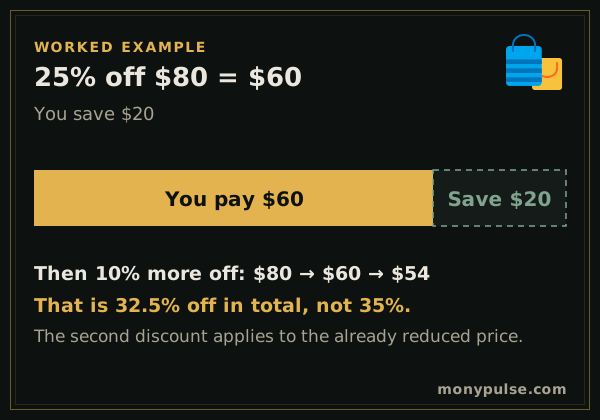
A jacket marked $80.00 is 25% off. The sale price is $60.00 and you save $20.00.
If the store takes another 10% off at checkout, you pay $54.00 on the $80 jacket. That is a total discount of 32.5%, not 35%, because the second discount is taken from the lower price.
How to calculate a discount in your head
Find 10% by moving the decimal point one place, then build from it: 10% of $80 is $8, so 20% is $16 and 25% is $20, a quarter of the price. To get the sale price in one step, multiply by the share you keep: 25% off means you pay 75%, and $80 × 0.75 = $60.
| Discount | You pay | $50 item | $80 item | $120 item |
|---|---|---|---|---|
| 10% | 90% | $45.00 | $72.00 | $108.00 |
| 20% | 80% | $40.00 | $64.00 | $96.00 |
| 25% | 75% | $37.50 | $60.00 | $90.00 |
| 30% | 70% | $35.00 | $56.00 | $84.00 |
| 40% | 60% | $30.00 | $48.00 | $72.00 |
| 50% | 50% | $25.00 | $40.00 | $60.00 |
To find the percent off from two prices, divide the savings by the original price: a $120 item on sale for $84 is ($120 − $84) ÷ $120 = 30% off.
Is it really a deal?
A percent off is only as good as the original price it starts from. Federal Trade Commission guides say a “former price” used in a sale should be one the item was actually offered at for a reasonable time. Comparing the sale price with what other stores charge is the surest check, and the percent-off mode lets you measure any two prices.
For sellers: discounts and margin
A discount comes straight out of your profit. On a product with a 40% margin, a 25% discount cuts the profit on each sale from $40 to $15 per $100 of list price, so you would need more than two and a half times as many sales to earn the same profit. Check the effect with the profit margin calculator and the break-even calculator.
Related calculators
To add your state’s tax to a purchase, use the sales tax calculator. For pricing from cost, use the markup calculator.
Assumptions and limits
- The second discount applies to the already reduced price, as stores usually apply an extra percent off.
- Sales tax is added after the discount, which is how most states tax sale prices.
Frequently asked questions
How do I calculate a percent off?
Multiply the price by the discount and subtract it, or multiply the price by one minus the discount. 25% off $80 is $80 × 0.75 = $60, a $20 saving.
Is 25% off plus an extra 10% off the same as 35% off?
No. The extra 10% comes off the already reduced price, so the total discount is 32.5%. On an $80 item you pay $54, not $52.
How do I find the percent off from two prices?
Subtract the sale price from the original price and divide by the original. A drop from $80 to $60 is a $20 saving, or 25% off.
Is the discount taken before or after sales tax?
Store discounts are usually taken before tax, so you also pay less tax. Manufacturer coupons are taxable in some states. Add your rate under More options to see the total.
Sources and method
- Part 233, Guides Against Deceptive Pricing · Federal Trade Commission, Electronic Code of Federal Regulations
Formulas and figures checked against these sources on November 11, 2026. The calculator runs entirely in your browser; nothing you type is sent to us or stored. Results are estimates for education, not financial, tax or legal advice, and MonyPulse is not a lender, tax preparer or investment adviser. Found an error? Tell us. See how we build and test our calculators and our editorial standards.