How the Profit calculator works
Gross profit
Gross profit = Revenue − Cost of goods sold
Operating profit (EBIT)
Operating profit = Gross profit − Operating expenses
Net profit
Net profit = Operating profit − Interest + Other income − Income tax
- Margin
- each profit ÷ revenue × 100
Worked example
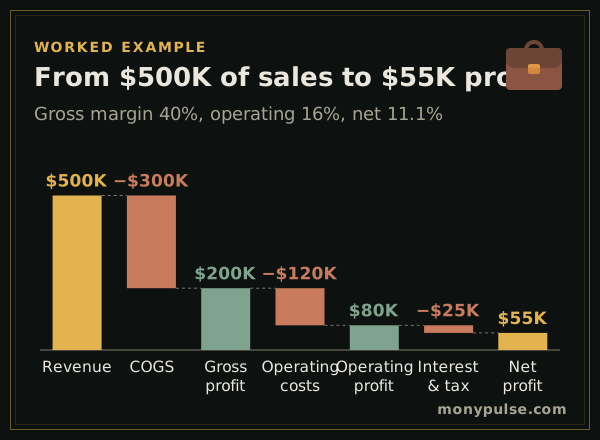
A business with $500,000 in revenue and $300,000 in cost of goods sold has a gross profit of $200,000, a 40% gross margin. After $120,000 of operating expenses, operating profit is $80,000 (16% of revenue).
Subtract $10,000 of interest and profit before tax is $70,000. At a 21% tax rate the tax is $14,700, leaving a net profit of $55,300, a net margin of 11.1%.
Three kinds of profit, three questions
- Gross profit answers: do we make money on what we sell? If it is thin, look at pricing and supplier costs.
- Operating profit answers: does the business as a whole pay its way? If gross profit is fine but operating profit isn’t, overhead is the problem.
- Net profit answers: what is left for the owners after lenders and the tax authorities are paid?
The results show each one in dollars and as a share of revenue, the way an income statement lays them out.
Gross, operating and net profit on one page
Many people search separately for a gross profit calculator, an operating profit calculator and a net profit calculator, but they are steps in the same calculation. Keeping them together makes it easy to see which step is eating your profit.
Related calculators
For the margin on a single product, use the profit margin calculator. To work out the cost of goods sold from your inventory, use the cost of goods sold calculator, and to see what the business could sell for based on its earnings, try the business valuation calculator.
Assumptions and limits
- Figures cover the same period, such as a year or a quarter.
- Tax is a flat rate on profit before tax and is zero when there is a loss. Real tax depends on the business structure, deductions and credits.
- Depreciation and amortization belong in operating expenses.
Frequently asked questions
How do you calculate net profit?
Start with revenue, subtract the cost of goods sold to get gross profit, subtract operating expenses to get operating profit, then subtract interest and taxes and add any other income. What remains is net profit, the bottom line.
What is the difference between gross profit and net profit?
Gross profit only removes the direct cost of what you sold. Net profit removes everything: overhead, interest and taxes. A business can have a strong gross profit and still lose money if its overhead is too high.
What is operating profit?
Profit from the business's main activity before interest and taxes, also called operating income or EBIT. It shows how well the business runs regardless of how it is financed.
What tax rate should I use?
C corporations pay a 21% federal income tax rate, plus any state tax. Sole proprietors, partnerships and S corporations don't pay income tax at the business level; the owners pay it on their personal returns, so you can enter 0 to see pre-tax results.
What is a good net profit margin?
It depends on the industry. Low-margin businesses like grocery stores may earn a few percent; software and professional services can earn much more. Track your own margin over time and against similar businesses.
Sources and method
- Beginners' Guide to Financial Statements · U.S. Securities and Exchange Commission
- Publication 334, Tax Guide for Small Business · Internal Revenue Service
Formulas and figures checked against these sources on November 11, 2026. The calculator runs entirely in your browser; nothing you type is sent to us or stored. Results are estimates for education, not financial, tax or legal advice, and MonyPulse is not a lender, tax preparer or investment adviser. Found an error? Tell us. See how we build and test our calculators and our editorial standards.