How the Business Valuation calculator works
Earnings or revenue multiple
Value = Yearly earnings (or revenue) × Multiple
- SDE
- seller’s discretionary earnings: profit before tax plus the owner’s salary and perks, interest, depreciation and one-time costs
- EBITDA
- earnings before interest, taxes, depreciation and amortization, after paying a market salary to management
Discounted cash flow
Value = Σ CF_{t} ÷ (1 + r)t + [CF_{5} × (1 + g) ÷ (r − g)] ÷ (1 + r)5
- CF
- free cash flow in each of the next five years
- r
- discount rate: the yearly return a buyer requires
- g
- long-term growth rate after year five
Value to the owner
Equity value = Business value − debt paid off + extra cash
Worked example
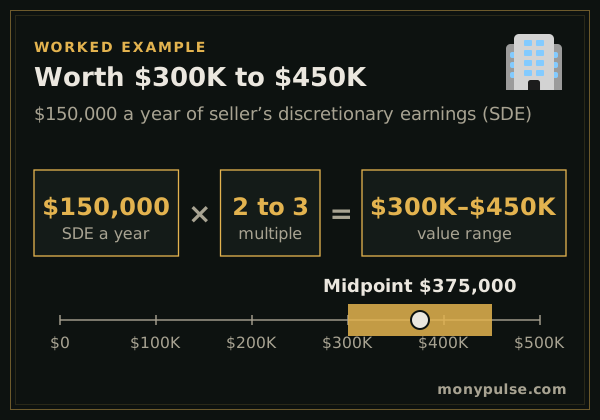
An owner-run business earns $150,000 a year in seller’s discretionary earnings. At multiples of 2 to 3 times SDE, it would be valued at $300,000 to $450,000, with a midpoint of $375,000. If the owner has a loan that must be paid off at closing, enter it under More options to see what the owner would actually keep.
Switch to the discounted cash flow method and the same business, with $120,000 of free cash flow growing 5% a year and a 20% discount rate, is worth about $745,000, and roughly half of that comes from the years after year five. That gap shows why the method and its assumptions matter.
Three methods, three viewpoints
- Earnings multiple: the most common shortcut for small businesses. It reflects what buyers have paid for similar earnings.
- Revenue multiple: used for businesses with thin or uneven profits, such as fast-growing software firms, but it ignores how much of the revenue becomes profit.
- Discounted cash flow: values the business on the cash it will produce, adjusted for risk through the discount rate. It works best when cash flow is steady and well understood.
Comparing two or three methods gives a more honest range than any single number.
What raises or lowers value
Buyers pay more for growing revenue, many small customers instead of a few big ones, recurring revenue, clean financial records and a business that runs without the owner. They pay less when the owner is the business, when sales depend on one client or when the books are unclear.
Related calculators
Build the earnings figure from your income statement with the profit calculator. If you are buying, check the loan payment with the business loan calculator, and compare the expected return with other investments using the ROI calculator.
Assumptions and limits
- This is an estimate to start a conversation, not an appraisal. Buyers, lenders and the IRS rely on qualified appraisers.
- Multiples differ widely by industry, size, growth, customer concentration and how much the business depends on the owner. Enter a range that fits sales of similar businesses.
- The DCF uses five years of cash flow growing at one rate, then steady growth forever. Small changes in the discount rate change the result a lot, which the results show.
Frequently asked questions
How do you value a small business?
Most small businesses are priced as a multiple of their earnings. Owner-run businesses usually use seller’s discretionary earnings (SDE); larger firms with professional managers use EBITDA. Buyers also check the value against the assets and a cash-flow forecast.
What multiple should I use?
There is no single answer. Small owner-operated businesses often sell for low single-digit multiples of SDE, while larger, growing companies command higher EBITDA multiples. Look at recent sales of similar businesses in your industry, or ask a business broker or appraiser.
What is SDE?
Seller’s discretionary earnings: the total cash benefit one owner-operator gets from the business. Start with pre-tax profit, then add back the owner’s salary and personal perks, interest, depreciation and one-time expenses.
When is a discounted cash flow better?
When the business has predictable cash flow you can forecast, or when it is growing too fast for today's earnings to show its value. It is very sensitive to the discount rate, so test a range.
Do I need a professional valuation to sell or buy with an SBA loan?
Often, yes. SBA lenders must get an independent business valuation for many change-of-ownership loans, and an appraisal is also used for estates, gifts and partner buyouts.
Sources and method
- Plan your business · U.S. Small Business Administration
- Beginners' Guide to Financial Statements · U.S. Securities and Exchange Commission
Formulas and figures checked against these sources on November 11, 2026. The calculator runs entirely in your browser; nothing you type is sent to us or stored. Results are estimates for education, not financial, tax or legal advice, and MonyPulse is not a lender, tax preparer or investment adviser. Found an error? Tell us. See how we build and test our calculators and our editorial standards.