How the Paycheck calculator works
Take-home pay
Net pay = Gross pay − federal income tax − Social Security − Medicare − state tax − 401(k) − benefits − other deductions
Payroll taxes
Social Security = 6.2% of wages up to $184,500 (2026); Medicare = 1.45% of all wages + 0.9% above $200,000
Federal income tax
Tax on (yearly wages − 401(k) − pre-tax benefits − standard deduction), less child credits, ÷ paychecks per year
Worked example
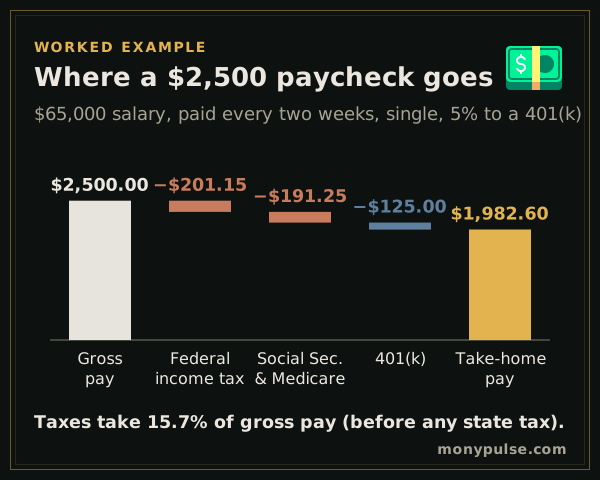
On a $65,000 salary paid every two weeks, each paycheck starts at $2,500.00. A single filer putting 5% into a 401(k) pays about $201.15 in federal income tax and $191.25 in Social Security and Medicare per check, and $125.00 goes to the 401(k).
That leaves $1,982.60 per paycheck, or $51,548 a year, before any state income tax. All taxes together take 15.7% of gross pay.
Take-home pay calculator: what comes out of every paycheck
Used as a take-home pay after taxes calculator, it subtracts these from your gross pay:
- Federal income tax depends on your pay, filing status and W-4. It follows the 2026 brackets of 10% to 37%, applied to income above the standard deduction.
- Social Security is 6.2% of wages, up to $184,500 of pay in 2026. Above that, it stops for the rest of the year.
- Medicare is 1.45% of all wages, plus 0.9% on wages over $200,000.
- State and local taxes range from nothing to more than 10% depending on where you live and work.
- Deductions such as 401(k) contributions, health insurance and HSA payments come out before or after tax depending on the type.
Take-home pay on common salaries in 2026
On a $65,000 salary in 2026, a single filer with no state income tax and no pre-tax deductions takes home about $54,408 a year, or $2,092.60 every two weeks. Federal income tax takes $5,620 of the $65,000, and Social Security and Medicare take $4,973 between them.
| Salary | Single: take-home per year | Single: per biweekly check | Married filing jointly: take-home per year |
|---|---|---|---|
| $40,000 | $34,320 | $1,320.00 | $36,160 |
| $50,000 | $42,355 | $1,629.04 | $44,395 |
| $60,000 | $50,390 | $1,938.08 | $52,570 |
| $65,000 | $54,408 | $2,092.60 | $56,588 |
| $75,000 | $61,593 | $2,368.94 | $64,623 |
| $85,000 | $68,628 | $2,639.52 | $72,658 |
| $100,000 | $79,180 | $3,045.38 | $84,710 |
| $125,000 | $96,704 | $3,719.37 | $104,798 |
| $150,000 | $113,791 | $4,376.58 | $123,185 |
Worked out with this calculator for the 2026 tax year: standard deduction, no state or local income tax (as in Texas or Florida), no 401(k), health insurance or other deductions, paid every two weeks; the married column assumes one earner. In a state with an income tax, enter its rate above and the take-home pay drops by roughly that share of your pay. A traditional (pre-tax) 401(k) contribution lowers take-home pay by less than the amount you put in, because it also lowers your income tax.
Payroll tax rates behind every paycheck
| Tax | Employee | Employer | Wage limit |
|---|---|---|---|
| Social Security | 6.2% | 6.2% | $184,500 in 2026 |
| Medicare | 1.45% | 1.45% | None |
| Extra Medicare | 0.9% | — | Over $200,000 |
| Federal unemployment | — | 0.6% | First $7,000 |
| State unemployment | Usually none | Set by state | Set by state |
The Social Security wage limit rises to $192,300 in 2027. Federal unemployment tax (FUTA) is 6% before a credit of up to 5.4% for state unemployment tax paid on time, which leaves 0.6%. Source: IRS Publication 15 and SSA.
Biweekly paycheck calculator and other pay schedules
Whatever the schedule, the last line is the same: take-home pay after taxes and deductions, the number that lands in your bank account.
Choose weekly, biweekly, semimonthly or monthly to see the same salary split into each schedule. The table under the results lists every item per paycheck, per month and per year, which helps when you build a monthly budget from a biweekly paycheck.
Related calculators
To see your whole year’s federal tax, brackets and effective rate, use the income tax calculator. If you’re paid by the hour, the hourly to salary calculator converts your wage, and to plan where your take-home pay goes, try the budget calculator.
Assumptions and limits
- Federal tax is figured on your full year's pay with the standard deduction and the IRS brackets, then spread evenly over your paychecks. That matches the withholding on an up-to-date 2020-or-later Form W-4 for one job.
- State and local tax is the flat rate you enter applied to taxable wages. State rules vary widely; check your state's tables for exact withholding.
- Pre-tax health, HSA and FSA payments reduce wages for all taxes; traditional 401(k) contributions reduce income tax but not Social Security or Medicare.
- Overtime, bonuses, tips and second jobs are not included.
Frequently asked questions
How much is my take-home pay?
Start from your gross pay per paycheck and subtract federal income tax, 7.65% for Social Security and Medicare, any state income tax, and deductions such as 401(k) contributions and health insurance. On a $65,000 salary paid every two weeks with 5% to a 401(k), a single filer takes home about $1,983 per paycheck before state tax.
What is the difference between gross pay and net pay?
Gross pay is what you earn before anything is taken out. Net pay, or take-home pay, is what lands in your bank account after taxes and deductions.
Why is my biweekly paycheck different from half my monthly pay?
There are 26 biweekly paychecks a year but only 24 semimonthly ones, so each biweekly check is smaller, and twice a year you get a third paycheck in a month.
How can I take home more pay?
Check that your W-4 matches your situation; claiming dependents lowers withholding. Pre-tax benefits and 401(k) contributions cut income tax now, though 401(k) money is taxed later when withdrawn.
Does this include state tax?
Only if you enter a rate. Nine states don't tax wages: Alaska, Florida, Nevada, New Hampshire, South Dakota, Tennessee, Texas, Washington and Wyoming. For others, use your effective state rate.
Sources and method
- Publication 15-T, Federal Income Tax Withholding Methods · Internal Revenue Service
- IRS releases tax inflation adjustments for tax year 2026, including amendments from the One, Big, Beautiful Bill · Internal Revenue Service
- Topic no. 751, Social Security and Medicare withholding rates · Internal Revenue Service
- Contribution and Benefit Base · Social Security Administration
Formulas and figures checked against these sources on November 12, 2026. The calculator runs entirely in your browser; nothing you type is sent to us or stored. Results are estimates for education, not financial, tax or legal advice, and MonyPulse is not a lender, tax preparer or investment adviser. Found an error? Tell us. See how we build and test our calculators and our editorial standards.