How the Payroll Tax calculator works
Social Security and Medicare (FICA)
Each side pays 6.2% of wages up to $184,500 (2026) + 1.45% of all wages; employees pay 0.9% more on wages over $200,000
Federal unemployment (FUTA)
FUTA = 6.0% × first $7,000 of wages − 5.4% state credit = 0.6% × first $7,000
State unemployment (SUTA)
SUTA = State rate × wages up to the state's wage base
Worked example
An employee earns $60,000 a year. The employer pays $3,720 of Social Security tax and $870 of Medicare tax, $42 of federal unemployment tax and $189 of state unemployment tax at a 2.7% rate on the first $7,000. That is $4,821 in employer payroll taxes, so the employee costs $64,821 a year before benefits.
From the employee’s pay, $4,590 is withheld for Social Security and Medicare, the same 7.65% the employer pays, plus income tax withholding.
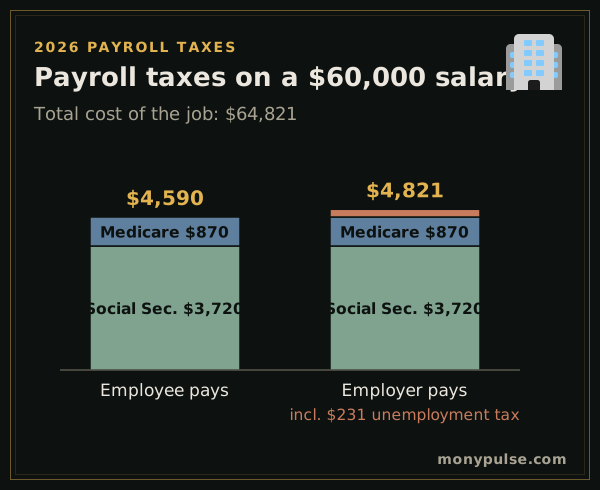
Employer vs employee taxes
Social Security and Medicare are split evenly: the employer pays 7.65% and withholds 7.65% from the employee. Unemployment taxes are paid by the employer alone in most states. The Additional Medicare Tax of 0.9% on wages over $200,000 is withheld from the employee only, with no employer match.
Budgeting for a new hire
Before hiring, budget for wages plus roughly 8% to 10% in payroll taxes, plus benefits and insurance. Use the per-paycheck view to plan cash flow for each pay period, and multiply by the number of employees at the same pay to see the total.
Payroll tax rates for 2026 and 2027
| Tax | Employee | Employer | Wage limit |
|---|---|---|---|
| Social Security | 6.2% | 6.2% | $184,500 in 2026 |
| Medicare | 1.45% | 1.45% | None |
| Extra Medicare | 0.9% | — | Over $200,000 |
| Federal unemployment | — | 0.6% | First $7,000 |
| State unemployment | Usually none | Set by state | Set by state |
The Social Security wage limit rises to $192,300 in 2027. Federal unemployment tax (FUTA) is 6% before a credit of up to 5.4% for state unemployment tax paid on time, which leaves 0.6%. Source: IRS Publication 15 and SSA.
Related calculators
For the employee’s side, including income tax withholding and take-home pay, use the paycheck calculator. If you are self-employed and pay both halves yourself, use the self-employment tax calculator, and to see how a new hire affects the business, try the break-even calculator.
Assumptions and limits
- The employer gets the full 5.4% FUTA credit for paying state unemployment tax on time. Employers in states with credit reductions pay more.
- State unemployment rates and wage bases vary by state and by employer; enter the ones on your state notice.
- Income tax withholding is the employee's tax and is not an employer cost; it is covered by the paycheck calculator.
- Some states add employee or employer taxes for disability, family leave or training funds, which are not included.
Frequently asked questions
How much are payroll taxes for an employer?
At least 7.65% of wages for Social Security and Medicare, plus federal unemployment of up to $42 per employee a year and state unemployment. On a $60,000 salary that is about $4,821 a year with a 2.7% state rate on the first $7,000.
What payroll taxes come out of an employee's paycheck?
Social Security at 6.2% up to the yearly wage base, Medicare at 1.45% plus 0.9% on wages over $200,000, and federal, state and local income tax withholding.
What is the Social Security wage base for 2026?
$184,500. Social Security tax stops for the rest of the year once an employee's wages pass it; Medicare tax continues on all wages.
How much does an employee really cost?
Wages plus employer payroll taxes, plus benefits such as health insurance, retirement contributions and workers' compensation insurance. Payroll taxes alone usually add about 8% to 10% to wages.
When do employers pay payroll taxes?
Withheld taxes and the employer's share are deposited on a monthly or semiweekly schedule, reported quarterly on Form 941, with FUTA reported yearly on Form 940.
Sources and method
- Publication 15 (Circular E), Employer's Tax Guide · Internal Revenue Service
- Topic no. 759, Form 940, Employer's Annual Federal Unemployment (FUTA) Tax Return · Internal Revenue Service
- Contribution and Benefit Base · Social Security Administration
Formulas and figures checked against these sources on November 11, 2026. The calculator runs entirely in your browser; nothing you type is sent to us or stored. Results are estimates for education, not financial, tax or legal advice, and MonyPulse is not a lender, tax preparer or investment adviser. Found an error? Tell us. See how we build and test our calculators and our editorial standards.