How the Tax Refund calculator works
Refund or balance due
Refund = (Tax withheld + estimated payments + refundable credits) − tax after credits
- A negative result
- means you owe that amount when you file
Worked example
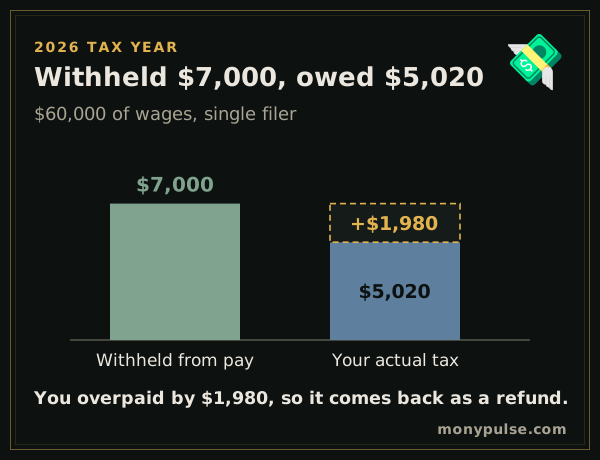
A single filer earns $60,000 in 2026 and has $7,000 of federal tax withheld from their paychecks. Their tax for the year, after the standard deduction, is $5,020. They paid more than they owe, so the estimated refund is $1,980.
Add a child under 17 and the child tax credit lowers the tax by up to $2,200, which raises the refund by the same amount.
Refund or balance due: what drives it
As a W-2 tax calculator it needs only two boxes from your form: box 1 for wages and box 2 for the federal income tax withheld.
Your refund is not a bonus; it is the gap between what was withheld and what you owe. The biggest drivers are:
- Your W-4: it tells your employer how much to withhold. Claiming dependents or extra deductions lowers withholding; asking for extra withholding raises it.
- Life changes: marriage, a new child, a second job or a big raise change your tax more than your withholding.
- Income with no withholding: interest, freelance pay, unemployment or investment gains can turn a refund into a bill.
Standard deduction and credits used
| Filing status | 2026 | 2027 |
|---|---|---|
| Single | $16,100 | $16,600 |
| Married filing jointly | $32,200 | $33,200 |
| Married filing separately | $16,100 | $16,600 |
| Head of household | $24,150 | $24,925 |
| Extra, each person 65+ or blind (unmarried) | $2,050 | $2,100 |
| Extra, each person 65+ or blind (married) | $1,650 | $1,700 |
| Child tax credit per child under 17 | $2,200 | $2,300 |
| Refundable part of the child tax credit | $1,700 | $1,800 |
People 65 or older can also deduct up to $6,000 each for 2025 through 2028, reduced by 6% of income above $75,000 ($150,000 for joint returns). The credit for other dependents is $500. Source: IRS.
Tax withholding calculator: check your W-2 withholding
If the estimate shows you’ll owe, you still have time to adjust withholding for the rest of the year or make an estimated payment, which can help avoid an underpayment penalty. The IRS Tax Withholding Estimator walks through a new W-4.
Related calculators
For the full tax picture with brackets and rates, use the income tax calculator. If you have freelance income, the quarterly tax calculator works out estimated payments, and to see how withholding affects each paycheck, try the paycheck calculator.
Assumptions and limits
- Tax is figured with the same rules as the income tax calculator: IRS brackets, the standard or itemized deduction, the senior deduction and the child tax credit.
- The refundable part of the child tax credit is included; the earned income tax credit and education credits are not.
- State refunds and taxes are separate and not included.
Frequently asked questions
How do I estimate my tax refund?
Work out your tax for the year, then compare it with what was already paid through withholding and estimated payments. If you paid more than you owe, the difference comes back as a refund. With $60,000 of wages and $7,000 withheld, a single filer would get back about $1,980 for 2026.
Where do I find my withholding?
Box 2 of your Form W-2 shows federal income tax withheld for the year. Before the year ends, use your latest pay stub's year-to-date figure plus what will be withheld from the remaining paychecks.
Why is my refund smaller than last year?
Common reasons are less withholding after a W-4 change, a raise that moved more income into a higher bracket, a child who turned 17, or income without withholding, such as freelance work or interest.
When will I get my refund?
The IRS issues most e-filed refunds with direct deposit within 21 days. You can track it with the IRS Where's My Refund tool.
Should I aim for a big refund?
A refund means you lent money to the government without interest. If you get a large refund every year, you can adjust your W-4 to take home more in each paycheck; if you owe, raising withholding avoids a surprise bill.
Sources and method
- Refunds (Where's My Refund?) · Internal Revenue Service
- Tax Withholding Estimator · Internal Revenue Service
- IRS releases tax inflation adjustments for tax year 2026, including amendments from the One, Big, Beautiful Bill · Internal Revenue Service
Formulas and figures checked against these sources on November 11, 2026. The calculator runs entirely in your browser; nothing you type is sent to us or stored. Results are estimates for education, not financial, tax or legal advice, and MonyPulse is not a lender, tax preparer or investment adviser. Found an error? Tell us. See how we build and test our calculators and our editorial standards.