How the Income Tax calculator works
Taxable income
Taxable income = Total income − adjustments − standard or itemized deduction − other deductions
- Standard deduction (2026)
- $16,100 single or married filing separately; $32,200 married filing jointly; $24,150 head of household
Tax
Tax = Σ (income in each bracket × that bracket's rate) − credits
- Rates
- 10%, 12%, 22%, 24%, 32%, 35% and 37%
Effective tax rate
Effective rate = Income tax ÷ total income × 100
Worked example
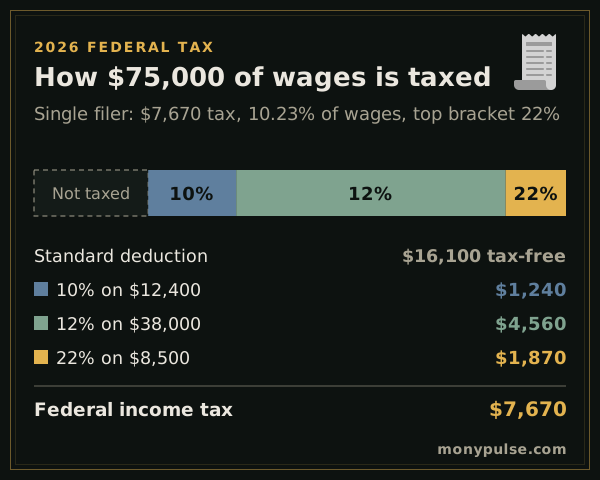
A single filer earns $75,000 in wages in 2026. Subtracting the $16,100 standard deduction leaves $58,900 of taxable income. The first $12,400 is taxed at 10%, the next $38,000 at 12% and the rest at 22%.
The federal income tax is $7,670. That is an effective tax rate of 10.23%, even though the marginal tax bracket is 22%: only the top slice of income is taxed at that rate.
Tax bracket calculator: how your brackets really work
The U.S. has seven brackets, from 10% to 37%. Each rate applies only to the income inside its band. The bracket table under the results shows your taxable income split across the bands and the tax on each slice, which is the clearest way to see why your effective rate is so much lower than your top rate.
What tax bracket am I in?
Your tax bracket is the rate on your last dollar of taxable income: your income minus the standard deduction, which for 2026 is $16,100 for single filers and $32,200 for married couples filing jointly. A single filer earning $100,000 in wages has $83,900 of taxable income, which falls in the 22% bracket, but pays $13,170 in federal income tax in total, an effective rate of 13.17%.
| Salary | Single: bracket | Single: tax (effective rate) | Married filing jointly: bracket | Married filing jointly: tax (effective rate) |
|---|---|---|---|---|
| $40,000 | 12% | $2,620 (6.55%) | 10% | $780 (1.95%) |
| $60,000 | 12% | $5,020 (8.37%) | 12% | $2,840 (4.73%) |
| $75,000 | 22% | $7,670 (10.23%) | 12% | $4,640 (6.19%) |
| $100,000 | 22% | $13,170 (13.17%) | 12% | $7,640 (7.64%) |
| $150,000 | 24% | $24,734 (16.49%) | 22% | $15,340 (10.23%) |
| $200,000 | 24% | $36,734 (18.37%) | 22% | $26,340 (13.17%) |
| $300,000 | 35% | $68,134 (22.71%) | 24% | $49,468 (16.49%) |
Worked out with this calculator for 2026: wages only, the standard deduction, no children, credits or other income. Pre-tax 401(k) contributions, other income and credits change your bracket and your tax; enter them above.
2026 and 2027 federal tax brackets
| Rate | Single | Married filing jointly | Head of household |
|---|---|---|---|
| 10% | $0 – $12,400 | $0 – $24,800 | $0 – $17,700 |
| 12% | $12,401 – $50,400 | $24,801 – $100,800 | $17,701 – $67,450 |
| 22% | $50,401 – $105,700 | $100,801 – $211,400 | $67,451 – $105,700 |
| 24% | $105,701 – $201,775 | $211,401 – $403,550 | $105,701 – $201,750 |
| 32% | $201,776 – $256,225 | $403,551 – $512,450 | $201,751 – $256,200 |
| 35% | $256,226 – $640,600 | $512,451 – $768,700 | $256,201 – $640,600 |
| 37% | Over $640,600 | Over $768,700 | Over $640,600 |
| Rate | Single | Married filing jointly | Head of household |
|---|---|---|---|
| 10% | $0 – $12,800 | $0 – $25,600 | $0 – $18,250 |
| 12% | $12,801 – $52,025 | $25,601 – $104,050 | $18,251 – $69,650 |
| 22% | $52,026 – $109,125 | $104,051 – $218,250 | $69,651 – $109,100 |
| 24% | $109,126 – $208,325 | $218,251 – $416,650 | $109,101 – $208,300 |
| 32% | $208,326 – $264,550 | $416,651 – $529,100 | $208,301 – $264,550 |
| 35% | $264,551 – $661,375 | $529,101 – $793,650 | $264,551 – $661,350 |
| 37% | Over $661,375 | Over $793,650 | Over $661,350 |
Brackets apply to taxable income, after the standard or itemized deduction. Married filing separately uses half of each joint amount. Source: IRS inflation adjustments for 2026 and 2027.
Effective tax rate vs. marginal rate
Your effective tax rate is your total income tax divided by your total income: the share of everything you earned that went to federal income tax. Your marginal rate is the bracket your last dollar falls in. The calculator shows both. Use the marginal rate to judge a raise, a bonus or a deduction, since it is the rate that changes; use the effective rate to compare your overall tax with other years or other households. That makes this page an effective tax rate calculator too: the result panel shows your effective rate next to your bracket.
Standard deduction and child tax credit for 2026 and 2027
| Filing status | 2026 | 2027 |
|---|---|---|
| Single | $16,100 | $16,600 |
| Married filing jointly | $32,200 | $33,200 |
| Married filing separately | $16,100 | $16,600 |
| Head of household | $24,150 | $24,925 |
| Extra, each person 65+ or blind (unmarried) | $2,050 | $2,100 |
| Extra, each person 65+ or blind (married) | $1,650 | $1,700 |
| Child tax credit per child under 17 | $2,200 | $2,300 |
| Refundable part of the child tax credit | $1,700 | $1,800 |
People 65 or older can also deduct up to $6,000 each for 2025 through 2028, reduced by 6% of income above $75,000 ($150,000 for joint returns). The credit for other dependents is $500. Source: IRS.
What lowers your tax
- Adjustments such as traditional IRA and HSA contributions reduce income before deductions.
- Deductions reduce taxable income: most people take the standard deduction; those with large mortgage interest, state and local taxes or charitable gifts may itemize.
- Credits reduce the tax itself, dollar for dollar. The child tax credit is $2,200 per child under 17 in 2026, and part of it can be refunded.
- Since 2025: people 65 and older can deduct an extra $6,000 each, and some workers can deduct qualified tips and overtime, through 2028.
Related calculators
To see whether you’ll get a refund, use the tax refund calculator. For take-home pay per paycheck, use the paycheck calculator, and if you have business income, the self-employment tax calculator adds Social Security and Medicare.
Assumptions and limits
- Uses the IRS brackets, standard deductions and child tax credit for 2026 and 2027, including the 2025 tax law's senior deduction.
- Long-term capital gains and qualified dividends are taxed at 0%, 15% or 20% on top of ordinary income, and the 3.8% net investment income tax is added when it applies.
- The qualified business income deduction is included below the income threshold; above it, limits apply and it is left out.
- The earned income tax credit, education credits, the alternative minimum tax and state taxes are not included.
Frequently asked questions
How is federal income tax calculated?
Start with total income, subtract adjustments to get adjusted gross income, subtract the standard or itemized deduction to get taxable income, then apply the brackets: 10% on the first slice, 12% on the next and so on. Credits then reduce the tax.
What are the 2026 tax brackets?
For single filers, 10% up to $12,400 of taxable income, 12% to $50,400, 22% to $105,700, 24% to $201,775, 32% to $256,225, 35% to $640,600 and 37% above that. Married couples filing jointly have brackets roughly twice as wide.
What is the difference between effective and marginal tax rates?
Your marginal rate is the rate on your last dollar of income, your top bracket. Your effective rate is your total tax divided by your income. It is lower than your marginal rate for almost everyone, because the first dollars are covered by the standard deduction and the next ones are taxed at 10% and 12%.
Will a raise push me into a higher bracket and cost me money?
No. Only the income above the bracket line is taxed at the higher rate, so under the brackets a raise always leaves you with more after tax. Income-tested benefits are a separate matter: losing a credit or subsidy as income rises can take back part of a small raise, or near a cutoff all of it.
What changed for 2027?
The IRS raised the brackets and standard deduction for inflation: the standard deduction is $16,600 for single filers and $33,200 for married couples filing jointly in 2027. Choose 2027 above to plan ahead.
Sources and method
- IRS releases tax inflation adjustments for tax year 2026, including amendments from the One, Big, Beautiful Bill · Internal Revenue Service
- IRS releases tax inflation adjustments for tax year 2027; taxpayers continue to benefit from the Working Families Tax Cuts · Internal Revenue Service
- Federal income tax rates and brackets · Internal Revenue Service
Formulas and figures checked against these sources on November 12, 2026. The calculator runs entirely in your browser; nothing you type is sent to us or stored. Results are estimates for education, not financial, tax or legal advice, and MonyPulse is not a lender, tax preparer or investment adviser. Found an error? Tell us. See how we build and test our calculators and our editorial standards.