How the Bonus calculator works
Withholding on a bonus paid separately
Federal = 22% of the bonus (37% on supplemental wages above $1 million in the year); Social Security = 6.2% up to the wage base; Medicare = 1.45% (+0.9% above $200,000)
Gross-up
Bonus = Net amount ÷ (1 − total withholding rate)
Worked example
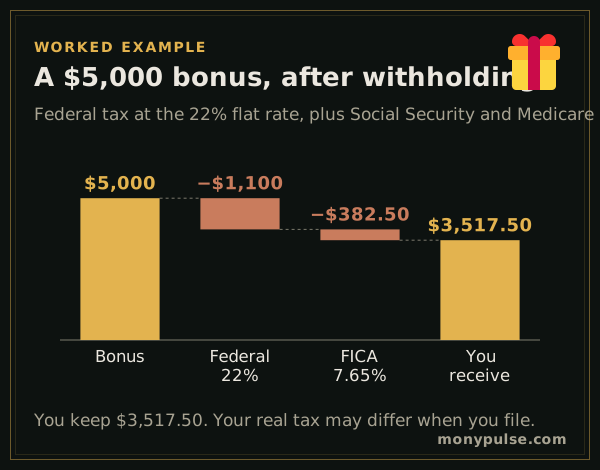
A $5,000.00 bonus paid on its own has $1,100.00 withheld for federal income tax and $382.50 for Social Security and Medicare, so you take home $3,517.50 before any state tax.
With a $70,000 salary, a single filer is already in the 22% bracket, so the bonus really adds about $1,100 of federal income tax, the same as was withheld. If your bracket were 12%, you’d get the extra back as a refund.
Withholding is not the final tax
The flat 22% rate is a shortcut for payroll, not a special bonus tax. When you file, the bonus is added to your other income and taxed at your normal rates. Workers in the 10% or 12% brackets are over-withheld on bonuses and get money back; workers in the 24% bracket or higher may owe a little more. The third result shows which way it is likely to go for you.
Gross up a bonus
Employers sometimes want a bonus to arrive as a round number, for example a $5,000 net award. Choose the gross-up mode and enter the amount to receive; the calculator finds the bonus that leaves exactly that after federal, Social Security, Medicare and state withholding.
Related calculators
For commissions paid with or without a base salary, use the commission calculator. To see your full-year tax with the bonus, use the income tax calculator, and if a raise is on the table too, compare it with the raise calculator.
Assumptions and limits
- The bonus is paid as a separate supplemental payment with the flat-rate method. If your employer adds it to a regular paycheck instead, withholding can be higher or lower.
- State withholding uses the rate you enter; many states have their own flat rate for bonuses.
- The actual tax figure compares federal income tax on your salary with and without the bonus, using the standard deduction.
Frequently asked questions
How much tax is taken out of a bonus?
Federal income tax is usually withheld at a flat 22%, plus 6.2% for Social Security and 1.45% for Medicare, 29.65% in total before state tax. On a $5,000 bonus that leaves about $3,518.
Why is my bonus taxed so much?
It usually isn't taxed more; it is withheld differently. The 22% flat rate may be higher or lower than your actual bracket. Any difference comes back as a refund, or is owed, when you file.
What is a bonus gross-up?
A gross-up is when an employer raises the bonus so that, after withholding, the employee receives a set amount. To net $5,000 with 29.65% withheld, the bonus has to be about $7,108.
Are bonuses over $1 million taxed differently?
Supplemental wages above $1 million in a year must be withheld at the top rate, 37%. The calculator applies this using the wages you've already been paid this year.
Sources and method
- Publication 15 (Circular E), Employer's Tax Guide · Internal Revenue Service
- Publication 15-T, Federal Income Tax Withholding Methods · Internal Revenue Service
- Topic no. 751, Social Security and Medicare withholding rates · Internal Revenue Service
Formulas and figures checked against these sources on November 11, 2026. The calculator runs entirely in your browser; nothing you type is sent to us or stored. Results are estimates for education, not financial, tax or legal advice, and MonyPulse is not a lender, tax preparer or investment adviser. Found an error? Tell us. See how we build and test our calculators and our editorial standards.