How the Quarterly Tax calculator works
Required yearly payments (safe harbor)
Required = the smaller of 90% of this year's total tax and 100% of last year's total tax (110% if last year's AGI was over $150,000)
- Total tax
- income tax plus self-employment tax, minus refundable credits
Each payment
Quarterly payment = (Required − tax withheld from wages) ÷ 4
Worked example
A single freelancer expects $60,000 of profit in 2027 and has no job withholding. Their total federal tax for the year, income tax plus self-employment tax, is about $11,981.
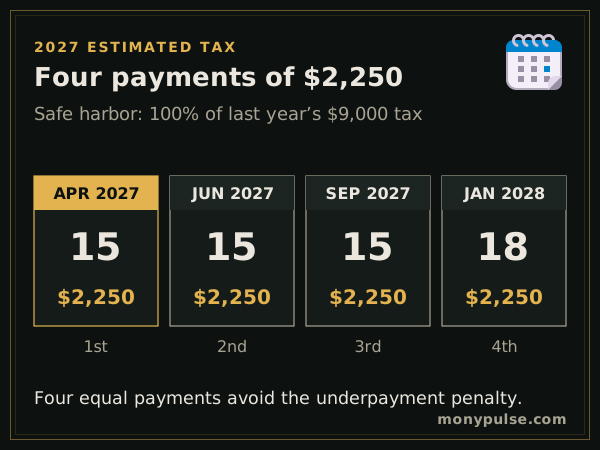
Last year’s total tax was $9,000, and the safe harbor lets them pay the smaller of 90% of this year’s tax or 100% of last year’s. They need $9,000 in estimated payments, or $2,250 each quarter, and pay the small remainder when they file, with no penalty.
The safe harbor rules
The IRS doesn’t need you to predict your tax exactly. You avoid the underpayment penalty if your withholding plus on-time estimated payments add up to the smaller of:
- 90% of this year’s tax, or
- 100% of last year’s tax, or 110% if last year’s adjusted gross income was over $150,000 ($75,000 if married filing separately).
When your income is rising, paying 100% or 110% of last year’s tax is often the simpler and lower option, which is why the calculator asks for last year’s figure.
If you also have a job
Tax withheld from a paycheck counts too, and it is treated as if it were paid evenly through the year, even if it is withheld late. Raising your W-4 withholding at your job can replace some or all of your estimated payments.
Estimated tax due dates for 2026 and 2027
| Payment | For 2026 | For 2027 |
|---|---|---|
| 1st payment | April 15, 2026 | April 15, 2027 |
| 2nd payment | June 15, 2026 | June 15, 2027 |
| 3rd payment | September 15, 2026 | September 15, 2027 |
| 4th payment | January 15, 2027 | January 18, 2028 |
When a date falls on a weekend or a federal holiday, the payment is due the next business day. Source: IRS Form 1040-ES.
Related calculators
To see the self-employment tax and income tax behind the total, use the self-employment tax calculator. For your whole return, use the income tax calculator, and if you invest, the capital gains tax calculator shows the tax on a sale that may need its own payment.
Assumptions and limits
- Income is earned evenly through the year. If most of it comes late in the year, the IRS annualized method on Form 2210 can lower earlier payments.
- Withholding from a job counts toward the required amount and is treated as paid evenly through the year.
- No estimated payments are required if you expect to owe less than $1,000 after withholding and credits.
- Federal only. Most states with an income tax have their own estimated payments.
Frequently asked questions
Who has to pay quarterly estimated taxes?
Anyone who expects to owe $1,000 or more when they file after withholding and credits, usually freelancers, independent contractors, small-business owners, landlords and investors with income that has no tax withheld.
When are quarterly taxes due?
For tax year 2026: April 15, June 15 and September 15, 2026, and January 15, 2027. For 2027: April 15, June 15 and September 15, 2027, and January 18, 2028, because January 15 falls on a weekend and the following Monday is a federal holiday.
How do I avoid the underpayment penalty?
Pay at least the safe harbor amount on time: 90% of this year's tax, or 100% of last year's tax (110% if last year's AGI was over $150,000), whichever is smaller. The calculator uses the smaller one.
What if I missed a payment?
Pay as soon as you can. The penalty works like interest on the late amount for the days it was late, so paying sooner keeps it small.
How do I pay estimated taxes?
Online through IRS Direct Pay or your IRS online account, through EFTPS, or by mail with a Form 1040-ES voucher.
Sources and method
- Estimated taxes · Internal Revenue Service
- About Form 1040-ES, Estimated Tax for Individuals · Internal Revenue Service
- Topic no. 306, Penalty for underpayment of estimated tax · Internal Revenue Service
Formulas and figures checked against these sources on November 11, 2026. The calculator runs entirely in your browser; nothing you type is sent to us or stored. Results are estimates for education, not financial, tax or legal advice, and MonyPulse is not a lender, tax preparer or investment adviser. Found an error? Tell us. See how we build and test our calculators and our editorial standards.