How the Overtime calculator works
Overtime pay
Overtime pay = Hourly rate × 1.5 × overtime hours
- 1.5
- time and a half, required by federal law for hours over 40 in a workweek; use 2 for double time
Qualified overtime for the deduction
Qualified overtime = 0.5 × hourly rate × overtime hours (the premium above the regular rate)
- Yearly cap
- $12,500, or $25,000 on a joint return, reduced by $100 for each $1,000 of income above $150,000 ($300,000 joint)
Worked example
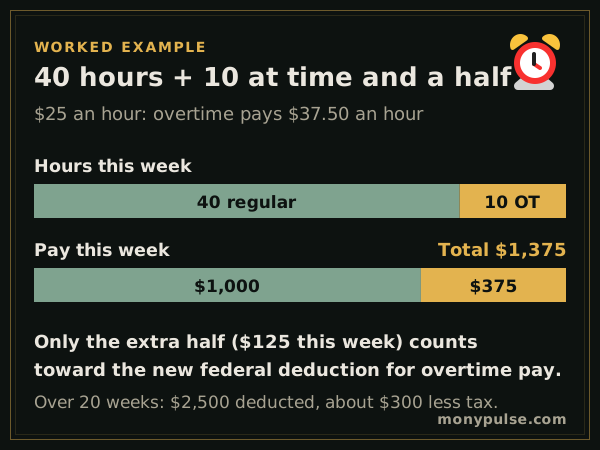
You earn $25.00 an hour and work 50 hours this week. The first 40 hours pay $1,000. The 10 overtime hours are paid at $37.50 an hour, time and a half, adding $375.00, for $1,375.00 in total.
Of each overtime hour, the extra $12.50 above your regular rate is the qualified overtime premium, $125.00 this week. If you work this much overtime in 20 weeks of the year, that is $2,500 of qualified overtime, and the new deduction lowers your federal income tax by about $300 for a single filer.
How the no tax on overtime deduction works
The 2025 budget law created a deduction, not an exemption. Your full overtime pay is still on your W-2 and still withheld from. When you file, you deduct the qualified premium, up to $12,500 a year or $25,000 on a joint return, which lowers taxable income. The saving equals the deduction times your tax bracket, so a worker in the 12% bracket saves 12 cents per dollar of qualified overtime. The deduction shrinks once modified adjusted gross income passes $150,000, or $300,000 for joint filers, and it runs from 2025 through 2028.
| Filing status | Most you can deduct | Starts shrinking above |
|---|---|---|
| Single or head of household | $12,500 | $150,000 of modified AGI |
| Married filing jointly | $25,000 | $300,000 of modified AGI |
| Married filing separately | Not allowed | — |
Only the extra half of time-and-a-half pay counts, and only overtime required by the Fair Labor Standards Act. The cap falls by $100 for each $1,000 of income above the threshold. It lowers income tax, not Social Security or Medicare. Source: IRS.
Time and a half vs double time
Federal law requires time and a half after 40 hours in a workweek. Some states, such as California, also require overtime after 8 hours in a day and double time after 12, and some union contracts pay double time on holidays. Enter double-time hours under More options; only the federally required half-time premium counts toward the tax deduction.
Related calculators
To see overtime in your take-home pay, use the paycheck calculator. For your whole year’s federal tax, including this deduction’s effect on your bracket, use the income tax calculator, and to turn your hourly rate into a yearly figure, try the hourly to salary calculator.
Assumptions and limits
- All overtime hours are hours over 40 in a workweek, which federal law requires to be paid at least 1.5 times the regular rate.
- Only the half-time premium required by federal law counts for the deduction, even if your employer pays double time.
- The tax saving uses 2026 federal brackets and the standard deduction for your filing status. It does not change Social Security, Medicare or state income tax.
- Exempt salaried employees who aren't owed overtime under federal law can't claim the deduction.
Frequently asked questions
How is overtime pay calculated?
Multiply your regular hourly rate by 1.5 to get the overtime rate, then multiply by the hours you worked over 40 in the workweek. At $25 an hour, 10 overtime hours pay $37.50 × 10 = $375.
Is overtime tax-free now?
Not entirely. For 2025 through 2028, you can deduct the premium part of required overtime, the extra half in time and a half, up to $12,500 a year ($25,000 joint). Overtime is still taxed for Social Security and Medicare and is still withheld from your paycheck.
Does overtime put me in a higher tax bracket?
It can push some income into a higher bracket, but only the dollars above the bracket line are taxed at the higher rate. Working the overtime still leaves you with more after tax than not working it.
Who gets overtime pay?
Most hourly workers covered by the Fair Labor Standards Act must get time and a half after 40 hours in a workweek. Some salaried, professional and other workers are exempt, and some states require daily overtime or double time.
Do I need anything special to claim the deduction?
Your qualified overtime should appear on your Form W-2 or 1099, you need a valid Social Security number, and married couples must file jointly. The deduction is available whether you itemize or not.
Sources and method
- Overtime Pay · U.S. Department of Labor, Wage and Hour Division
- What to know about the No Tax on Overtime deduction · Internal Revenue Service
- Treasury, IRS provide guidance for individuals who received tips or overtime during tax year 2025 · Internal Revenue Service
Formulas and figures checked against these sources on November 12, 2026. The calculator runs entirely in your browser; nothing you type is sent to us or stored. Results are estimates for education, not financial, tax or legal advice, and MonyPulse is not a lender, tax preparer or investment adviser. Found an error? Tell us. See how we build and test our calculators and our editorial standards.