How the Raise & Salary Increase calculator works
New pay
New pay = Current pay × (1 + raise %)
Raise percentage
Raise % = (New pay − Old pay) ÷ Old pay × 100
Raise after inflation
Real raise = (1 + raise) ÷ (1 + inflation) − 1
Worked example
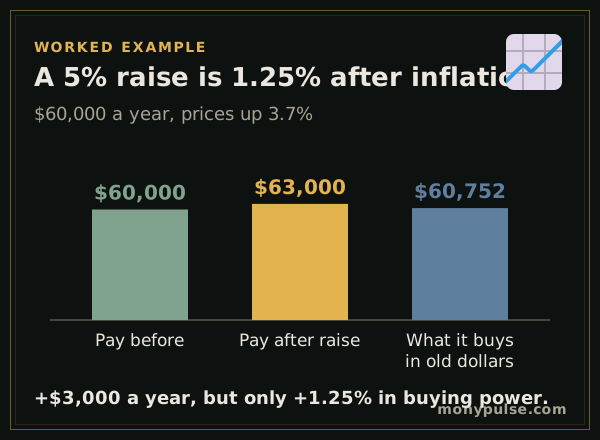
You earn $60,000 a year and get a 5% raise. Your new salary is $63,000, $3,000 more a year or $250.00 more a month before taxes.
Prices rose 3.7% over the past year, so the raise is worth 1.25% in real terms: more buying power, but much less than the 5% headline. A raise below 3.7% would leave you able to buy less than last year.
Salary increase calculator: three ways to use this raise calculator
- Raise in percent: the usual case for an annual review.
- Raise in dollars: when an offer says “$3,000 more a year” or “$1.50 more an hour”.
- Old and new pay: to find the percentage when you change jobs or get a promotion.
Why inflation matters
A raise only adds buying power if it beats the rise in prices. The table under the results shows several raise sizes next to their after-inflation value, which is useful before a salary negotiation. Over several years, raises that just match inflation keep your standard of living flat while raises that beat it compound.
Related calculators
To see what the raise adds to each paycheck after taxes, use the paycheck calculator. For a one-time payment instead of a raise, compare the bonus calculator, and to see how your new pay ranks nationally, try the income percentile calculator.
Assumptions and limits
- Hourly pay is converted to a yearly figure at 40 hours a week, 52 weeks a year.
- All figures are before taxes. Your take-home pay rises by less than the raise.
- The default inflation rate is the change in the Consumer Price Index for All Urban Consumers over the 12 months to September 2026; replace it with the rate that fits your situation.
Frequently asked questions
How do I calculate a raise percentage?
Subtract your old pay from your new pay, divide by your old pay and multiply by 100. Going from $60,000 to $63,000 is a $3,000 raise, or 5%.
How much is a 5% raise on $60,000?
$3,000 a year, bringing pay to $63,000. That is $250 more a month, or about $115 more per biweekly paycheck before taxes.
Is my raise keeping up with inflation?
Compare it with inflation. With prices up 3.7% in the 12 months to September 2026, a 5% raise is worth about 1.25% more in buying power; a 3% raise is a small cut in real terms.
What is a good raise?
A raise that beats inflation increases your buying power. Promotions and job changes often bring larger raises than annual merit increases, so compare offers on the full pay and benefits.
Sources and method
- Consumer Price Index Summary · U.S. Bureau of Labor Statistics
- Employment Cost Index · U.S. Bureau of Labor Statistics
Formulas and figures checked against these sources on November 11, 2026. The calculator runs entirely in your browser; nothing you type is sent to us or stored. Results are estimates for education, not financial, tax or legal advice, and MonyPulse is not a lender, tax preparer or investment adviser. Found an error? Tell us. See how we build and test our calculators and our editorial standards.