Kodak
Kodak Invented the Digital Camera, Then Went Bankrupt
In 1975 a Kodak engineer built the first digital camera and was told to keep quiet about it. Kodak made about $16 billion a year, mostly from film. In 2012 it filed for bankruptcy.
- Revenue, 1996
- $16BRevenue, 1996. Eastman Kodak's revenue in 1996, near its peak, earned mostly from film, paper and processing.
- Revenue, 2025
- $1.07BRevenue, 2025. Kodak's revenue in 2025, as a much smaller printing and materials company after its 2012 bankruptcy.
In this story · 6 chapters
The short answer
Kodak engineer Steven Sasson built the first digital camera in 1975, but Kodak made most of its money from film and treated digital as a sideline. When photography moved to digital cameras and then to phones, its film business collapsed. Kodak filed for Chapter 11 on January 19, 2012, with $6.75 billion of debts.
In December 1975, in a lab in Rochester, New York, a young engineer pointed a strange machine at a lab technician named Joy Marshall and pressed a button. The machine weighed about 8 pounds and was the size of a toaster. It had a lens from a movie camera, a new kind of electronic sensor, and a cassette tape recorder.
The image took 50 milliseconds to capture and 23 seconds to record to the tape. Then the tape went into a playback unit wired to a television, and a black-and-white picture, 100 pixels by 100, appeared on the screen.
The engineer was Steven Sasson. The company was Eastman Kodak. He had built the first digital camera, at the company that made more money from film than anyone on earth.
The Great Yellow Father
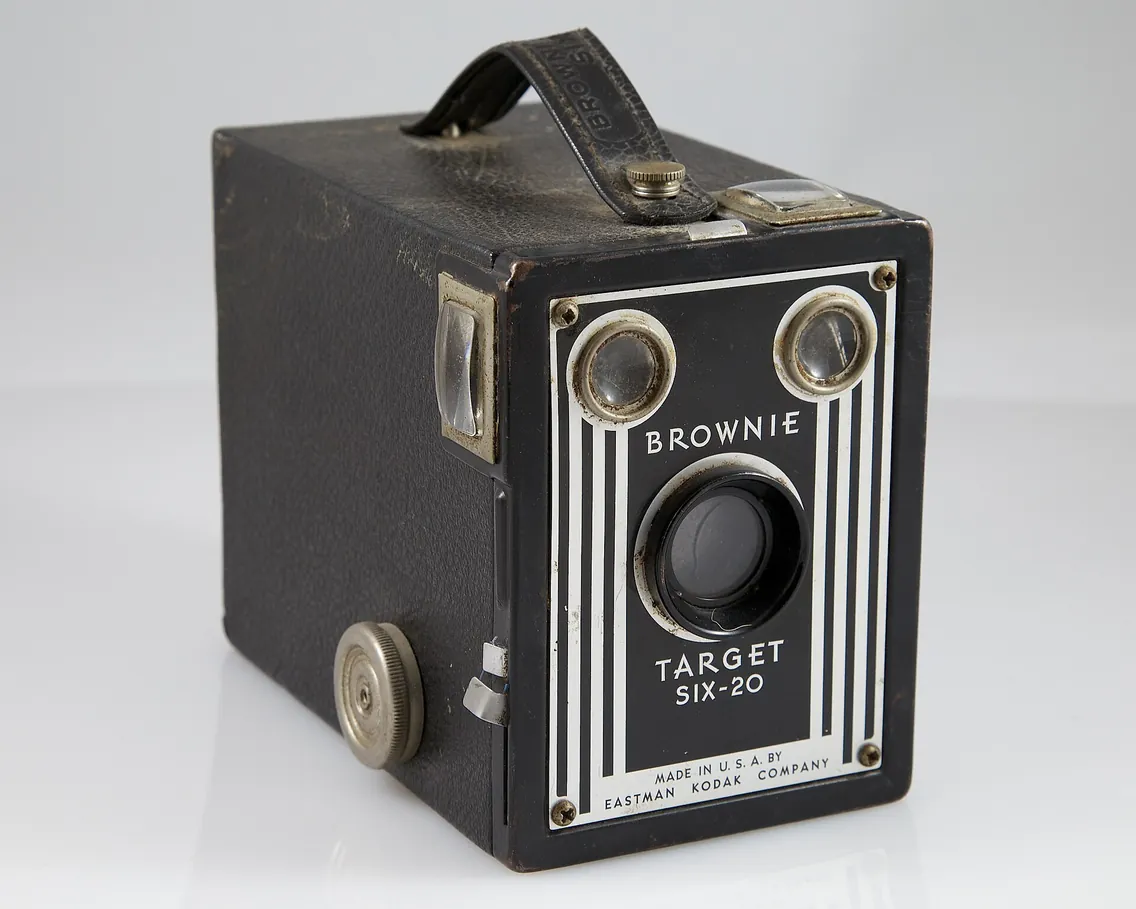
Kodak’s business was one of the best ever invented. George Eastman had worked it out around 1900, when the Brownie camera sold for $1 and a roll of film cost 15 cents. Sell the camera cheaply, then earn on every roll of film, every print and every envelope of developed pictures, for as long as the customer kept taking photos.
In Rochester people called the company the Great Yellow Father, and a job there was seen as a job for life. In 1996 Kodak’s revenue was about $16 billion. In 1997 the stock market valued it at more than $30 billion.
“Don’t tell anyone”
Sasson showed his camera to Kodak executives. They were polite, and unconvinced. He told The New York Times in 2015 that they could not imagine anyone wanting to look at their pictures on a television set. In another interview he summed up the reaction as: that’s cute, but don’t tell anyone about it.
The doubts were partly reasonable. The camera was crude, slow and nowhere near the quality of film. But there was a second reason. A camera that used no film, no paper and no chemicals threatened the products that paid for everything at Kodak. According to the Times, the marketing side told Sasson that Kodak could sell such a camera, but would not, because it would eat into film. Kodak patented the design in 1978 and kept it out of public view for years.
Sasson guessed that digital photography would reach ordinary consumers in 15 to 20 years. He was close.

The ten-year warning
In 1981 Sony announced an electronic camera, and one of Kodak’s biggest photofinishing customers asked whether it should worry. Vince Barabba, then Kodak’s head of market intelligence, ran a careful study. Its findings, as he later described them, came in two parts. The bad news: digital could replace Kodak’s film business. The good news: it would take time, and Kodak had about ten years to prepare.
Kodak treated the ten years as breathing room, not a countdown. It kept investing in digital technology. Through the 1990s it spent some $4 billion developing imaging technology that would end up in cameras and phones, and it built up a portfolio of more than a thousand digital imaging patents. It also sold digital cameras early: the DC40, one of the first consumer digital cameras, went on sale in 1995, and its EasyShare range of 2001 became a big seller. But it treated digital as a sideline, protecting film for as long as film paid.
Why Kodak failed
When the change came, it came quickly. Digital cameras became cheap and good. Then phones replaced cameras for most people, and people stopped printing pictures at all. Every digital camera Kodak sold replaced a stream of film and prints that had been far more profitable.
Kodak stopped selling traditional film cameras in 2004. Its revenue fell, year after year. In the first nine months of 2011 its sales dropped 18% to $4.3 billion and it lost $647 million. By then it was trying to sell its 1,100 digital imaging patents to raise cash, and could not find a buyer at the price it wanted.
On January 19, 2012, Eastman Kodak filed for Chapter 11 bankruptcy protection, listing $5.1 billion of assets and $6.75 billion of debts. Three weeks later it announced it would stop making digital cameras, the product it had invented. Its camera business had shrunk to about a quarter of company revenue and was losing money; leaving it was expected to cut losses by about $100 million a year. Steven Sasson, by then retired, called it a bit sad.
Selling the ideas
In December 2012 Kodak agreed to sell its digital imaging patents for about $525 million to a group organized by Intellectual Ventures and RPX, with a dozen technology companies taking licenses. Analysts had once thought the portfolio might fetch $2 billion to $3 billion. The sale was a condition of the loans Kodak needed to leave bankruptcy.
The company that emerged in 2013 was a fraction of its old self, focused on commercial printing, chemicals and film for the movie industry. In 2025 Kodak reported revenue of $1.07 billion, about a fifteenth of what it earned in 1996.
The camera Sasson built in 1975 still exists, a toaster-sized box that marked the moment the future arrived, at the one company that most needed it not to.
What the record shows
- Inventing isn’t the same as committing. Kodak built the first digital camera and still lost the digital age.
- High margins can hide a threat. Film was so profitable that its replacement looked like the enemy.
- A deadline is not a delay. The 1981 study gave Kodak ten years. It used them to protect film.
- Patents can outlive products. Kodak’s ideas were still worth about $525 million when the company could not survive on them.
Blockbuster made a similar mistake with streaming, and Yahoo with search. For a company that did reinvent itself in time, see Lego’s comeback. And for an inventor who refused to let incumbents bury his idea, read about James Dyson’s 5,127 prototypes.
 5,127Read nextJames Dyson's 5,127 Vacuum PrototypesJames Dyson built 5,127 prototypes of a bagless vacuum cleaner and went deep into debt. British manufacturers turned it down. Fifteen years after his first cardboard model, he put his own name on it.Dyson · 4 min read
Questions readers ask
- Who invented the digital camera?
- Kodak engineer Steven Sasson. In December 1975 he finished a working digital camera. It weighed about 8 pounds, took 0.01-megapixel black-and-white pictures and needed 23 seconds to record each one to a cassette tape. The pictures were viewed on a television.
- Why didn't Kodak sell its digital camera?
- The 1975 machine was a lab prototype, far from a product. But Sasson has said management also feared that digital would eat into film sales. Kodak did sell consumer digital cameras from 1995, starting with the DC40, but for years it treated them as a sideline to film.
- Why did Kodak fail and go bankrupt?
- Kodak earned most of its money from film, paper and processing. When photography moved to digital cameras and then phones, that business collapsed, and digital cameras earned far less. Kodak filed for Chapter 11 on January 19, 2012, with $5.1 billion of assets and $6.75 billion of debts.
- Does Kodak still exist?
- Yes. It emerged from bankruptcy in 2013 as a much smaller company focused on commercial printing and materials. In 2025 its revenue was $1.07 billion.
Run the numbers yourself
- Compound Interest CalculatorSee how a deposit grows with compounding, extra contributions and different compounding frequencies.
- Budget CalculatorPlan a monthly budget, see what is left over and compare it with the 50/30/20 rule.
- Emergency Fund CalculatorSize an emergency fund from essential expenses and see how long it will take to build it.
People and companies in this story
People
- Steven Sasson
- George Eastman
- Vince Barabba
Companies
- Kodak
- Eastman Kodak
- Sony
- Canon
This story is on these lists
Share this story
Send the link to someone who would like this story, or keep it for later.
The timeline
Drawn to scale: the gaps are the years in between. Choose a year.
Sources & further reading 14
- Kodak DC40 digital camera, 1995Science Museum Group Collection
- Milestones: Handheld Digital Camera, 1975IEEE, Engineering and Technology History Wiki
- The first digital cameraIEEE Spectrum
- This man invented the digital camera in 1975, and his bosses at Kodak never let it see the light of dayBusiness Insider, on The New York Times interview, August 2015
- Digital camera turns 30, sort ofAssociated Press, via NBC News, 2005
- How Kodak FailedChunka Mui, Forbes, January 2012
- You Press the Button, Kodak Used to Do the RestMIT Technology Review, December 2011
- Kodak files for Chapter 11 bankruptcyRochester Democrat and Chronicle, via ABC News, January 2012
- Kodak to stop making cameras, digital framesAssociated Press, via ABC7, February 2012
- Kodak agrees to sell digital imaging patents for $525 millionRochester Business Journal, December 2012
- Kodak sells digital imaging patents for $525MAssociated Press, via KSL, December 2012
- Kodak sells digital imaging patents for $525MM in key restructuring goalABL Advisor, December 2012
- Kodak's Problem ChildFailure Inc., Medium
- Eastman Kodak 2025 Annual ReportEastman Kodak, SEC filing
Spot an error? Send a correction. Corrections are dated and noted here.
- Correction, : An earlier version said Kodak did not sell consumer digital cameras until 2001. Kodak's first consumer digital camera, the DC40, went on sale in 1995. This has been corrected.
Photographs are credited under each picture; licenses are listed on the image credits page.