Arm
How Acorn and Apple Created Arm in a Turkey Barn
Arm built a chip empire without making chips. It started in 1990 with twelve engineers from a struggling computer maker and a converted barn near Cambridge. Its designs are now inside most of the world's phones.
- Apple's stake cost
- $1.5MApple's stake cost. Apple's cash for 43% of the new venture in 1990, by Robin Saxby's account. Other sources give $3 million.
- Value at 2023 IPO
- $54.5BValue at 2023 IPO. Arm's valuation when it returned to the stock market on Nasdaq in September 2023.
In this story · 7 chapters
The short answer
Arm was founded in November 1990 as Advanced RISC Machines, a joint venture of Acorn Computers, Apple and VLSI Technology, with twelve Acorn engineers as its founding team. It designs processors and licenses them to chipmakers for fees and royalties. SoftBank bought it in 2016, and it returned to the stock market in 2023 at a $54.5 billion valuation.
The meter said zero. On April 26, 1985, the first samples of a new processor arrived at Acorn Computers in Cambridge from VLSI Technology, the American firm that had built them. Steve Furber plugged one into a development board and it ran perfectly first time, which was surprising enough. Then he looked at the ammeter wired into the chip’s power line. The needle wasn’t moving.
The board had a fault. No current was reaching the processor’s power pins at all. “The processor was actually running on leakage from the logic circuits,” Sophie Wilson, who designed its instruction set, later told The Register. The chip was drawing so little power that the stray current from the parts around it was enough to keep it going.
Nobody at Acorn had been trying to build a low-power chip. They wanted a fast one for a desktop computer. The accident turned out to be the most valuable feature the processor had, and the basis of a company that now says its designs have shipped in more than 350 billion chips.
A computer maker running on leakage
Acorn was the company behind the BBC Micro, the computer found in a great many British classrooms in the 1980s. By 1983 it needed a successor to the aging 8-bit 6502 chip inside it. Wilson and Furber tested the 16-bit processors on the market and didn’t like any of them. The big chipmakers they visited had huge design teams and buildings full of engineers.
Then they visited the Western Design Center, the small American firm behind the 6502’s successor, and found a handful of people designing processors. If a team that small could do it, so could they. Influenced by research papers on reduced-instruction-set computing, or RISC, they designed their own: a simple 32-bit chip with about 25,000 transistors. Wilson did the instruction set and Furber the internal architecture. Acorn’s co-founder Hermann Hauser later joked that he gave the project two advantages: a design team of just two people, and no money.
The company itself was in trouble. In February 1985, two months before the chip arrived, the Italian firm Olivetti stepped in with cash and a large stake, and it soon took control of Acorn. The ARM project was a small side effort inside a company now owned by an office-equipment maker with other priorities.
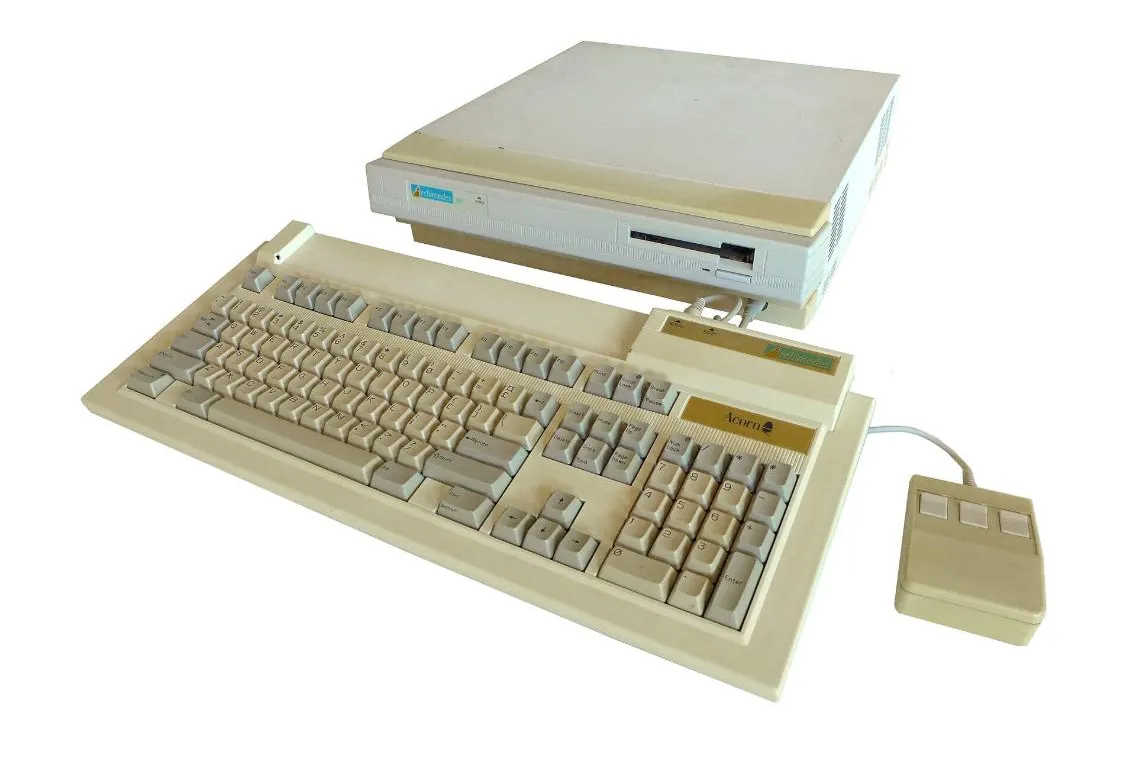
The chip went into Acorn’s Archimedes computers in 1987. They were fast, and they did not sell in large numbers. A brilliant processor inside a niche computer had nowhere much to go.
Apple calls
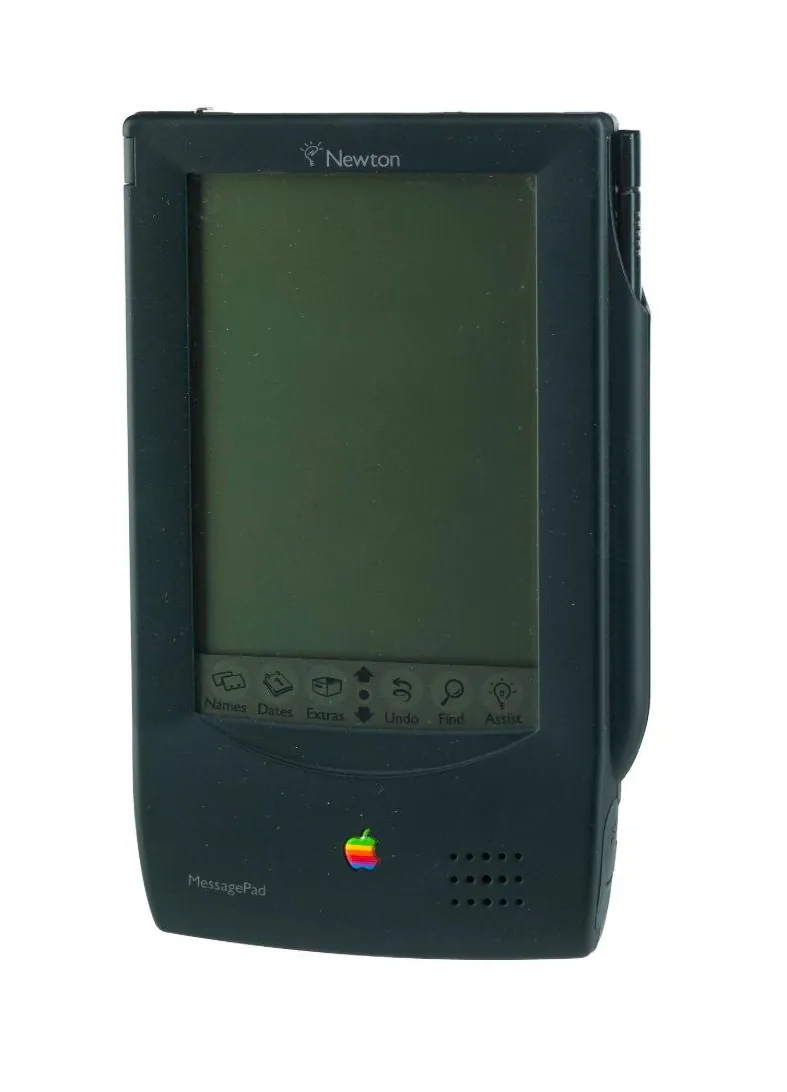
The buyer who changed that was Apple. In the late 1980s it was developing the Newton, a handheld computer that would run on batteries. It needed a processor that was fast and frugal, and the ARM chip was both. What Apple didn’t want was to depend on a part owned by Acorn, a competitor in the computer business.
The solution was a new company. Advanced RISC Machines Ltd was set up in November 1990 as a joint venture between Acorn, Apple and VLSI Technology. Steve Furber has said the name changed from Acorn RISC Machine at Apple’s request, so a rival’s name wouldn’t appear in it. Acorn provided twelve engineers who had worked on the chip. VLSI provided design tools. Apple provided cash.
How much cash depends on whom you ask. Robin Saxby, who became chief executive in 1991, has said Apple got 43% of the company for $1.5 million, with Acorn taking another 43%, VLSI about 5% and the team the rest. Other accounts give Apple’s investment as $3 million. What nobody disputes is that the new company was small and poor. Its first office was a converted barn near Cambridge. Arm’s own history calls it “an old turkey barn.”
The question in the barn
Saxby, an engineer who had spent eleven years at Motorola, joined full-time in February 1991 and found twelve people, a promising design and very little money. In an early meeting, by the Royal Society’s account, he persuaded one engineer to volunteer as vice president of marketing, another as vice president of sales, and so on down the line.
The lack of money shaped everything that followed. Arm could not afford chip factories. It couldn’t even afford to make chips in volume through someone else. So it decided not to. It would design processors and sell the right to build them.
The Newton forced the issue. It launched in 1993 on an Arm chip and was not a commercial success. Had Arm depended on Apple, it would have gone down with the product. Instead Saxby pushed a model with two income streams: an upfront fee for a license to use an Arm design, and a royalty on every chip a licensee produced. Texas Instruments signed in 1993. Others followed.
Why licensing worked
The model sounds modest. It was a sharp piece of strategy.
A chipmaker that licensed an Arm core didn’t have to design a processor from scratch, which saved years and a great deal of money. It could add its own circuits around the core and sell the result as its own. Arm, meanwhile, competed with none of its customers, because it made nothing they sold. Rivals in the chip business could all license from Arm without handing market share to each other.
The royalty did the rest. Once a design was licensed, Arm earned a small amount on every chip shipped for years, sometimes decades. Each new licensee widened the base, and every software developer who wrote for Arm made the next licensee more likely.
Mobile phones took it from there. Arm encouraged Nokia, then the world’s biggest phone maker, to use Arm designs in its GSM handsets. The Nokia 6110, launched in 1997, was a hit, and Arm’s own history calls it “a massive success.” Phones needed exactly what the accidental chip of 1985 offered: decent speed on very little battery. Arm says that today more than 99% of the world’s smartphones are based on its technology.
Apple cashes out
Arm floated on the London Stock Exchange and Nasdaq on April 17, 1998. By then Apple was in deep trouble, and it sold its stake gradually over the following years. The company has never published what it made. In a Business Weekly interview, Saxby recalled that Apple’s former chief executive John Sculley told him Apple would have gone bust without the roughly $800 million it raised from selling the shares. That is Saxby’s memory of Sculley’s remark, not an audited figure, but the scale is plausible: Apple turned a small investment into one of the best returns in its history.
The irony came later. Apple’s iPhone, launched in 2007, ran on an Arm-based processor, and in 2020 Apple began moving its Mac computers to Arm-based chips of its own design.
From barn to $54.5 billion
In July 2016 the Japanese group SoftBank agreed to buy Arm for about £24 billion, then about $32 billion, completing the deal on September 5 that year. In 2020 Nvidia agreed to buy Arm from SoftBank for $40 billion. Regulators objected, and the deal was abandoned in February 2022. On September 14, 2023, Arm returned to the stock market, this time on Nasdaq alone, raising $4.87 billion at a valuation of $54.5 billion. SoftBank still owns most of it.
In its 2026 financial year, which ended in March 2026, Arm reported record revenue of $4.92 billion. That is a modest figure next to the chip giants it supplies. That is the point of the model: Arm’s work is multiplied by every company that builds on it.
What the barn teaches
Arm’s founders didn’t set out to build a low-power chip, a licensing business or the standard architecture for mobile phones. They set out to make a fast processor for a British desktop computer. Each piece of the eventual strategy came from a constraint. They had little money, so they skipped factories. Their first big customer failed, so they sold to everyone. Their chip happened to sip power, so they went where batteries mattered.
That’s a useful corrective to the idea that great companies follow a master plan. Arm’s founders made sensible choices under pressure and stuck with them for thirty years. It is the same pattern found in Corning’s Gorilla Glass, which spent decades waiting for the iPhone to need it, and in Bubble Wrap, which found its market only after two failed ones.
 $800Read nextThe Apple Cofounder Who Sold His 10% for $800On April 1, 1976, Ronald Wayne owned 10% of a new partnership called Apple Computer. Eleven days later he signed out of it for $800. In fiscal 2025 Apple had revenue of $416 billion.Apple · 4 min read
Questions readers ask
- Who founded Arm?
- Arm was founded in November 1990 as Advanced RISC Machines, a joint venture of Acorn Computers, Apple and VLSI Technology. Twelve Acorn engineers formed the founding team, and Robin Saxby joined as the first chief executive in 1991.
- Does Arm make chips?
- Arm's business was built on designing processor architectures and cores and licensing them to chipmakers. It earns upfront license fees and royalties on the chips its partners produce.
- Who designed the first ARM processor?
- Sophie Wilson designed the instruction set and Steve Furber the microarchitecture at Acorn Computers in Cambridge. The first chip came back from the fab on April 26, 1985.
- How much did Apple make from its Arm stake?
- Apple put in either $1.5 million or $3 million, depending on the source, for a large share of the 1990 venture. Robin Saxby has said that Apple's then chief executive John Sculley told him the stake was later sold for about $800 million. Apple has not published a figure.
- Who owns Arm today?
- SoftBank Group bought Arm in 2016 and still owns most of it. Arm relisted on Nasdaq in September 2023; SoftBank held about 90% afterward.
Run the numbers yourself
- Profit Margin CalculatorTurn cost and price into profit, margin and markup, or find the price that hits a target margin.
- Business Valuation CalculatorEstimate what a business could be worth with earnings multiples, a revenue multiple and a DCF.
- ROI CalculatorMeasure return on investment and the annualized return, and compare two investments side by side.
People and companies in this story
People
- Sophie Wilson
- Steve Furber
- Robin Saxby
- Hermann Hauser
- John Sculley
Companies
- Arm
- Acorn Computers
- Apple5 stories
- VLSI Technology
- Texas Instruments
- Nokia2 stories
- SoftBank
This story is on these lists
Share this story
Send the link to someone who would like this story, or keep it for later.
The timeline
Drawn to scale: the gaps are the years in between. Choose a year.
Sources & further reading 9
- Arm Holdings fiscal 2026 annual report (Form 20-F)US SEC
- Arm official historyArm Newsroom
- SoftBank to buy leading chip designer ARM for USD 32bnAFP, via Business Standard, July 2016
- ARM creators Sophie Wilson and Steve Furber, part two: the accidental chipThe Register, May 2012
- The ARM chip at 37Archives of IT, April 2022
- 40 years of the ARM chip: From Cambridge to the worldBusiness Weekly
- A brief history of Arm, part 1Arm Developer blog
- Robin SaxbyRoyal Society
- Arm HoldingsWikipedia
Spot an error? Send a correction. Corrections are dated and noted here.
- Correction, : An earlier version said SoftBank held about 86% of Arm after its 2023 listing (it was about 90%), said about 80% of handsets contain an Arm core (Arm says more than 99% of smartphones use its technology), and included two quotes and an Apple shareholding figure we could not confirm. These have been corrected or removed.
Photographs are credited under each picture; licenses are listed on the image credits page.