Play-Doh
Play-Doh Started as a Wallpaper Cleaner
For twenty years a Cincinnati soap company lived on a putty that wiped coal soot off wallpaper. Then the soot went away, the company nearly went with it, and a nursery school teacher saw what the putty was really for.
- Started as
- A dying cleanerStarted as. By the early 1950s Kutol's wallpaper cleaner had lost its market as homes stopped burning coal.
- Cans sold
- 3B+ cansCans sold. Play-Doh sold since 1956, according to figures Smithsonian Magazine cited from Fortune in 2019.
In this story · 7 chapters
The short answer
Play-Doh began as a wallpaper cleaner. Kutol Products of Cincinnati made the putty from the 1930s to wipe coal soot off wallpaper. When coal heating faded after World War II, nursery school teacher Kay Zufall found that children loved modeling with it, and in 1956 it was repackaged as a toy. Hasbro has owned it since 1991.
Every winter in the 1930s, the walls of American homes turned gray. Families heated their houses with coal, and coal left a film of soot on everything, including the wallpaper. Wallpaper in those days could not simply be washed with water. It had to be cleaned with something that would lift the dirt without soaking the paper.
That something, for millions of households, came from a soap company in Cincinnati.
1933: A contract with Kroger
Kutol Products had been founded in Cincinnati in 1912. By the late 1920s it was struggling. According to The Strong National Museum of Play, the company’s fortunes turned in 1933, when Cleo McVicker negotiated a contract with the Kroger grocery chain to supply a ready-made wallpaper cleaner.
Kutol had never made one. Cleo’s brother Noah, the company’s product developer, came up with the formula: a soft, non-toxic putty made largely from water, salt and flour. You rolled it over the wall and the soot came away with it.
It worked, and it sold. Smithsonian Magazine reports that Kutol became the largest maker of wallpaper cleaner in the world. The putty carried the company for about twenty years.
The market disappears
Then the reason for the product went away. After World War II, American homes switched from coal to oil, natural gas and electricity, which burned clean. Washable vinyl wallpaper arrived too, and it could be wiped with a damp cloth. By the early 1950s, sales of Kutol’s cleaner were falling fast.
Cleo McVicker died in 1949, and his son Joe took over the business. Joe inherited a company built on one product that fewer and fewer people needed. “Kutol was headed down the drain at that point,” Christopher Bensch of the Strong museum told Smithsonian.
1955: A teacher’s idea
The rescue came from inside the family. Joe’s sister-in-law, Kay Zufall, ran a nursery school in New Jersey. She had read a newspaper article about using wallpaper cleaner to make Christmas decorations, and she wanted an inexpensive material for her pupils. She knew Kutol’s putty was non-toxic, so she tried it in the classroom.
The children loved it. Zufall told Joe what she had seen and urged him to sell the putty as a toy. According to the Strong museum, he traveled to her school, looked at what the children had made, and was convinced.
The McVickers reworked the formula for children and added color. They wanted to call the new product Kutol’s Rainbow Modeling Compound. Kay Zufall and her husband, Robert, suggested something a child might actually say. They called it Play-Doh.
1956: Rainbow Crafts
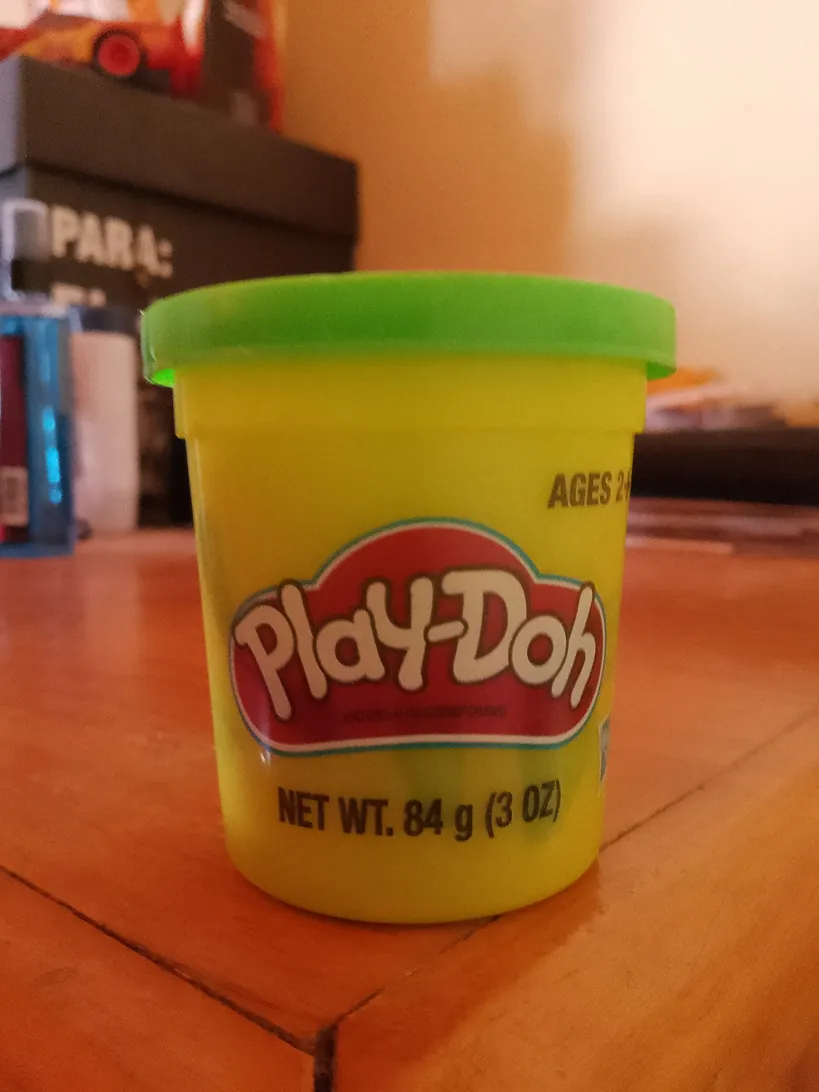
In 1956 the McVickers formed a subsidiary, Rainbow Crafts Company, to sell the toy. The first Play-Doh was white. Red, blue and yellow followed.
Joe McVicker took it to an educational convention for school-supply makers and started with schools around Cincinnati. Smithsonian names Woodward & Lothrop, a department store in Washington, D.C., as the first retailer to stock it. Macy’s in New York and Marshall Field’s in Chicago soon followed.
Selling to shops was one thing. Getting children to ask for it was another, and Kutol had almost no money for advertising.
The Captain Kangaroo deal
McVicker’s answer was television. He approached Bob Keeshan, who played Captain Kangaroo on one of the most popular children’s programs in America. According to Smithsonian, Keeshan agreed to feature Play-Doh on the show twice a week in exchange for 2% of sales.
There was nothing on paper. “There was never a contract but the deal ran for years,” Bensch said.
The exposure worked. Play-Doh also appeared on Ding Dong School and Romper Room, and by 1958 its sales had reached nearly $3 million. In 1960, Rainbow Crafts hired engineers to design accessories, and the Play-Doh Fun Factory, a press that squeezed the dough into shapes, became a classic in its own right. By 1964, the Strong museum reports, the company was shipping more than a million cans a year.
Bigger owners
On January 26, 1965, the patent Joe McVicker had applied for was granted. The same year General Mills bought Rainbow Crafts for $3 million, according to histories of the company. The toy then passed through a chain of larger companies: General Mills merged it with its Kenner toy business, Tonka bought Kenner and Rainbow Crafts in 1987, and in 1991 Hasbro acquired Tonka. Hasbro still makes Play-Doh.
The product kept growing. Smithsonian, citing Fortune, put sales at more than 3 billion cans since 1956. The Strong museum inducted Play-Doh into its National Toy Hall of Fame in 1998.
In 2018 Hasbro did something unusual: it trademarked the smell. On May 18 that year the US Patent and Trademark Office registered Play-Doh’s scent, described in the registration as a sweet, slightly musky, vanilla-like fragrance with hints of cherry. The smell of a wallpaper cleaner had become a protected piece of intellectual property.
What the record shows
- The product outlived its purpose. Kutol’s putty didn’t stop working when coal heating ended. The market changed, and the material was still good for something else.
- The best idea came from a user. Nobody at Kutol thought of the putty as a toy. A teacher watching children found the use, and the company was willing to listen.
- Names sell. The makers wanted a technical name for schools. A name a child could say made it a toy for every home.
- No budget is not the same as no options. Joe McVicker paid for national television exposure with a share of future sales rather than cash up front.
The pattern runs through this archive. Bubble Wrap was meant to be wallpaper before it found its purpose in shipping. Corning’s strengthened glass waited decades for the iPhone. Play-Doh’s material was right from the start. It took a teacher to find the people who needed it.
 $10.3BRead nextBubble Wrap Was Supposed to Be WallpaperTwo engineers in New Jersey sealed a pair of shower curtains together in 1957 and tried to sell the result as wallpaper. Then as greenhouse insulation. It took an IBM computer to find out what it was for.Bubble Wrap · 5 min read
Questions readers ask
- Was Play-Doh really a wallpaper cleaner?
- Yes. Kutol Products of Cincinnati made it from the 1930s to wipe coal soot off wallpaper. When coal heating faded after World War II, the company repackaged the putty as a children's toy in 1956.
- Who invented Play-Doh?
- Noah McVicker developed the original wallpaper cleaner formula for Kutol. His nephew Joe McVicker turned it into a toy after Joe's sister-in-law, nursery school teacher Kay Zufall, found that children loved modeling with it.
- Who named Play-Doh?
- Kay Zufall and her husband, Robert. The McVickers had planned to call it Rainbow Modeling Compound.
- Who owns Play-Doh now?
- Hasbro, which acquired the brand in 1991. General Mills had bought Rainbow Crafts, the company that made Play-Doh, in 1965.
- How many cans of Play-Doh have been sold?
- More than 3 billion cans since 1956, according to figures from Fortune cited by Smithsonian Magazine in 2019.
Run the numbers yourself
- Profit Margin CalculatorTurn cost and price into profit, margin and markup, or find the price that hits a target margin.
- Business Valuation CalculatorEstimate what a business could be worth with earnings multiples, a revenue multiple and a DCF.
- ROI CalculatorMeasure return on investment and the annualized return, and compare two investments side by side.
People and companies in this story
People
- Cleo McVicker
- Noah McVicker
- Joe McVicker
- Kay Zufall
- Bob Keeshan
Companies
- Kutol Products
- Rainbow Crafts
- Kroger
- General Mills
- Kenner
- Hasbro2 stories
Share this story
Send the link to someone who would like this story, or keep it for later.
The timeline
Drawn to scale: the gaps are the years in between. Choose a year.
Sources & further reading 5
- Rainbow Crafts CompanyPGPedia (Cincinnati business history)
- The Accidental Invention of Play-DohSmithsonian Magazine, November 2019
- The History of Play-Doh: Good, Clean Fun!The Strong National Museum of Play
- Play-DohWikipedia
- Kutol Wallpaper CleanerWebster Parish Journal, April 2026
Spot an error? Send a correction. Corrections are dated and noted here.
Photographs are credited under each picture; licenses are listed on the image credits page.