Bloomberg
Michael Bloomberg Was Fired With $10 Million. Then Came the Terminal.
In 1981 Salomon Brothers was sold and one of its partners was shown the door with $10 million for his stake. The next morning he started a company to sell Wall Street the data it didn't know it needed. Merrill Lynch later paid $4.43 billion just to get out.
- His payout
- $10MHis payout. Michael Bloomberg's payout for his partnership stake when Salomon Brothers' new owner let him go in 1981.
- Implied value
- $22.5BImplied value. The value implied for Bloomberg LP when its founder's company bought out Merrill Lynch's last 20% in 2008.
In this story · 7 chapters
The short answer
In 1981, when Salomon Brothers was sold, Michael Bloomberg was shown the door with $10 million for his stake. The next morning he started a company to sell financial data to Wall Street. Merrill Lynch became its first customer and bought 30% for $30 million. In 2008 it sold its last 20% to Bloomberg's company for a reported $4.43 billion.
In 1981 Salomon Brothers, one of the most powerful firms on Wall Street, was bought by the commodities trader Phibro. The new management had no place for one of its partners, Michael Bloomberg, and let him go.
He was 39. He had spent fifteen years at the firm, his entire career. And he was leaving with a check for $10 million, the value of his stake in the partnership.
Most people in that position would have protected the money. Bloomberg started a company with it, by his own account the very next morning.
Fifteen years at Salomon
Bloomberg had joined Salomon in 1966 on $9,000 a year. He worked his way up through the trading floor and became a general partner in 1972, running equity trading. Then he was moved sideways, to head the firm’s information systems.
It looked like a demotion. It turned out to be the most valuable job he ever had. Running Salomon’s computer systems taught him how much traders needed accurate, fast data, especially on bonds, and how poorly the market supplied it.
When he left, he had a theory: that Wall Street would pay a premium for specialized financial data and analytics delivered straight to a trader’s desk.
The next morning
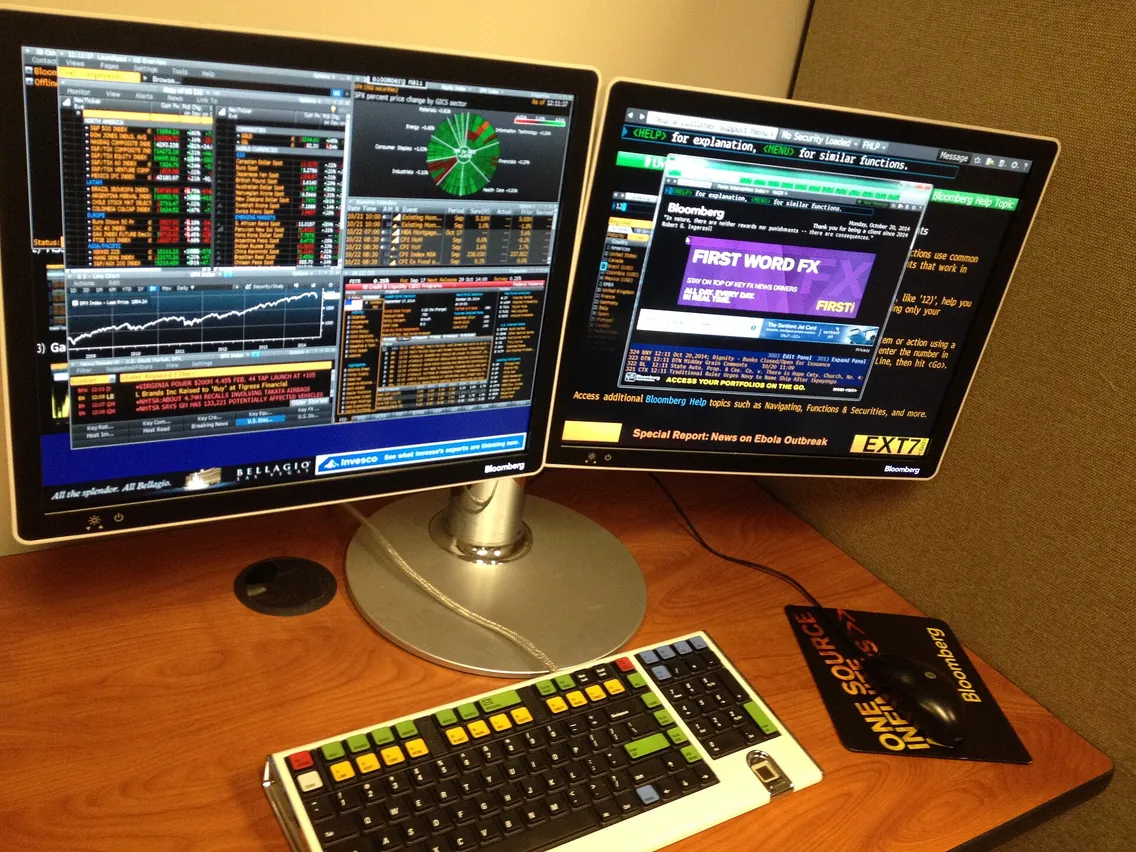
Bloomberg teamed up with three former Salomon colleagues, Thomas Secunda, Duncan MacMillan and Charles Zegar. On October 1, 1981, they founded Innovative Market Systems. They began building a computer system that would show real-time market data and do the financial calculations traders otherwise did by hand.
“Getting fired from Salomon Brothers drove home a lesson that I’ve carried with me throughout my career,” Bloomberg told Fortune in 2025. “Every setback is an opportunity.”
One customer, $30 million
A data business needs someone to buy the data, and Bloomberg needed a big name. He found it in Merrill Lynch.
Merrill became the first customer. The first Market Master terminals went into service there at the end of 1982; Fast Company counts 20 units, IEEE Spectrum 22. Merrill also bought a 30% stake in the young company for $30 million. In return, Innovative Market Systems agreed not to sell terminals to Merrill’s competitors for five years.
For a start-up, the deal was close to perfect. It brought revenue, a large cash investment and, above all, a reference: if Merrill Lynch relied on the system, so could anyone. Merrill even released the company from the exclusivity restriction early, in 1984, and the terminals could be sold across Wall Street. In 1986 the company itself was renamed Bloomberg L.P.
The terminal that wouldn’t leave
The business model was simple: firms paid a recurring fee for every terminal on every desk, and the company kept upgrading the system to keep them paying. By 1991, according to Union College’s history of the company, 10,000 terminals were installed. Bloomberg added a news service in 1990 and a website in 1993, and grew into a media business too.
It has never stopped raising the price. Bloomberg ties its increases to inflation, and from January 2025 a single terminal cost $31,980 a year, according to the treasury network NeuGroup. Firms with more than one paid $28,320 per terminal.
Buying back Merrill
This is where the money story turns. Merrill Lynch had bought 30% of a start-up for $30 million. As the company grew, that stake became one of the best investments Merrill ever made, and Bloomberg wanted it back.
In late 1996 Bloomberg bought one-third of Merrill’s stake, 10% of the company, for $200 million. That valued the whole business at $2 billion.
Then came 2008. Merrill Lynch was facing heavy losses in the financial crisis. It agreed to sell its remaining 20% to Bloomberg Inc., the company that held Michael Bloomberg’s interests, for a reported $4.43 billion. The price valued Bloomberg L.P. at about $22.5 billion.
The headline number hid a detail. Merrill’s own filings, Fortune reported a month later, showed that it received just $110 million of the price in cash. Most of the rest came as notes from Bloomberg’s company, to be paid over time. Merrill had sold its best investment in a hurry, and had to accept the buyer’s terms.
Add it up. Merrill paid $30 million for 30% in the early 1980s. It received about $4.63 billion when it sold out. Bloomberg, for his part, owns about 88% of the firm.
The rest of the fortune
The company made Bloomberg rich enough to do something else. He stepped down as chief executive in 2001 to run for mayor of New York City, and won three terms. In 2014 he went back to run the company again.
Forbes put his fortune at about $109 billion in January 2026, almost all of it his stake in the company he started with his severance. He has also become one of the largest donors in the world: Forbes counts more than $21 billion in lifetime giving, $3.7 billion of it in 2024 alone. He has said he intends the company to pass eventually to his foundation, Bloomberg Philanthropies.
What the record shows
- Severance is capital. Bloomberg’s $10 million could have been savings. He made it seed money, and kept control by not spending it on anyone else’s idea.
- The best product is the one you’ve already built. He had spent years building Salomon’s internal systems. His company sold the same kind of tool to everyone.
- One big customer can carry a start-up. Merrill brought cash, revenue and credibility in one deal.
- Early equity is the most expensive money there is. The 30% that cost Merrill $30 million cost Bloomberg more than $4.6 billion to buy back.
Bloomberg’s story mirrors others in this archive. Stewart Butterfield built Slack from tools his team made for itself. Sara Blakely refused outside money altogether and kept her company whole. Bloomberg took one investor early, and spent decades and billions buying it out.
 1999Read nextAmancio Ortega: The Zara Founder Who Avoided the CameraAmancio Ortega left school at 14 to deliver shirts in A Coruña. He built Zara into the heart of a €40 billion company, and for decades almost nobody outside Galicia knew his face.Zara · 6 min read
Questions readers ask
- How did Michael Bloomberg start Bloomberg LP?
- When Phibro bought Salomon Brothers in 1981, Bloomberg was fired and paid $10 million for his partnership stake. He used the money to found Innovative Market Systems with three former Salomon colleagues. It was renamed Bloomberg L.P. in 1986.
- Who was the first Bloomberg Terminal customer?
- Merrill Lynch. It took the first Market Master terminals in late 1982. In the early 1980s it also bought a 30% stake in the company for $30 million, with a five-year exclusivity deal it waived in 1984. Accounts differ on the exact year of the investment.
- How much does Michael Bloomberg own of Bloomberg LP?
- About 88%, according to Forbes. He has said the company will eventually pass to his foundation, Bloomberg Philanthropies.
- How much does a Bloomberg Terminal cost?
- From January 2025, a single terminal cost $31,980 a year, and $28,320 per terminal for firms with more than one, according to NeuGroup. Bloomberg raises the price in line with inflation.
Run the numbers yourself
- Net Worth CalculatorAdd up what you own and owe, then compare your net worth with U.S. households your age.
- Compound Interest CalculatorSee how a deposit grows with compounding, extra contributions and different compounding frequencies.
- Millionaire CalculatorFind the age you could reach $1 million, and what that million would be worth after inflation.
People and companies in this story
People
- Michael Bloomberg
- Thomas Secunda
- Duncan MacMillan
- Charles Zegar
Companies
- Bloomberg L.P.
- Salomon Brothers
- Phibro
- Merrill Lynch
This story is on these lists
Share this story
Send the link to someone who would like this story, or keep it for later.
The timeline
Drawn to scale: the gaps are the years in between. Choose a year.
Sources & further reading 10
- Merrill's Bloomberg sale: not much cashFortune, via CNNMoney, August 2008
- Bloomberg Terminals: how much more you'll pay next yearNeuGroup, October 2024
- How much richer Michael Bloomberg has gotten over the last 5 yearsGOBankingRates, via inkl, April 2026
- Bloomberg explores future ownership options as succession planning takes shapecitybiz, 2026
- Bloomberg IPO: everything you need to know about BloombergFOREX.com, 2026
- The Bloomberg TerminalIEEE Spectrum
- The Bloomberg TerminalFast Company, 2015
- Billionaire Mike Bloomberg was fired after 15 years at Salomon BrothersFortune, September 2025
- Bloomberg LPEBSCO Research Starters
- Bloomberg: HistoryUnion College Library
Spot an error? Send a correction. Corrections are dated and noted here.
Photographs are credited under each picture; licenses are listed on the image credits page.