Tetra Pak
Tetra Pak: The Paper Pyramid That Built a Fortune
In 1952 a dairy in southern Sweden began selling cream in odd little paper pyramids. The carton looked like a novelty. It became one of the largest private fortunes in Europe.
- First product
- 100 mlFirst product. The first product: cream, sold in small paper tetrahedrons by a dairy in Lund in November 1952.
- Price for half
- $7BPrice for half. The price at which Hans Rausing sold his half of the business to his brother Gad in 1995.
In this story · 6 chapters
The short answer
Tetra Pak was founded by Ruben Rausing in Lund, Sweden, in 1951. Its tetrahedron-shaped carton was developed inside his earlier company, Åkerlund & Rausing, from an idea by Erik Wallenberg, and patented in 1944. The first cartons, holding cream, went on sale in November 1952. The Rausing family still owns the business.
Pour a glass of juice on a long-haul flight, open a carton of milk at a school in Mexico, or pick up oat milk in a London corner shop, and there is a good chance the box came off a machine designed by one Swedish company. Most people never notice the name printed in small type near the base. It belongs to Tetra Pak, and behind it sits one of the largest family fortunes in Europe.
It started with cream. In November 1952 a dairy association in Lund, a university town in the south of Sweden, began selling 100 ml portions of it in paper pyramids. They looked odd on the shelf and they were awkward to pack in a crate. Within a few decades the company that made them was turning out tens of billions of cartons a year, and two brothers who had inherited it were, by Forbes’s count in 1994, the third-richest people in the world.
A Swede in the American aisles
Ruben Rausing was born in 1895 in Raus, near Helsingborg. He studied at the Stockholm School of Economics and then, unusually for a Swede of his generation, went to New York. He finished a master’s degree at Columbia University in 1920.
In America he saw something that hadn’t reached Sweden yet: self-service grocery stores, where customers took packaged goods off shelves instead of asking a clerk to weigh and wrap them. Rausing concluded that this was the future, and that it would need a lot of packaging. Tetra Pak’s own history makes a point of this order of events. Most new companies start with an invention and look for buyers. Rausing started by studying the market and only then worked out what his company should make.
Back in Sweden, he and Erik Åkerlund founded the packaging firm Åkerlund & Rausing in 1929. By the spring of 1933 Åkerlund had been bought out and Rausing was the sole owner. The firm grew into one of the larger packaging manufacturers in Europe. Milk, though, remained a problem nobody had solved well.
Why milk was hard
In the 1940s most milk was still sold in glass bottles. Glass was heavy, broke and had to be collected, washed and returned. A paper package would be lighter and cheaper, but liquid soaks paper, and a carton has to be sealed tight enough to stay clean and strong enough to be stacked.
Inside Åkerlund & Rausing a small team worked on it. The company’s history credits Erik Wallenberg with the shape. His experiments started from a tube of paper. Seal the tube across at one end, fill it, then seal it again across the other end at a right angle, and you get a tetrahedron, a pyramid with four triangular sides. It used very little material for the volume it held, and the filling could be continuous: a machine could form, fill and seal packages from a single paper roll without stopping.
The patent is dated March 27, 1944. Turning it into a machine took the rest of the decade. A first model of the filling concept was built in 1946. The team, which by some accounts included engineer Harry Järund and sales manager Erik Torudd, also had to develop a coated paper that milk would not soak through.
Cream first, then the world
AB Tetra Pak was set up in Lund in 1951 as a subsidiary of Åkerlund & Rausing. When it showed its system to the press on May 18 that year, it drew a lot of attention. In September 1952 the first machine was delivered to Lundaortens Mejeriförening, the Lund dairy association, and in November the pyramids of cream reached shops.
Milk followed in 1954, in half-liter cartons for dairies in Stockholm and Eskilstuna. The same year a machine went to Hamburg, the first export. France and Italy followed. By 1960 Tetra Pak had opened a packaging-material plant in Mexico and could produce more than a billion cartons a year. Hans Rausing, Ruben’s son, negotiated the first machine export to the Soviet Union in 1959, using the Russian he had studied at Lund University.
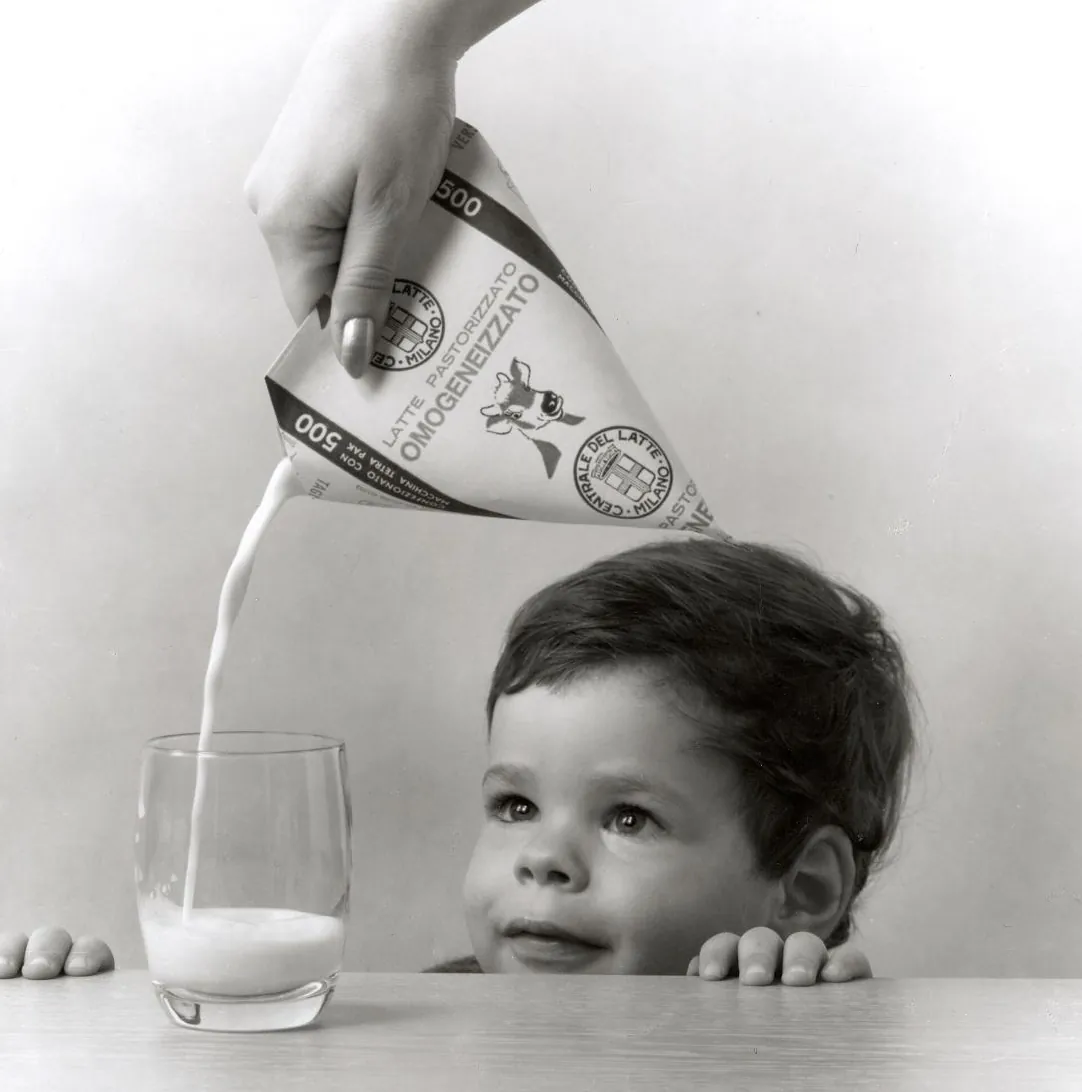
The business model was the important part. Tetra Pak didn’t sell cartons the way a box maker does. It sold filling machines to dairies and then supplied the packaging material that ran through them. Each machine created a steady demand for the company’s material for as long as the dairy used it. The founder’s own rule, quoted by the company, was that “a package should save more than it costs.” For a dairy that no longer had to wash and collect glass bottles, it usually did.
The box beats the pyramid
The tetrahedron gave Tetra Pak its name, but it had a weakness. Pyramids don’t stack neatly. They wasted space in crates, trucks and shop fridges.
In 1963 the company launched the Tetra Brik, a rectangular carton that filled every centimeter of a pallet. A photograph from that year shows Hans Rausing holding one. Then came the step that changed what milk could do. In 1961 Tetra Pak had unveiled an aseptic filling machine in Thun, Switzerland: the product and the carton were sterilized separately and joined in a sterile setting, so the milk inside lasted for months without a refrigerator. In 1969 the two ideas were combined in the Tetra Brik Aseptic.
That carton opened markets where cold chains were weak or didn’t exist. It let dairies ship milk long distances and let shops keep it on ordinary shelves. Tetra Pak says school milk programs using its cartons, the first of which began in Mexico in 1962, now reach about 68 million children in 52 countries.
Two brothers and a $7 billion handshake
Ruben Rausing’s sons ran the expansion. Hans became managing director in 1954, with his brother Gad as his deputy, and the two led the company for about three decades. In 1965 the family sold Åkerlund & Rausing and kept Tetra Pak.
The family moved, too. In the early 1980s Hans settled in England, partly to escape Sweden’s high tax rates. Tetra Pak moved its headquarters to Switzerland, where it is still based in Pully. Ruben Rausing died on August 10, 1983. In 1991 Tetra Pak bought Alfa Laval, a Swedish maker of dairy and food-processing equipment, and in 1993 the combined group was renamed Tetra Laval.
By the mid-1990s, according to a MoneyWeek profile, Tetra Pak was producing about 75 billion packages a year. In 1994 Forbes ranked Hans and Gad Rausing third on its list of the world’s richest people. A year later, the brothers split. Hans sold his 50% stake to Gad for about $7 billion, Bloomberg reported, and agreed not to compete for five years. When that clause expired in 2001 he took control of Ecolean, a packaging company in Helsingborg.
Gad Rausing died in 2000. His three children, Finn, Jörn and Kirsten, now own equal shares of Tetra Laval, according to the Swedish business weekly Affärsvärlden. Hans died in 2019 at his estate in East Sussex, aged 93. Forbes estimated his family’s fortune at about $12 billion. Tetra Pak, sold in more than 160 countries, reported net sales of €12.35 billion in 2025, by its own figures.
What the carton teaches
The pyramid is the part of the story people remember, because it is strange and memorable. The business, though, was built on less glamorous decisions.
Rausing studied the customer before he had a product. He saw supermarkets in New York and asked what they would need, years before Swedish shoppers had them. His company then sold a system, machine plus material, which made each customer more valuable the longer they stayed. And when the original shape proved awkward, the company replaced it with a duller rectangle that stacked better and kept milk fresh without a fridge.
Ownership is the last lesson. Like Zara’s founder, Amancio Ortega, the Rausings kept control of their company instead of selling it to outside investors. Tetra Laval is still private. Unlike Ortega, they never listed even part of it on a stock exchange, so the family’s fortune is one of the least visible of its size. The carton is everywhere. The family that owns the machines filling it mostly stays out of view.
 $700,000Read nextChobani Began in a Yogurt Plant Kraft Threw AwayIn 2005 Kraft was closing an old yogurt factory in upstate New York. A feta maker with no yogurt experience bought it with a government-backed loan. Twenty years later, Chobani was valued at $20 billion.Chobani · 5 min read
Questions readers ask
- Who invented Tetra Pak?
- Tetra Pak was founded by Ruben Rausing in Lund, Sweden, in 1951. The tetrahedron-shaped carton was developed inside his earlier company, Åkerlund & Rausing, from an idea by Erik Wallenberg, and patented in 1944.
- Why is it called Tetra Pak?
- The first package was a tetrahedron, a shape with four triangular faces. The company took its name from that shape.
- What was the first product sold in a Tetra Pak carton?
- Cream. The Lund dairy association began selling it in 100 ml tetrahedron cartons in November 1952. Milk followed in 1954.
- Who owns Tetra Pak today?
- Tetra Pak is part of Tetra Laval, a private group owned by the Rausing family. After Hans Rausing sold his half to his brother Gad in 1995, ownership passed to Gad's three children.
- What is aseptic packaging?
- Aseptic packaging fills a sterilized product into a sterilized carton in a sterile setting, so milk or juice can keep for months without refrigeration. Tetra Pak unveiled its first aseptic milk machine in 1961.
Run the numbers yourself
- Net Worth CalculatorAdd up what you own and owe, then compare your net worth with U.S. households your age.
- Compound Interest CalculatorSee how a deposit grows with compounding, extra contributions and different compounding frequencies.
- Millionaire CalculatorFind the age you could reach $1 million, and what that million would be worth after inflation.
People and companies in this story
People
- Ruben Rausing
- Erik Wallenberg
- Hans Rausing
- Gad Rausing
Companies
- Tetra Pak
- Åkerlund & Rausing
- Tetra Laval
- Alfa Laval
This story is on these lists
Share this story
Send the link to someone who would like this story, or keep it for later.
The timeline
Drawn to scale: the gaps are the years in between. Choose a year.
Sources & further reading 8
- Tetra Pak in figuresTetra Pak
- Dr Ruben Rausing (1895–1983), founder of Tetra PakTetra Pak
- Tetra Pak: The history of an ideaTetra Pak, company history (PDF)
- Our heritage: timelineTetra Pak
- Hans Rausing, Swedish Tetra Pak carton billionaire, dies at 93Bloomberg, August 2019
- Statement on the death of Hans RausingTetra Pak, August 2019
- Tetra Pak: From idea to industry leaderPackaging Journal
- Four Swedes who have been among the world's ten richestAffärsvärlden
Spot an error? Send a correction. Corrections are dated and noted here.
- Correction, : An earlier version gave a 2018 revenue figure that belonged to the wider Tetra Laval group and said school milk programs reached 56 countries. It now uses Tetra Pak's own 2025 figure and its count of 52 countries.
Photographs are credited under each picture; licenses are listed on the image credits page.