Crocs
How Crocs Nearly Went Broke in 2008
Crocs went from 200 pairs at a boat show to the biggest footwear IPO of its time. Then, in 2008, it lost $185 million and its shares fell below a dollar. In 2025 it sold more than $4 billion of shoes.
- Net loss, 2008
- -$185MNet loss, 2008. Crocs' net loss for 2008, the year its sales fell and its warehouses filled with unsold shoes.
- Revenue, 2025
- $4.04BRevenue, 2025. Crocs, Inc. revenue for 2025, according to its full-year results.
In this story · 5 chapters
The short answer
Crocs raised $208 million in 2006 in what was then the largest IPO by a footwear company. In 2008 sales fell, its warehouses filled with unsold shoes, and it lost $185.1 million; its shares fell as low as $0.79. It closed factories, cut jobs and shut stores, then rode a fashion comeback to $4.04 billion of revenue in 2025.
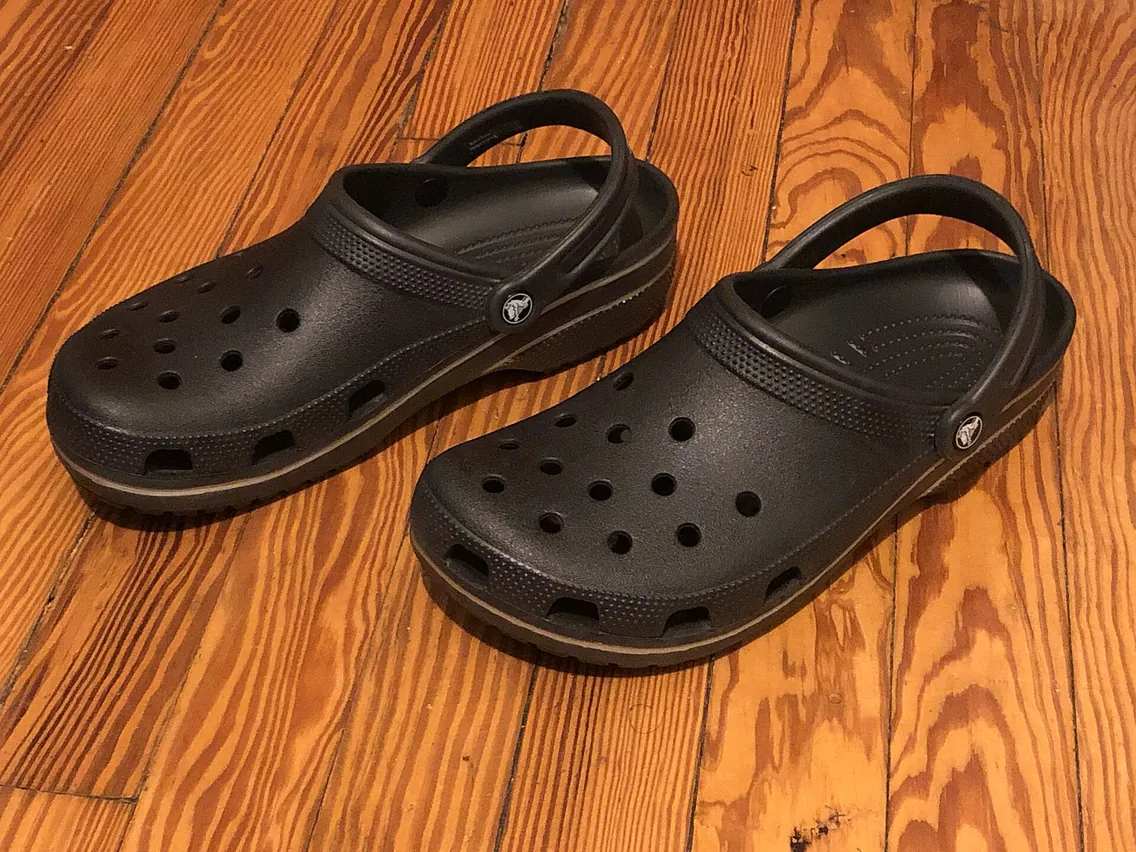
In November 2002 three friends from Colorado took a stand at the Fort Lauderdale Boat Show in Florida. They were selling a single product: a foam clog with holes in the top, made for slippery boat decks. They had 200 pairs.
They sold all of them.
The shoe was not their invention. Scott Seamans, Lyndon Hanson and George Boedecker Jr. had found it through a small company in Quebec City called Foam Creations, which made it from a soft, light, water-resistant foam. They called their company Crocs, and the first model the Beach.
The fastest climb in shoes
The clog was hard to love on sight. People bought it anyway, especially those who spent all day on their feet: hospital staff, restaurant workers, new parents. In 2004 Crocs bought Foam Creations outright, and with it exclusive rights to the foam it called Croslite.
In February 2006 Crocs went public on the Nasdaq. It priced its shares at $21 and raised $208 million, at the time the largest IPO ever by a footwear company. Later that year it bought Jibbitz, a small business making charms that clipped into the shoe’s holes, for $10 million.
Then came 2007. Revenue more than doubled, rising 139% to $847.4 million. Crocs sold 46.9 million pairs. Its net income was $168.2 million. Management told investors to expect revenue of about $1.16 billion in 2008.
To meet the demand, the company had added factories, stores and stock. It was building for a future that never arrived.
The fall
In April 2008 Crocs cut its forecast for the first quarter. The stock fell 30% in after-hours trading. The same day it announced it would lay off 600 factory workers in Quebec City.
As the financial crisis spread, shops cut their orders. Crocs had filled warehouses with shoes nobody was buying, and it began writing down their value.
The 2008 annual report told the story in numbers. Revenue fell 14.8%, to $721.6 million. Unit sales dropped by 11.6 million pairs. Returns and allowances more than doubled. A company that had made $168 million the year before lost $185.1 million.
At the end of 2008 Crocs had $51.6 million in cash and a credit line that was due for repayment on April 2, 2009. Its shares fell as low as 79 cents.
Shrinking to survive
The way back was not glamorous. Crocs closed factories, cut jobs and shut down stores. In 2010 it announced another restructuring that eliminated 180 jobs and closed dozens of its stores. It recovered enough to pass $1 billion in annual revenue again. But in 2013 its profit fell to $10.4 million, from $131.3 million the year before.
In December 2013 the private-equity firm Blackstone agreed to buy $200 million of new convertible preferred stock, which came with two seats on the board. Crocs used the money, with cash of its own, to fund a $350 million buyback of its shares. On the same day, its chief executive, John McCarvel, announced he would retire. The stock jumped 21%, its best day in more than four years.
The brand that had grown too fast spent years doing less. It closed more than a hundred stores. In 2018 it shut its last company-run factory in Mexico and decided to close the final one, in Italy, handing all manufacturing to outside suppliers. Online sales were growing by almost a quarter a year, and that was where the company wanted its money to go. Later that year Crocs bought back half of Blackstone’s stake for $183.7 million.
The return of the clog
Then the fashion world changed its mind. Designers began putting Crocs on runways. Balenciaga released a platform version in 2017. Under chief executive Andrew Rees, who took over that year, Crocs leaned into designer collaborations and a new marketing campaign.
Chief executive Andrew Rees put it bluntly in 2019: the goal was not to make the haters love the brand, but to use the tension between lovers and haters. Crocs released clogs with musicians such as Post Malone and Justin Bieber, and a high-heeled version with Balenciaga. By 2022 it ranked sixth among teenagers’ favorite footwear brands in Piper Sandler’s twice-yearly survey.
The numbers followed. In 2021 revenue grew 67% to a record $2.3 billion, with an operating margin of 30%, and Crocs spent $1 billion buying back its own shares. In February 2022 it paid $2.5 billion for HEYDUDE, a fast-growing casual shoe brand, borrowing $2 billion to do it.
That bet has been harder. In 2025 Crocs wrote down $737 million of the HEYDUDE brand’s value, and HEYDUDE sales fell 13.3%. But the core business held. Crocs, Inc. reported revenue of $4.04 billion for 2025, just below its record of $4.10 billion the year before.
The company that sold 200 pairs at a boat show, then nearly ran out of money, now sells more than $4 billion of shoes a year.
What the record shows
- Growth built on inventory is fragile. When demand slowed in 2008, warehouses full of unsold shoes turned a $168 million profit into a $185 million loss.
- A share price can fall further than the business. Crocs stock lost almost all of its value. The brand, and the people who liked the shoe, did not disappear.
- Own what makes you different. Buying Foam Creations gave Crocs control of its foam and its factories from the start.
- Big deals are a new risk. The $2.5 billion HEYDUDE purchase brought growth, then heavy write-downs.
Other businesses in this archive survived a cash crisis that should have ended them. Nike ran so short of cash in 1975 that its own bank called the FBI. And Berkshire Hathaway began as a failing textile mill.
 $1,000Read nextNike Was Always Broke: The Blue Ribbon Sports YearsPhil Knight and his old track coach started with $500 each. For more than a decade, the faster their company grew, the closer it came to running out of cash. In 1975 its own bank called the FBI. Last year Nike sold $46.4 billion of goods.Nike · 4 min read
Questions readers ask
- How did Crocs start?
- Three friends from Colorado, Scott Seamans, Lyndon Hanson and George Boedecker Jr., found a foam clog made by Foam Creations of Quebec. They launched it as a boat shoe at the 2002 Fort Lauderdale Boat Show and sold all 200 pairs.
- How much did Crocs lose in 2008?
- Crocs reported a net loss of $185.1 million for 2008 in its annual report, after revenue fell 14.8% to $721.6 million. Its shares fell as low as $0.79 during the financial crisis.
- How big was the Crocs IPO?
- Crocs listed on the Nasdaq on February 8, 2006, at $21 a share, raising $208 million. It was described at the time as the largest IPO by a footwear company.
- How much revenue does Crocs make now?
- Crocs reported revenue of $4.04 billion for 2025, down 1.5% from a record $4.10 billion in 2024.
Run the numbers yourself
- Stock Average CalculatorFind your average cost per share across several buys and see how a new purchase changes it.
- Profit Margin CalculatorTurn cost and price into profit, margin and markup, or find the price that hits a target margin.
- Business Valuation CalculatorEstimate what a business could be worth with earnings multiples, a revenue multiple and a DCF.
People and companies in this story
People
- Scott Seamans
- Lyndon Hanson
- George Boedecker Jr.
- Ron Snyder
- Andrew Rees
Companies
- Crocs
- Foam Creations
- Jibbitz
- HEYDUDE
- Blackstone2 stories
This story is on these lists
Share this story
Send the link to someone who would like this story, or keep it for later.
The timeline
Drawn to scale: the gaps are the years in between. Choose a year.
Sources & further reading 12
- Crocs, Inc. Form 10-K for 2007US Securities and Exchange Commission
- Crocs, Inc. Form 10-K for 2008US Securities and Exchange Commission
- Crocs credit facility extension deadline loomsFashionNetwork, 2009
- Crocs, Inc. announces financial partnership with BlackstoneCrocs, Inc. via SEC, December 2013
- US based Crocs announced slight increase for its 2013 revenueWorld Footwear, 2014
- Crocs shares rise as Blackstone takes stakeBloomberg, via The Philadelphia Inquirer, December 2013
- Crocs closes down last production sites in Mexico, ItalyAFP, via FashionNetwork, August 2018
- Crocs acquires 50% of Blackstone's interest for $183.7 millionModaes, December 2018
- Crocs, Inc. reports record annual revenues of $2.3 billion, growing 67% over 2020Crocs, Inc., February 2022
- Crocs company analysisWonder
- Crocs, Inc. to acquire casual footwear brand HEYDUDECrocs, Inc. via SEC, December 2021
- Crocs, Inc. reports fourth quarter and full-year 2025 resultsCrocs, Inc. via SEC, February 2026
Spot an error? Send a correction. Corrections are dated and noted here.
Photographs are credited under each picture; licenses are listed on the image credits page.